Los Angeles shade balls: 96 million spheres, 11 years on
Eleven years after Los Angeles covered a reservoir with 96 million black plastic balls, the spheres face replacement, and their hidden water cost is back in focus.
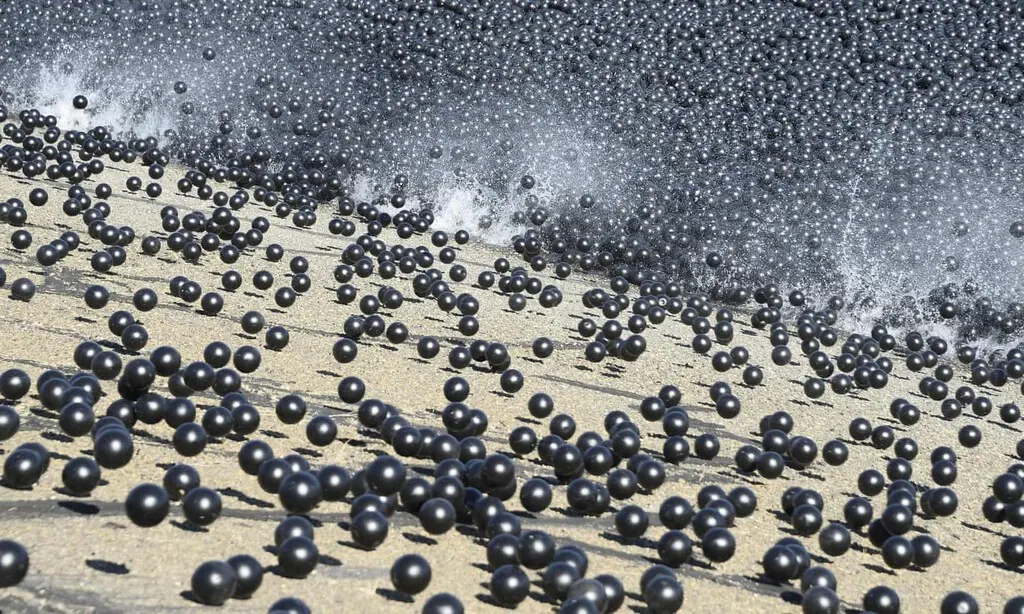
In August 2015, Los Angeles covered its Sylmar reservoir with 96 million black plastic balls. Eleven years later, the spheres have reached their planned service life of at least ten years, and the water used to make them is a question the project can no longer avoid.
The city acted during a historic drought that ran from 2011 to 2017. The balls blanketed roughly 70 hectares of surface in a $34.5 million project that was meant to prevent the loss of more than 1.1 billion litres of water a year.
A chemical problem, not just evaporation
The project became famous as an anti-evaporation measure, but its main goal was chemical. Sunlight helps turn bromide in the water into bromate, a potentially carcinogenic byproduct whose level in drinking water is regulated. The balls block about 95% of sunlight, slow algae growth and reduce the need for chlorine.
Each sphere is about ten centimetres wide and made of high-density polyethylene suitable for drinking water. Carbon black gives it its colour and protects it from ultraviolet radiation, and water inside keeps the wind from moving it. The alternative, floating covers over a divided reservoir, was budgeted at no less than $300 million. Los Angeles had already tested the idea at Ivanhoe in 2008.
The bill nobody saw from the shore
A study published in Nature in July 2018 by researchers from MIT, Imperial College London and the University of Twente added the water footprint of making the balls. Their estimate ranged from about 250 million to 2.9 billion litres. In the reference scenario, manufacturing needed around 2.9 million cubic metres of water, against estimated savings of 1.7 million cubic metres during the drought period studied. The system would need about two and a half years to repay that debt, and longer outside dry periods when evaporation is lower.
The authors did not call the balls useless. They showed that their environmental value depends on accounting well beyond the reservoir itself.
What happens now
The Los Angeles Department of Water and Power has warned that the balls can lose structural integrity, split at the seams or break, and said they would be removed, recycled and replaced over time. No confirmed figures exist on how many have deteriorated or been replaced, or whether there is an updated renewal schedule. Nor is there official word on whether the city will move to another system, such as floating solar panels. Its documents still present the balls as a water-quality measure alongside ultraviolet disinfection.
Apps worth a look
 SUMO: the number puzzle
Tap the right tiles, add them up, hit the target. Easy to learn, hard to master. Free, for all ages.
 Dialo: learn languages by speaking
Talk to an AI conversation partner; every sentence comes back corrected and explained in your language. 9 languages, A1 to C2.
 ediviewer: read EDI files like documents
Open EDIFACT and X12 messages, see every segment explained, convert to JSON/XML, export PDF and Excel. Runs locally, no upload.
More from this day
See all →
Rafale B374 Delivered to DGA as Flying Lab for the F5 Standard

Paco startup to take over BlaBlaCar Bus routes from January

ONE store launches OneDrama short-form video and Character Chat

AIM Intelligence Takes Runner-Up at Singapore's SLINGSHOT 2026
More in: Science
See all →
Rubin Observatory Finds Two Hidden Milky Way Companions

Waste to chemicals: Polish team turns biowaste into raw materials
Physicists trap a single positron for months in quantum cyclotron