Underwater Umbrellas Reduce Coral Bleaching in Florida Keys Test
Researchers shaded Caribbean corals with small fabric canopies during a record-hot summer and saw less bleaching, and even some recovery of color, in the covered colonies.
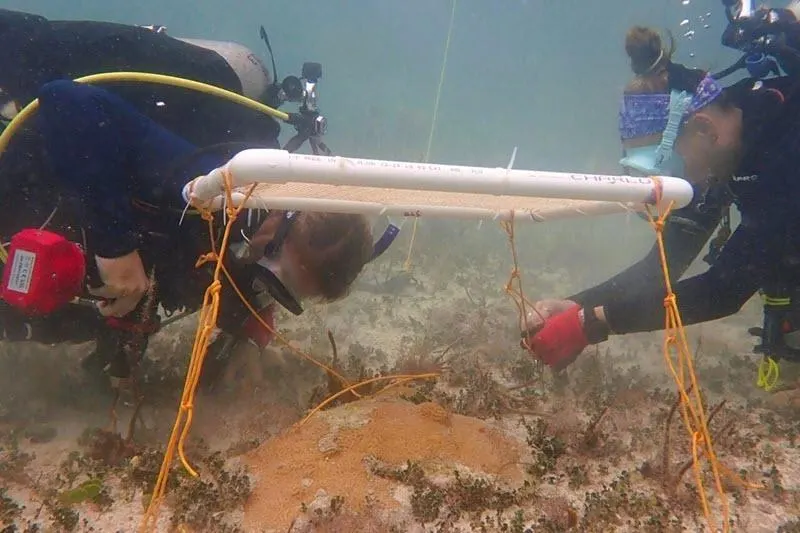
Shading corals with small "underwater umbrellas" can ease bleaching during marine heatwaves, according to a study published in Frontiers in Marine Science. Corals under the canopies bleached less than expected, and some began regaining their color.
The team tested the idea on Caribbean reefs, where corals are vulnerable to the combined stress of sunlight and heat. Each shade is a pipe frame covered with nylon fabric, anchored to the seabed so it floats about 30 centimeters above the coral. The design was inspired by a similar structure built by colleagues in Dominica during the 2023 marine heatwave.
How the experiment worked
In summer 2024, the researchers placed 20 shades over 10 colonies of two brain coral species, Pseudodiploria clivosa and Colpophyllia natans, at Newfound Harbor in the Florida Keys. They chose 20 unshaded colonies as a control group. The shades cut the sunlight reaching the corals by 60 percent. Every two weeks, divers checked the colonies' color and took tissue samples to track the algae living inside them.
Heat stress at the site that summer was the second highest ever recorded there. The gap between shaded and unshaded corals was widest at the peak of that stress. No coral died in either group. Lead author Karen Neely of Nova Southeastern University said the structures suit small areas, such as high-priority colonies, coral nurseries and small restoration plots, though new engineering could scale them up.
Caveats and next steps
Unshaded corals also bleached less than predicted, possibly because heat-tolerant Durusdinium algae became dominant. That alga can slow coral growth and raise disease risk. The team found no difference in algae density or type between groups, but permit rules limited sampling to colony edges, which get less light. Earlier installation, before water temperatures hit bleaching levels, might also have helped. Neely said there is no evidence of harm to other parts of the ecosystem.
Larger-scale trials have already begun this summer. The researchers also want to study long-term effects, since shading should in theory reduce later disease and boost reproduction, though that remains to be tested.
The stakes are high: by 2050, most reefs are projected to face major bleaching every year. Reefs support fisheries, jobs and coastal protection for millions of people, so shading is a stopgap while emissions cuts catch up.
More from this day
See all →
Gemini Adds Built-In Editor for PDFs and Documents, Free for All

Polish Robot Discovers Four New Chemical Reactions on Its Own

HYPE Plans European Dealer Network and Ultra-Premium Camper