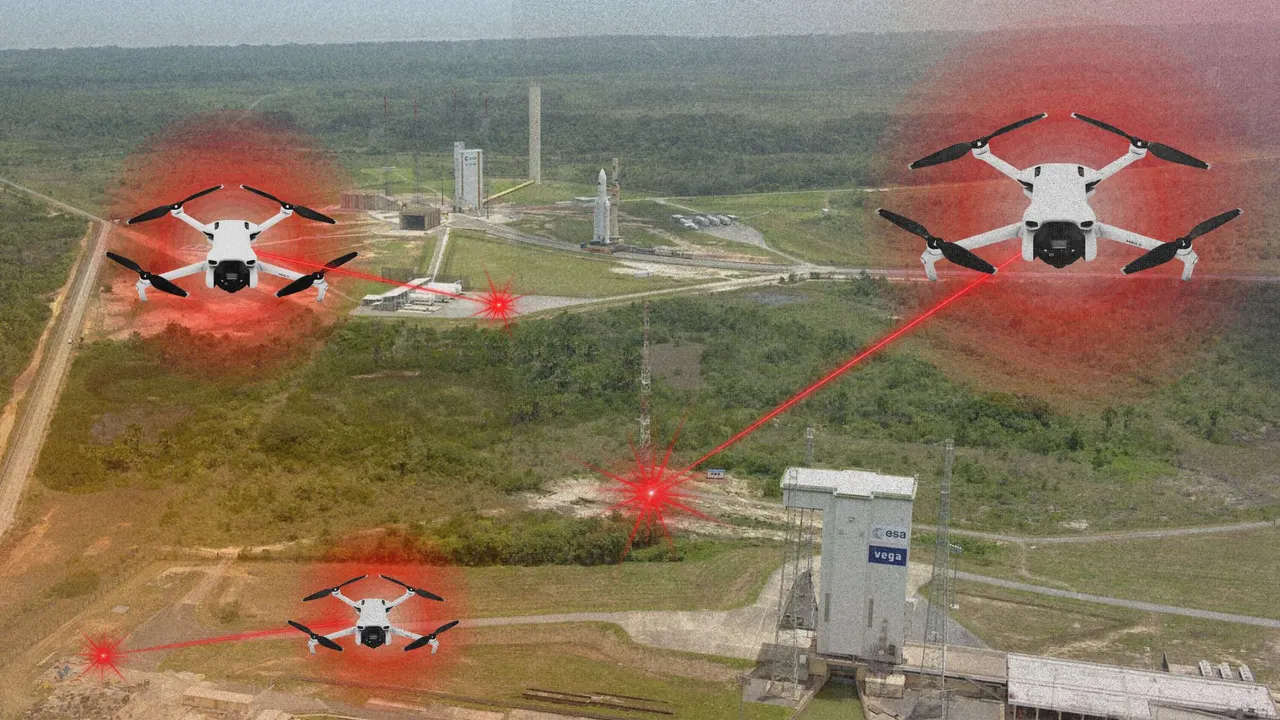
Ariane 6 drone threat: Kourou has no lasers, but a huge no-fly zone
Europe's spaceport in French Guiana won't copy Cape Canaveral's anti-drone lasers. Its security chief admits a drone swarm is something the base is not ready for.
 SUMO· the number puzzle
 Dialo· learn languages by speaking
 ediviewer· read EDI files like documents
 giftdetect· the right gift in minutes
Cape Canaveral is getting anti-drone lasers. Europe's spaceport in Kourou, French Guiana, is not. Asked about a possible drone swarm targeting an Ariane 6 launch, the site's head of protection put it bluntly: « On n'est pas du tout paré à faire ça. » In English, roughly: we are not ready for that at all.
The contrast comes from news in late September 2026, when the US Space Force said it would install anti-drone lasers at Cape Canaveral after a drone intrusion 2.5 kilometres from the lunar launch pad. People quickly asked what the Guiana Space Centre (CSG) does. Thierry Vallée, who runs protection, safeguards and environment at the CSG, said the base is not on the "neutralisation" track for now. Lasers are "not necessarily studied in depth". He did mention experiments on drones in general in 2027, without details.
He gives two reasons: geography and rules. The base sits between the Atlantic and the Amazon jungle, inside airspace where flying is banned anyway. Activity matters too. Cape Canaveral ran 109 orbital launches in 2025, while Kourou had 7 (four Ariane 6 and three Vega-C), with 9 planned for 2026.
How is the Guiana Space Centre protected against drones?
The base runs Parade, a permanent anti-drone system also used at Paris-Charles-de-Gaulle airport. The French defence procurement agency awarded the programme to Thales and CS Group in May 2022. Each system combines a radar, a direction finder that locates a drone's radio signal, cameras and a jammer that cuts the link between drone and remote.
The main shield is a no-fly zone called SOP3, watched around the clock by the air and space force. Vallée puts its area at two to four times the base's 660 square kilometres, so roughly 1,300 to 2,600 km², with a ceiling of 27,500 feet (about 8,400 metres). Filming the site by drone needs separate authorisation.
So far the system has faced no hostile threat. It does regularly spot hobby drones, such as a father's gift to his kid, and the answer is to send gendarmes to explain. In May 2025 a man who flew a drone five minutes before a Vega-C launch had it seized and was banned from the CSG for six months.
Apps worth a look
SUMO: the number puzzleTap the right tiles, add them up, hit the target. Easy to learn, hard to master. Free, for all ages.
Dialo: learn languages by speakingTalk to an AI conversation partner; every sentence comes back corrected and explained in your language. 9 languages, A1 to C2.
ediviewer: read EDI files like documentsOpen EDIFACT and X12 messages, see every segment explained, convert to JSON/XML, export PDF and Excel. Runs locally, no upload.
giftdetect: the right gift in minutesPick who it is for, the occasion and their personality. The search engine reads product descriptions from local shops and ranks what fits. Free, no sign-up.
More from this day
See all →
AI hallucinations in UK courts: 25 cases hit by fake rulings
Android Auto not working in your car? One error may be behind it

Open databases expose up to 3.5 billion passwords and IDs

Stanford physicist's quantum gravity paper was built with GPT-6 Astra
More in: Space
See all →
Hera probe photos show DART crater on Dimorphos is huge

Tiangong laser cutting test: China's first precision cut in orbit
AT2025abao: a red giant swallowed its smaller companion