AT2025abao: a red giant swallowed its smaller companion
Astronomers nicknamed them Big Bao and Little Bao. Telescopes watched the bigger star swallow the smaller one and erupt, after years of warning signs.
 SUMO· the number puzzle
 Dialo· learn languages by speaking
 ediviewer· read EDI files like documents
 giftdetect· the right gift in minutes
Astronomers have watched one star eat another, and they saw the warning signs for years beforehand. The event, designated AT2025abao, involved a red giant nicknamed "Big Bao" and a smaller companion, inevitably called "Little Bao". The names come from the "abao" in the designation, and yes, the joke is about the bun.
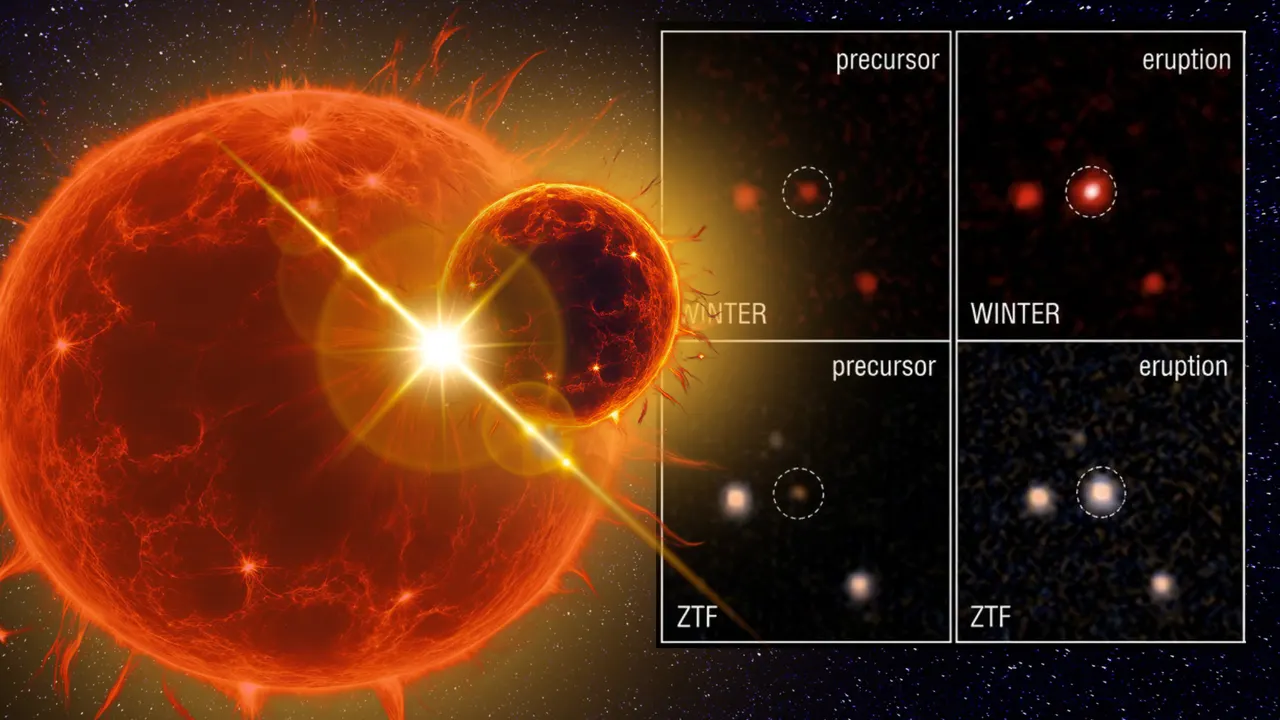
Big Bao is about 350 times the size of the sun and has a mass seven times greater. The team thinks it expanded so fast and so violently that it engulfed its companion. Little Bao, with roughly 70% of the sun's mass, then spiraled into the giant's core in fewer than 10 orbits. The finale was a bright eruption seen on Oct. 17, 2025 by two instruments at Caltech's Palomar Observatory: the Zwicky Transient Facility and WINTER.
How did astronomers spot the AT2025abao merger?
It started with an unexpected flash in the Andromeda galaxy. Viraj Karambelkar of Columbia University and colleagues turned a range of telescopes on it, including NEOWISE, SPHEREx, the James Webb Space Telescope and the W. M. Keck Observatory in Hawaii. They found the star behind it, WNTR23bzdiq / WTP19aalzlk, had been brightening steadily since 2019 after about 30 stable years. The event is a luminous red nova, a rare kind of stellar merger.
A red giant is a star that swells to hundreds of times its size after its core runs out of hydrogen. The sun will do the same one day. Such stars normally stay fairly stable for thousands of years, so nobody expected a blow-up. "We couldn't quite believe our luck," Karambelkar said.
What did the telescopes reveal?
In July 2025, SPHEREx found that Big Bao was fading in optical light but brightening in infrared. That points to a star cooling off and shedding dense clouds of gas and dust. When Little Bao hit the core, material was thrown out at around 1.8 million miles per hour. It slammed into the earlier cloud, producing the flash.
On Dec. 24, 2025, the James Webb Space Telescope measured the gas and dust around the star, which helped pin down Little Bao's mass. Because the merger was tracked for years beforehand, researchers now have a rare look at the conditions that lead up to one. The work was published on Nov. 18 in the journal Nature.
Apps worth a look
SUMO: the number puzzleTap the right tiles, add them up, hit the target. Easy to learn, hard to master. Free, for all ages.
Dialo: learn languages by speakingTalk to an AI conversation partner; every sentence comes back corrected and explained in your language. 9 languages, A1 to C2.
ediviewer: read EDI files like documentsOpen EDIFACT and X12 messages, see every segment explained, convert to JSON/XML, export PDF and Excel. Runs locally, no upload.
giftdetect: the right gift in minutesPick who it is for, the occasion and their personality. The search engine reads product descriptions from local shops and ranks what fits. Free, no sign-up.
More from this day
See all →
Galaxy S26 Ultra sold for $125 on Amazon Japan, and buyers got it

DWP cyber incident: UK benefits services pulled offline

Scientists use GTA V's Los Santos to model sea-level rise
Euro NCAP will mark down cars that beep too much from 2029
More in: Space
See all →
ADAspace Libra satellite trained an AI model in orbit for 45 minutes
JAXA astronaut recruitment 2027: Japan will hire again after five years
FCC approves SpaceX Starmind: up to 1 million AI satellites by 2040