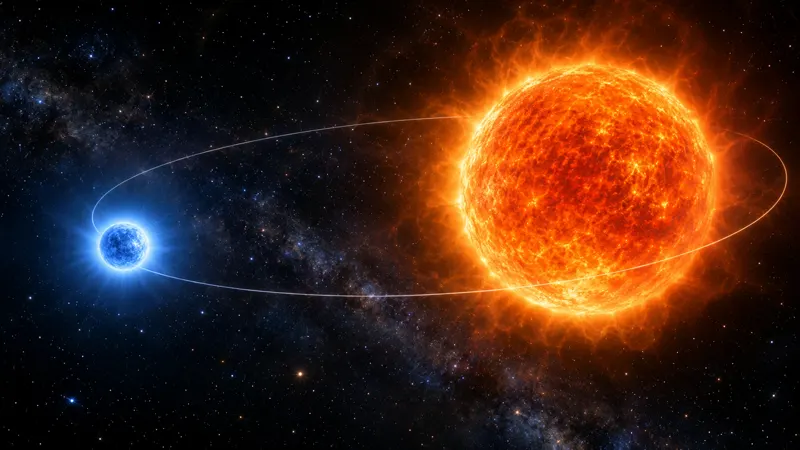
Webb spots H3+ 'forbidden' signal predicted 40 years ago
Webb has caught a faint rotational glow from H3+, the molecule often said to have built the Universe. It was predicted in 1986 and never seen, even in a lab.
 SUMO· the number puzzle
 Dialo· learn languages by speaking
 ediviewer· read EDI files like documents
 giftdetect· the right gift in minutes
For forty years, one of the most important molecules in space has kept a signal to itself. Now the James Webb Space Telescope has caught it. The molecule is the trihydrogen cation, H₃⁺, and the signal is a faint glow it should give off as it spins, predicted in 1986 and never seen, not even in a laboratory.
A team led by David Neufeld of Johns Hopkins University found the emission in gas thousands of light-years away. H₃⁺ underpins nearly all gas-phase chemistry between the stars, including the path to complex organic molecules, which is why it is often called the molecule that made the Universe. It has been spotted in interstellar clouds and is partly responsible for Jupiter's auroras.
Why is the H3+ signal called forbidden?
H₃⁺ is three hydrogen nuclei sharing two electrons, arranged in an equilateral triangle. That symmetry means no permanent dipole moment, so as it rotates its charge stays evenly spread and it should not radiate the way most molecules do.
In 1986 Fu-Shih Pan and Takeshi Oka at the University of Chicago calculated a loophole. Spinning stretches the triangle slightly, creating a tiny dipole and so a very weak emission. These transitions are called forbidden not because they break physics, but because they break the usual rules for molecular radiation.
What Webb actually saw
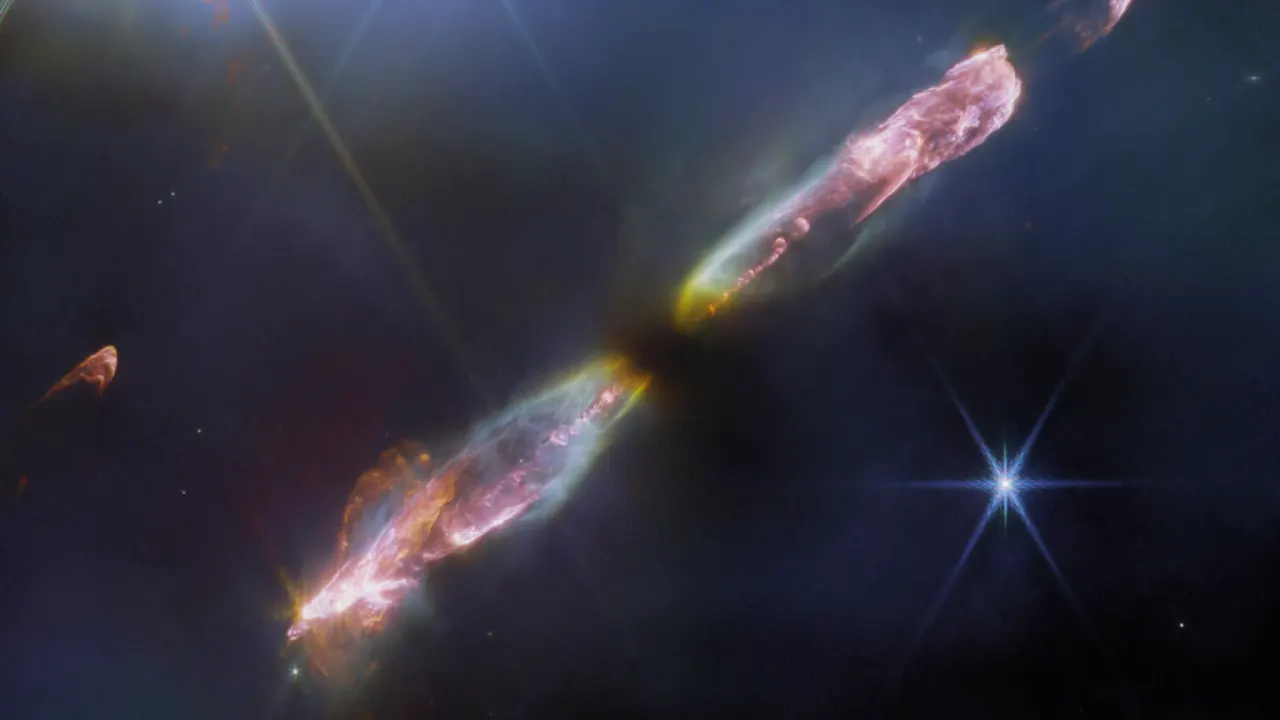
The source was HH 168, a Herbig-Haro object. These form when a young star flings jets of matter, moving hundreds of kilometres per second, into the cloud around it. The shocks heat gas to thousands of degrees. Webb's infrared vision cuts through the dust that hides such places.
Hidden among the infrared light from the hot gas were 26 extremely faint lines matching Pan and Oka's wavelengths. The strongest reached 72 sigma, a measure of statistical significance that leaves almost no doubt. The signal also followed the same pattern as ordinary molecular hydrogen, H₂.
The brightness is the puzzle. One shock model matched H₂ but underestimated H₃⁺ by a factor of five to six. Another fit H₃⁺ far better but relied on conditions beyond where it has been validated. The team also found the same emission in archived Webb data of another object, HH 211, which suggests it is not a one-off.
Pan and Oka were right all along. They just needed a sensitive enough instrument, and H₃⁺ itself may now become a tool for studying the chemistry of space.
Apps worth a look
SUMO: the number puzzleTap the right tiles, add them up, hit the target. Easy to learn, hard to master. Free, for all ages.
Dialo: learn languages by speakingTalk to an AI conversation partner; every sentence comes back corrected and explained in your language. 9 languages, A1 to C2.
ediviewer: read EDI files like documentsOpen EDIFACT and X12 messages, see every segment explained, convert to JSON/XML, export PDF and Excel. Runs locally, no upload.
giftdetect: the right gift in minutesPick who it is for, the occasion and their personality. The search engine reads product descriptions from local shops and ranks what fits. Free, no sign-up.
More from this day
See all →
Can you still refuse a Linky meter? What the EU ruling means

New peanut worm species found in Japan's deep sea has saw-toothed hooks

TikTok's For You feed breaks EU rules, Commission says