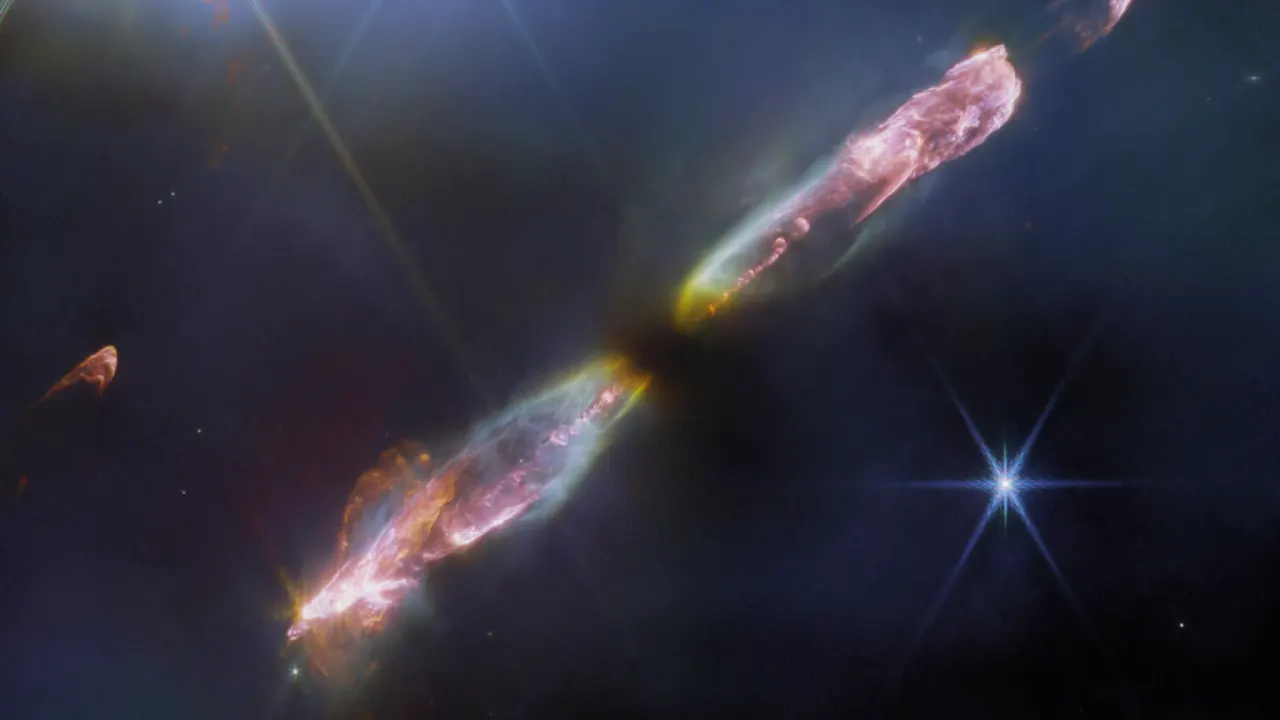
J0008+0128: the invisible object Gaia found that breaks star models
Astronomers found a hidden compact object about 20 km across, orbiting a red giant. Thousands of simulations could not explain how it formed.
 SUMO· the number puzzle
 Dialo· learn languages by speaking
 ediviewer· read EDI files like documents
 giftdetect· the right gift in minutes
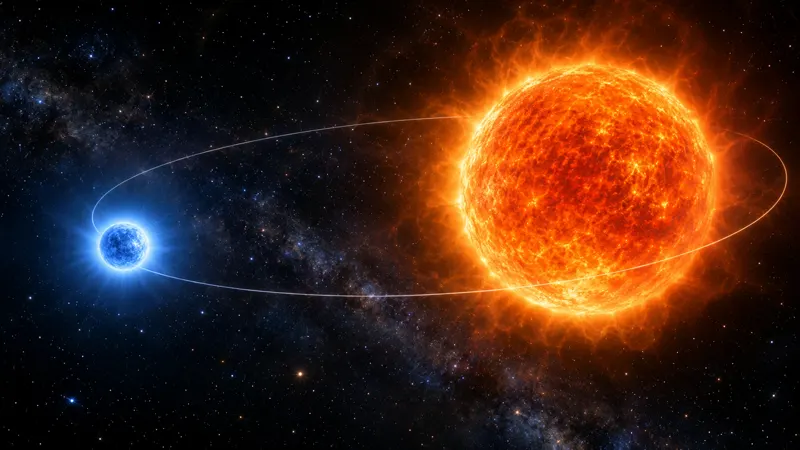
Something invisible is orbiting a red giant a few thousand light-years away, and nobody can say how it got there. The object, named J0008+0128, is heavier than the models of stellar evolution allow, at least if it is what astronomers suspect: a neutron star.
You cannot see it, of course. It is roughly 20 km across, so researchers studied it through its partner, the red giant, which is easy to observe. They measured the giant's radial velocity (how fast it moves toward or away from us) using the LAMOST and SDSS/APOGEE surveys plus the Nordic Optical Telescope. Astrometric data from the European Gaia spacecraft filled in the motion of the stars and pinned down the orbit. High-resolution spectra showed no lines that could belong to a second ordinary star.
What makes J0008+0128 so strange
The red giant weighs between 1.2 and 2.7 solar masses. The hidden companion comes in at 1.8 to 2.8 solar masses. The orbit takes about 1,220 days and is fairly close to circular, with an eccentricity of about 0.1. It is also too wide for the companion to have grown by pulling mass off its partner.
That combination is the problem. If the companion is a neutron star, it belongs to a very heavy class that has never been observed and does not even show up in models. The team ran thousands of simulations, including the POSYDON binary evolution models, and none reproduced the system.
How could it have formed?
The researchers see two options. One is that an unusually massive neutron star formed directly in a supernova. The other is that the system was once a triple, and two of its stars later merged: a neutron star with an ordinary star, or two neutron stars.
Why it matters
Pinning down the object's properties would help locate the line between neutron stars and black holes, and show which dying stars end up as which. It would also reveal how dense matter can get, and how much of it can resist collapsing into a black hole. If it really is a neutron star, the authors say, the finding could even point to something new in physics.
Apps worth a look
SUMO: the number puzzleTap the right tiles, add them up, hit the target. Easy to learn, hard to master. Free, for all ages.
Dialo: learn languages by speakingTalk to an AI conversation partner; every sentence comes back corrected and explained in your language. 9 languages, A1 to C2.
ediviewer: read EDI files like documentsOpen EDIFACT and X12 messages, see every segment explained, convert to JSON/XML, export PDF and Excel. Runs locally, no upload.
giftdetect: the right gift in minutesPick who it is for, the occasion and their personality. The search engine reads product descriptions from local shops and ranks what fits. Free, no sign-up.
More from this day
See all →
Foncier Innovant: France's AI tool that spots your garden shed

Can you still refuse a Linky meter? What the EU ruling means

New peanut worm species found in Japan's deep sea has saw-toothed hooks