Voyager 1 Gets Years More Science After Risky Big Bang Fix
NASA has completed its Big Bang heater swap on Voyager 1, freeing 10 watts of power. The probe then went silent for two days and entered safe mode.
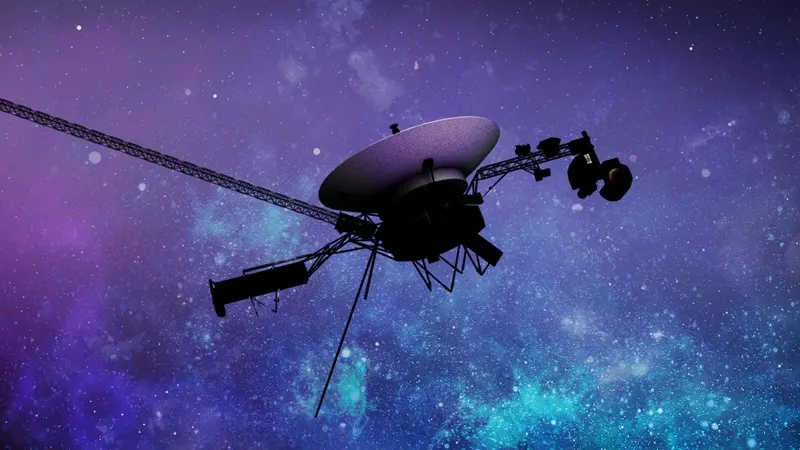
NASA has completed the "Big Bang" operation on Voyager 1, a power-saving maneuver that should let the probe keep doing science in interstellar space for years. The procedure freed 10 watts of electrical power, but it was followed by a scare: the spacecraft went into safe mode and for two days did not respond to commands from Earth.
What the Big Bang operation did
The team replaced three power-hungry heaters on the fuel lines of the probe's trajectory correction thrusters with three that draw less. That meant changing the state of six devices at the same time, and a mistake could have upset the thermal balance on board and disabled the spacecraft.
The swap was carried out in September 2026, eight weeks after the same reconfiguration on Voyager 2. Voyager 1 is about 24 billion km from Earth, roughly 4 billion km farther than its twin, so engineers tested the method on the closer craft first.
Both probes run on radioisotope thermoelectric generators that turn the heat of decaying plutonium-238 into electricity. Available power falls by about 4 watts a year. After almost 50 years of flight, engineers have had to switch off heaters and instruments one after another. Each probe started with ten science instruments, and two on Voyager 1 have been shut down in recent years for lack of power. Without Big Bang, the next instrument would have had to go dark in summer 2027.
Silence, then recovery
All seemed well after the switch, but on 18 and 19 October 2026 NASA's Deep Space Network failed twice, 24 hours apart, to detect Voyager 1's radio signal. A signal takes almost a day to travel one way, which makes any outage harder to deal with.
The signal returned on 20 October and communication has been normal since. A preliminary investigation found that one group of attitude thrusters switched off and backup thrusters came on automatically. This is part of the craft's fault protection: onboard computers put the spacecraft in a safe state and suspend normal operations. Engineers have not yet determined why the thruster group shut down.
Voyager 1 is moving at about 61,155 km/h. On 18 November 2026 it is due to reach 25.89 billion km from Earth, a distance of one light-day, a milestone NASA plans to mark. The two Voyagers are the only human-made craft directly sampling interstellar space, so each extra year of operation adds to the science.
More from this day
See all →
iPhone Duo hands-on: Apple's side controls leave lefties behind
China Moves to Curb Giant Car Screens and Gimmicky Features

Sam Altman Calls Home PC RAM for Local AI 'Pretty Terrible'
Octopus Renames Tempo Offer OctoSaisons as Chinese Solar Exports Fall
More in: Space
See all →
NASA Asks Industry to Rescue Hubble Before Its Orbit Decays
US Air Force Lab Tests SpaceX Starfall Capsule for Cargo Delivery

Google's Project Suncatcher TPU in orbit answers a prompt with a haiku