Google's Project Suncatcher TPU in orbit answers a prompt with a haiku
Google ran a prompt on a TPU in orbit and received a haiku from its Gemma model on Earth, the first complete demonstration for Project Suncatcher.
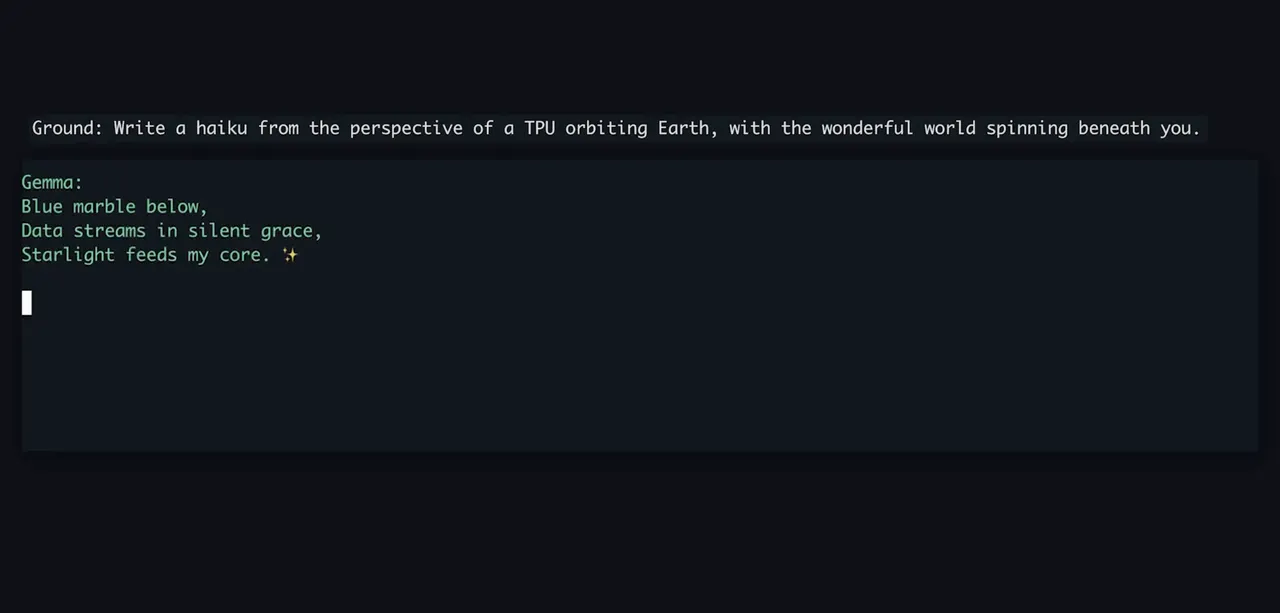
Google has run an AI prompt on a TPU chip in orbit and received the answer on the ground. The response, generated by its open Gemma model, was a haiku. Sundar Pichai announced the "hello world" milestone for Project Suncatcher on X on 30 October 2026.
According to Google, the team sent a command to orbit, booted the TPU, ran the prompt and got a first complete response back on Earth. The prompt asked for a haiku from the point of view of a TPU in orbit. Gemma answered: "Blue marble below, Data streams in silent grace, Starlight feeds my core." It follows the five-seven-five pattern.
A minimal test flight
The prototype satellite launched on 1 October 2026 aboard SpaceX's Transporter-18 rideshare mission from Vandenberg, California. Nicknamed MVP, for Minimum Viable Product, it was built with Earth-observation operator Planet. The satellite is about the size of a refrigerator and carries four Trillium-generation TPUs, powered by roughly one kilowatt of solar panels.
Google describes the flight as a basic test: can chips designed for air-conditioned data halls survive launch vibrations of 50 to 100 g for some components, vacuum, temperature swings and radiation? The haiku suggests that, so far, they can.
Why space
Unveiled in November 2025, Suncatcher starts from the idea that AI is now limited less by chips than by electricity, cooling and land. In a dawn-dusk sun-synchronous orbit at about 650 km, solar panels can produce up to eight times more energy than on the ground, according to Google. Its 2025 research paper envisions clusters of 81 satellites flying a few hundred metres apart and linked by laser. In bench tests, those optical links reached 1.6 terabits per second, and Trillium TPUs hit with protons showed no hard failures up to 15 krad, well beyond the dose expected over a five-year mission.
Google is not the first to run AI in orbit. In December 2025, Nvidia-backed startup Starcloud ran Gemma on an H100 GPU in space.
The real test comes in 2027, when two satellites are due to exchange data by laser while flying in tight formation. Its success will decide whether Suncatcher moves from demonstrations to large-scale orbital computing.
More from this day
See all →
Scentronic: Ohio State's Electronic Nose Shares Smells Remotely

SEC Warns Prediction Markets Over Insider Trading Risks

Anchorpoint Brings HKDAP Stablecoin to Solana Ahead of Retail Push

Sam Altman: Home PC RAM Is Wasted and Belongs in AI Servers
More in: Space
See all →
Satellite Deposit Scheme: $200,000 Bond Could Cut Space Debris
Isro launches NVS-03 satellite to strengthen NavIC network
NASA Marks 100th US Spacewalk From the ISS With New iROSA Array