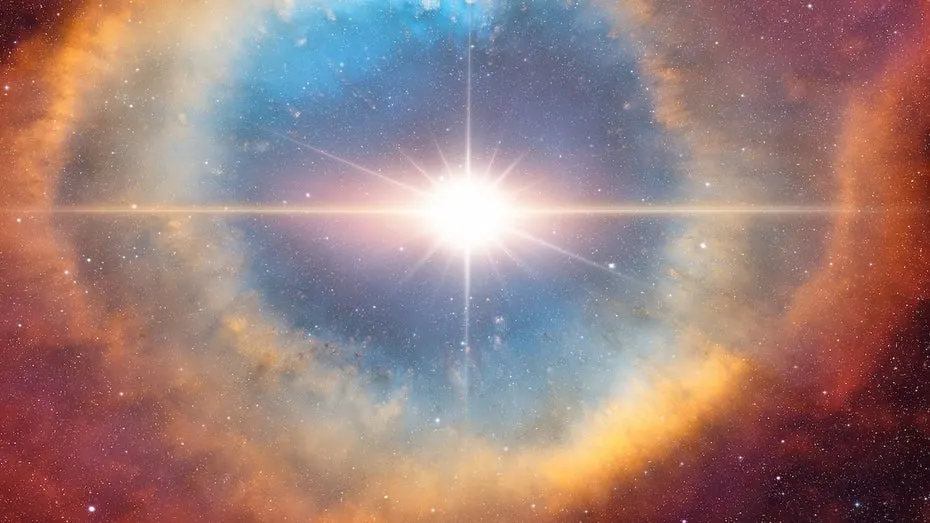
The Sun's heliotail: 14 years of NASA IBEX data show it changes
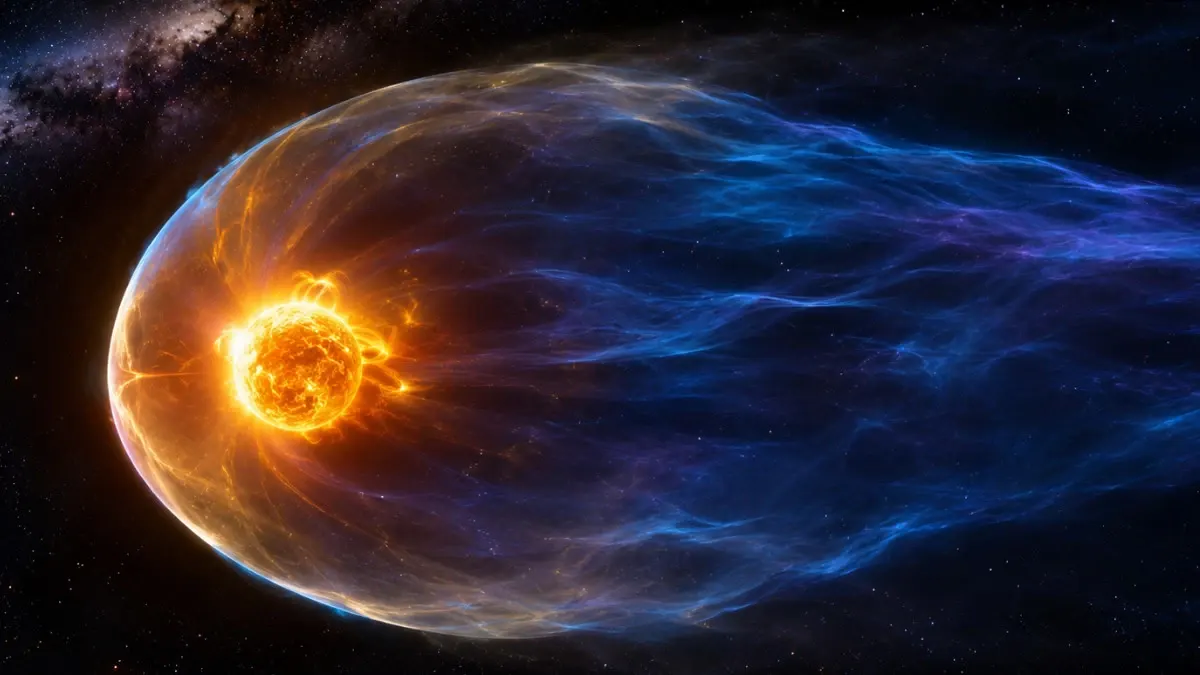
The Solar System drags a huge invisible tail, and it shifts with the Sun's cycle. Fourteen years of NASA IBEX data now show how, with a delay of about three years.
 SUMO· the number puzzle
 Dialo· learn languages by speaking
 ediviewer· read EDI files like documents
 giftdetect· the right gift in minutes
Comets are not the only things in space with a tail. The whole Solar System has one too, called the heliotail, and no ordinary telescope can see it. Now researchers have tracked how it changes over 14 years.
A team at Southwest Research Institute went through yearly maps built from observations by NASA's IBEX probe, covering 2009 to 2022. The result: the structure of the heliotail shifts with solar activity, but the effects show up only years later.
What is the heliotail?
The Sun constantly throws out charged particles, known as the solar wind. They travel far beyond the planets, until interstellar matter starts to dominate. The huge bubble this creates is the heliosphere, and it reduces the amount of galactic cosmic radiation reaching us.
As the Sun and planets move through the Milky Way, the heliosphere pushes against the surrounding interstellar medium. On the side opposite to the incoming matter, a stretched-out structure forms: the heliotail. Its exact size and 3D shape are still debated. The plasma in it gives off no light that regular telescopes can use.
How IBEX sees the invisible tail
IBEX, launched in 2008, detects energetic neutral atoms instead of light. They form, for example, when an ion from the solar wind grabs an electron from a neutral atom. By recording where such atoms come from, scientists map distant parts of the heliosphere.
Data from 2013 already showed four regions in the heliotail, arranged like a four-leaf clover. Two have a stronger flux of atoms, two a weaker one. Between 2009 and 2016, the flux of atoms at about 4.3 keV dropped roughly 2.4 times, then began to rise again. All four regions followed the same trend, lagging about three years behind changes in coronal holes near the Sun's poles, where fast solar wind streams come from.
The geometry moved as well. The northern and southern regions drifted toward the equatorial plane and later partly returned. One side region shifted by about 52 degrees in longitude and 36 degrees in latitude. The four regions are also not perfectly symmetrical, which fits the influence of the interstellar magnetic field.
The results, led by Maher Dayeh's team and published in The Astrophysical Journal Supplement Series, do not settle the heliotail's full shape. They give simulations hard data to match, including how the regions react to the solar cycle.
More detail should come from IBEX's successor, IMAP. It launched on 24 September 2025 and began its main science mission on 1 February 2026 near the L1 Lagrange point, about 1.5 million km from Earth toward the Sun. It carries 10 instruments, three of them for energetic neutral atoms, plus the Polish-built GLOWS, which studies the solar wind through ultraviolet glow from interstellar hydrogen.
Apps worth a look
SUMO: the number puzzleTap the right tiles, add them up, hit the target. Easy to learn, hard to master. Free, for all ages.
Dialo: learn languages by speakingTalk to an AI conversation partner; every sentence comes back corrected and explained in your language. 9 languages, A1 to C2.
ediviewer: read EDI files like documentsOpen EDIFACT and X12 messages, see every segment explained, convert to JSON/XML, export PDF and Excel. Runs locally, no upload.
giftdetect: the right gift in minutesPick who it is for, the occasion and their personality. The search engine reads product descriptions from local shops and ranks what fits. Free, no sign-up.
More from this day
See all →
Poland's CBK PAN space lab: from huts to a probe bound for Jupiter
iPhone satellite icon: what it means and when it appears
Jeep Cherokee failed smog, so he hacked its ECU with Claude
Moon dust aerogel: Purdue turns regolith and cardboard into insulation
More in: Science
See all →
Wildlife trafficking app spots ivory and pangolin scales in photos
Cyborg pigeons for hire: Russian firm takes orders for brain-implanted birds

Beyond Aero One: the hydrogen jet with no batteries and no fuel