Mars fingerprint rocks on Daedalia Planum puzzle scientists
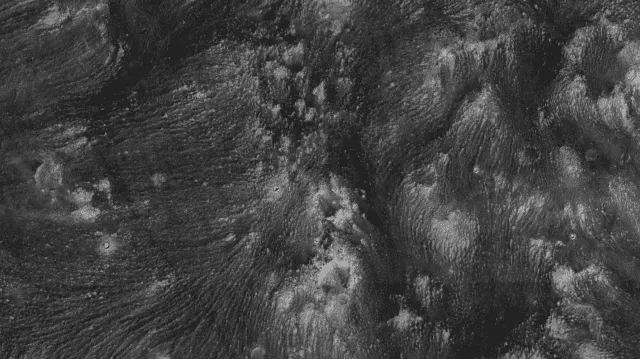
On Daedalia Planum, pale Martian rocks sit in curved lines about 5 to 10 metres apart, like a fingerprint. Nobody is sure how they got that way.
 SUMO· the number puzzle
 Dialo· learn languages by speaking
 ediviewer· read EDI files like documents
 giftdetect· the right gift in minutes
Most rocks on Mars look like they were thrown there by a careless giant. In one region, they look combed instead: pale stones lined up in swirling rows that resemble a fingerprint, and scientists cannot say for sure how it happened.
The spot is Daedalia Planum, a high plain near the equator in the Tharsis volcanic region. An orbital image taken in 2002 shows a fairly bland area. A picture captured in August 2024 by HiRISE, the high-resolution camera on NASA's Mars Reconnaissance Orbiter, tells a different story. Across a patch roughly 5 kilometres wide and 15 kilometres long, graceful curved lines weave through each other.
Paul Geissler, a late planetary scientist at the US Geological Survey, described it in October 2024. According to him, light-coloured rocks form long curving rows 5 to 10 metres apart, creating a fingerprint-like pattern. He said nothing like it had been found elsewhere on Mars, and that researchers were not sure how it formed.
What could make rocks line up on Mars?
Earth offers a clue. Cold regions have "patterned ground", where stones arrange themselves into stripes, circles or polygons. Repeated freezing and thawing slowly separates rocks from fine soil. Daedalia Planum sits at 5,455 metres above the datum, so a freeze-thaw cycle of its own is possible. It has not been confirmed.
The other idea involves marsquakes. Shake a container of mixed nuts and the biggest Brazil nuts rise to the top while small ones sink. This is called the Brazil nut effect. Ground shaking could, in theory, sort rocks by size in a similar way.
That explanation has holes too. Can quakes alone produce such neat, orderly rows? And is there enough seismic activity under the Tharsis volcanoes to do it? Both questions are still open.
Apps worth a look
SUMO: the number puzzleTap the right tiles, add them up, hit the target. Easy to learn, hard to master. Free, for all ages.
Dialo: learn languages by speakingTalk to an AI conversation partner; every sentence comes back corrected and explained in your language. 9 languages, A1 to C2.
ediviewer: read EDI files like documentsOpen EDIFACT and X12 messages, see every segment explained, convert to JSON/XML, export PDF and Excel. Runs locally, no upload.
giftdetect: the right gift in minutesPick who it is for, the occasion and their personality. The search engine reads product descriptions from local shops and ranks what fits. Free, no sign-up.
More from this day
See all →
AI piano plays solo on stage in Seoul ballet and string show
Shiretoko brown bear drones: NTT tests a one-week risk forecast

Yudetaro ends its Birthday Club to avoid holding personal data