λ-complex: giant star nursery found on the Milky Way's edge
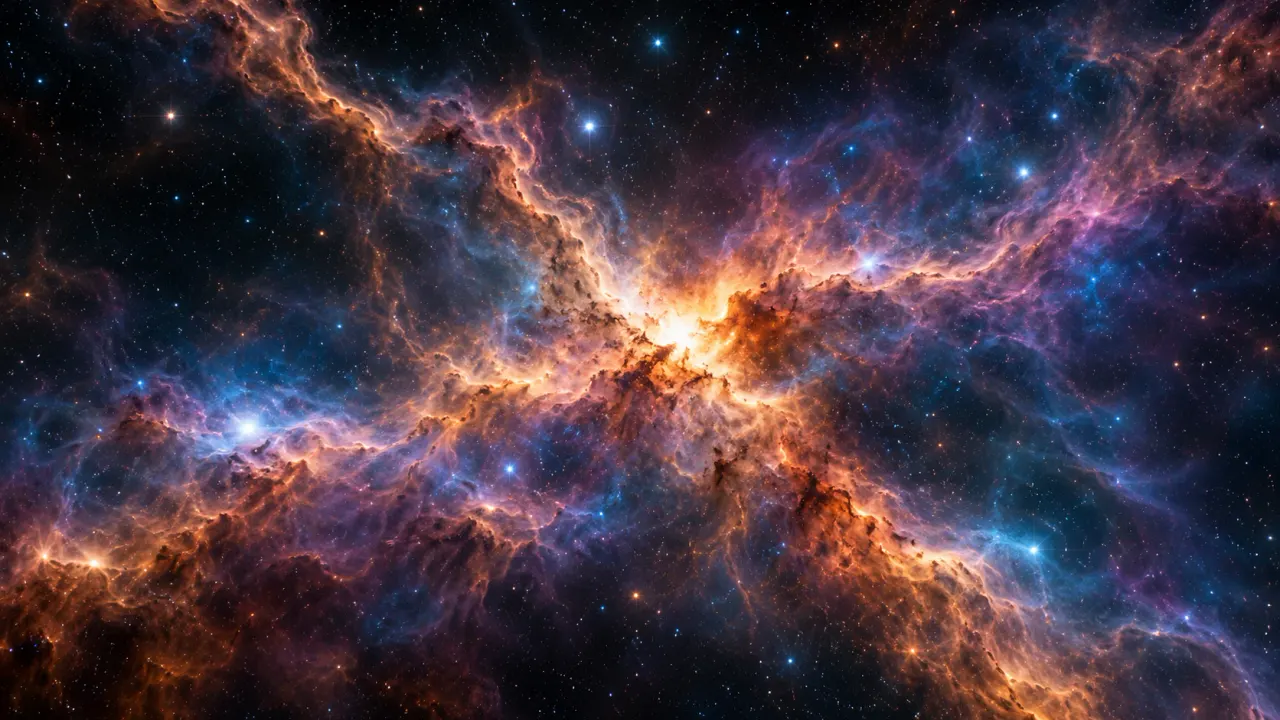
Astronomers found a star-forming region shaped like the Greek letter lambda, far out in the Milky Way. At 114 by 205 light-years, it dwarfs most of its kind.
 SUMO· the number puzzle
 Dialo· learn languages by speaking
 ediviewer· read EDI files like documents
 giftdetect· the right gift in minutes
Somewhere far out on the edge of the Milky Way, three huge streams of gas meet in one spot and form a shape like the Greek letter lambda. Astronomers have named it the λ-complex, and it is a giant star nursery.
The team was led by James Urquhart of the University of Kent, and the results appeared in Monthly Notices of the Royal Astronomical Society. The structure's catalogue name is G195.65−0.10. It sits about 43,000 light-years from the centre of the galaxy and 16,800 light-years from Earth.
What is a hub-filament system?
Stars are born in molecular clouds, which are vast patches of cold gas and dust, mostly hydrogen. Inside them, matter often stretches into long threads called filaments. Gas flows along these threads, and where several of them cross, the material piles up into a very dense knot, a hub. Young stars tend to show up along the filaments, while the most massive ones prefer the hubs. The whole arrangement is a hub-filament system.
Most well-studied examples lie in the inner Milky Way. This one suggests that similar star factories also work much farther from the galactic centre.
How big is the λ-complex?
The whole structure measures roughly 114 by 205 light-years. Earlier known hub-filament systems mostly spanned 33 to 65 light-years. Each of its three arms is about 110 to 136 light-years long.
The researchers found 61 dense clumps of gas that could become future stellar birthplaces. The hub itself holds a star cluster, two exceptionally bright clumps of material and a region of ionised gas. That gas is lit up by a star about 15 times the mass of the Sun, whose radiation strips electrons from atoms and turns the surroundings into plasma.
Massive star formation in the centre is already well under way. The arms may be just as interesting: 18 of the 61 clumps have more than 1,000 solar masses. Nine contain protostars, which are stars still in the making, and nine show no clear sign of them. Those nine are big reservoirs of material that could one day give birth to more massive stars.
Apps worth a look
SUMO: the number puzzleTap the right tiles, add them up, hit the target. Easy to learn, hard to master. Free, for all ages.
Dialo: learn languages by speakingTalk to an AI conversation partner; every sentence comes back corrected and explained in your language. 9 languages, A1 to C2.
ediviewer: read EDI files like documentsOpen EDIFACT and X12 messages, see every segment explained, convert to JSON/XML, export PDF and Excel. Runs locally, no upload.
giftdetect: the right gift in minutesPick who it is for, the occasion and their personality. The search engine reads product descriptions from local shops and ranks what fits. Free, no sign-up.
More from this day
See all →
Allstate outage: app and website down for five days

Tidal bans fully AI-generated music and will purge 27 million tracks
Ukraine's Blysk laser shoots down a jet-powered Geran drone

Keenadu Android trojan found on 220,000 devices, some preinstalled
More in: Science
See all →
Neuralink pivotal study: FDA clears Musk's brain chip trial

Shinkansen bullet trains become window frames in Nagoya

Stanford physicist's quantum gravity paper was built with GPT-6 Astra