Mars boulder rows look like a giant fingerprint, and no one knows why
NASA's HiRISE camera spotted thousands of pale boulders arranged in near-perfect curved lines on Mars. Scientists can't yet say how they formed.
 SUMO· the number puzzle
 Dialo· learn languages by speaking
 ediviewer· read EDI files like documents
 giftdetect· the right gift in minutes
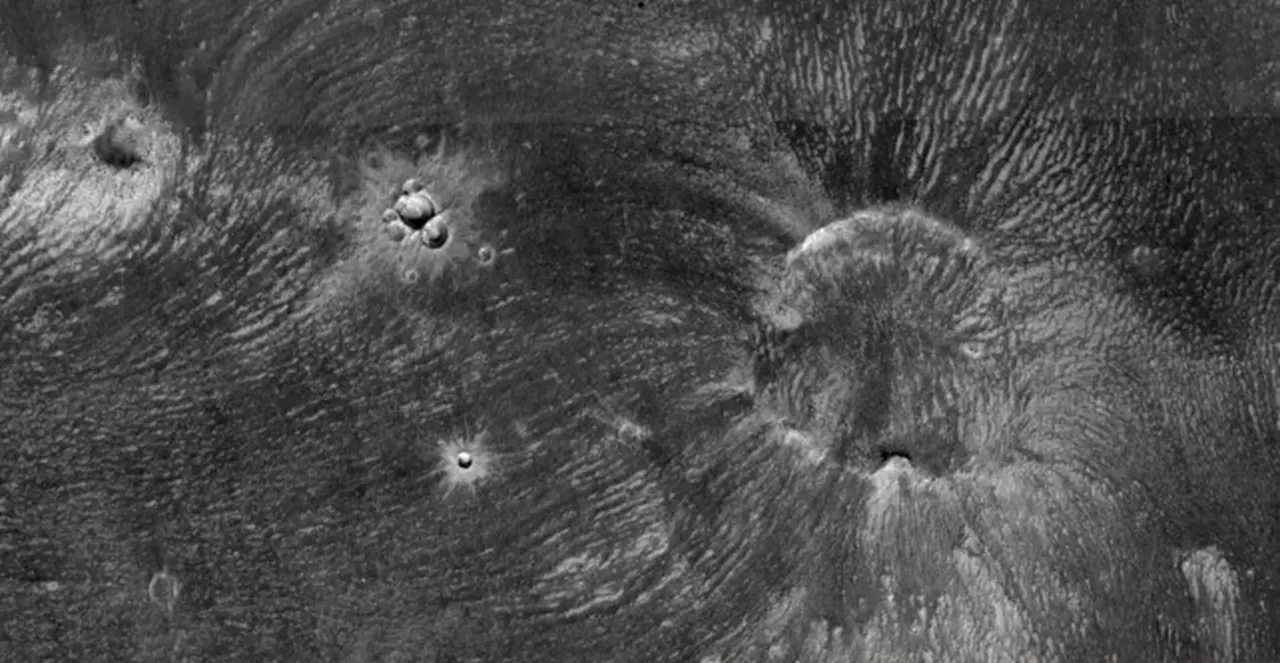
Imagine someone carefully lining up thousands of rocks in neat, parallel rows, then bending the whole pattern around craters. That is roughly what a NASA camera found on Mars, and the result looks like a giant fingerprint seen from orbit.
The formation sits in Daedalia Planum, a high volcanic area of the Tharsis region near the Martian equator, at a little over 5,400 metres above Mars's reference level. Older orbital images suggested a fairly dull stretch of ground. Then the Mars Reconnaissance Orbiter took a closer look.
The key pictures were taken in August 2024 with HiRISE, a high-resolution camera that can pick out single boulders. They cover an area of about 5 by 15 kilometres and show long, curved bands of pale stones. The rows are roughly 5 to 10 metres apart, and they flow smoothly around craters and other terrain features. Planetary scientist Paul Geissler of the US Geological Survey says nothing like this boulder layout has been found anywhere else on Mars.
How did the Mars fingerprint pattern form?
Nobody knows yet, but there are two main ideas. The first is a process seen on Earth called patterned ground, or structural soil sorting. In cold regions, water in the soil freezes, expands and pushes stones upward. Repeat that for long enough and you get stripes, circles and polygons of rock. Similar patterns exist on Svalbard and in the Alps. Daedalia Planum may once have had the right freeze-thaw conditions, though that is not confirmed.
The second idea involves quakes. Mars is not geologically dead, as NASA's InSight lander showed by recording marsquakes. Shaking can make a mix of large and small particles sort itself, with big pieces drifting up and small ones sinking. The catch: researchers don't know whether quakes alone could produce such long, regular, curved lines, or whether Tharsis was active enough to do it.
For now the rows remain unexplained, and the next step is simply more study of the images.
Apps worth a look
SUMO: the number puzzleTap the right tiles, add them up, hit the target. Easy to learn, hard to master. Free, for all ages.
Dialo: learn languages by speakingTalk to an AI conversation partner; every sentence comes back corrected and explained in your language. 9 languages, A1 to C2.
ediviewer: read EDI files like documentsOpen EDIFACT and X12 messages, see every segment explained, convert to JSON/XML, export PDF and Excel. Runs locally, no upload.
giftdetect: the right gift in minutesPick who it is for, the occasion and their personality. The search engine reads product descriptions from local shops and ranks what fits. Free, no sign-up.
More from this day
See all →
Motorola Razr Android Auto bug appears fixed by Android 17

Huawei Sense G1: a glucose sensor the size of a coin, 1.5 grams

GTA 6 PS5 Pro: Rockstar made 100 numbered consoles you can't buy

Android camera stabilization can leak what your speaker plays
More in: Science
See all →
Smart ring measures stress with infrared light, not electrodes
IRAS 06530-0213: astronomers see a dying star's last heartbeat

Atom-sized black holes could blow up stars from the inside