Lightning strikes could rise up to 140% by 2100, study finds
A machine learning model trained on one year of lightning data predicts 76 to 140% more ground strikes by 2100 if emissions stay high. Alaska could see far more.
 SUMO· the number puzzle
 Dialo· learn languages by speaking
 ediviewer· read EDI files like documents
 giftdetect· the right gift in minutes
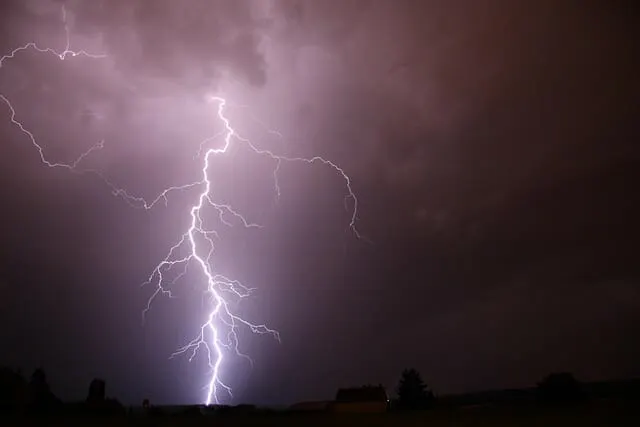
Lightning strikes on the ground could become 76 to 140% more frequent by 2100 if greenhouse gas emissions stay at today's levels. That is the result of a new study in the journal Earth's Future, led by Earth system scientist Andreas Krause at the Technical University of Munich.
Predicting how a warmer climate affects lightning is hard, because two key ingredients pull in opposite directions. Warm air near the ground rises (convection), stirring colder air above. Tiny ice crystals in the cold clouds collide and swap charge. Light crystals drift up, heavy ones sink, and an electric field builds until the air breaks down and a bolt fires. Warmer surface air strengthens that process, which is why lightning peaks in the early afternoon and is far more common in the tropics. But a warmer upper atmosphere can mean fewer ice crystals, making it harder for a storm to build up charge.
How did researchers predict future lightning?
The team trained a machine learning model on observations from 2019, matching recorded lightning against the weather that produced it: temperature, rainfall, humidity, pressure, wind speed and solar radiation. They then fed it the climate of 1901 to 1920 and of 1995 to 2014. The model found cloud-to-ground strikes rose 11% over the 20th century, roughly 12% for each degree Celsius of warming.
In a high-emissions scenario, the figure jumps to about 30% more strikes per degree. Earlier studies put the highest estimate at 8 to 17% per degree. The researchers say the gap comes mostly from different mathematical methods and newer global lightning data. The study looked only at strikes that reach the ground, not lightning inside or between clouds.
Where will lightning increase the most?
In absolute numbers, the biggest rise is expected in places that are already lightning-heavy: the Amazon, Southeast Asia and Oceania. The Amazon forecast is shaky, though, because the model learned from today's rainforest, which could look very different in 2100.
In relative terms, high latitudes lead, since a small increase on a low baseline looks big. Many of those regions could see strike density more than double. Alaska is the extreme case, with a predicted rise of 116 to 594%.
Krause admits there is "considerable uncertainty" over how lightning will respond to climate change. Next, the team wants to study how forests recover after being hit. Trees have evolved to cope with the local strike rate, he says, but little is known about whether some species survive lightning better than others.
Apps worth a look
SUMO: the number puzzleTap the right tiles, add them up, hit the target. Easy to learn, hard to master. Free, for all ages.
Dialo: learn languages by speakingTalk to an AI conversation partner; every sentence comes back corrected and explained in your language. 9 languages, A1 to C2.
ediviewer: read EDI files like documentsOpen EDIFACT and X12 messages, see every segment explained, convert to JSON/XML, export PDF and Excel. Runs locally, no upload.
giftdetect: the right gift in minutesPick who it is for, the occasion and their personality. The search engine reads product descriptions from local shops and ranks what fits. Free, no sign-up.
More from this day
See all →
GMKtec NEO-X1 Pro review: a desktop RTX 5070 in a 14.6-litre tower

AI piano plays solo on stage in Seoul ballet and string show
Mars fingerprint rocks on Daedalia Planum puzzle scientists