Kakao Mobility and Korean Army to Build Defense AI Control System
Kakao Mobility signed an agreement with the South Korean Army to apply its AI dispatch and autonomous-driving control technology to manned-unmanned combat systems.
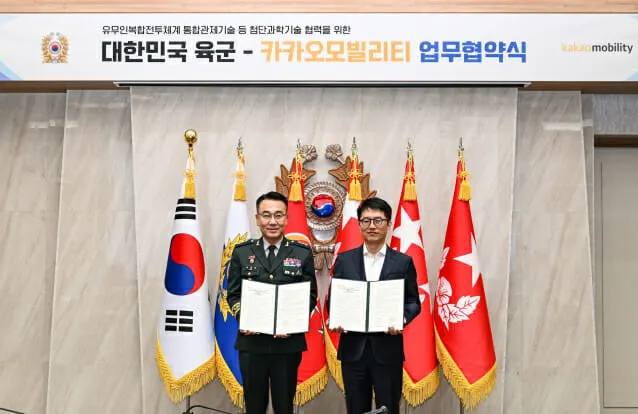
Kakao Mobility is taking its ride-hailing and autonomous-driving technology into the defense sector. The company said on November 3 that it signed a memorandum of understanding with the South Korean Army at Army Headquarters in Gyeryong, South Chungcheong Province, covering integrated control technology for manned-unmanned combat systems and other advanced science and technology cooperation.
Under the deal, the two sides plan to run field demonstrations that combine Kakao Mobility's AI and platform technology with the Army's effort to build such combat systems. The company will adapt tools it has used in civilian mobility services, including real-time route search, travel-demand prediction, swarm distributed control and autonomous-driving and robot control, to military operating conditions.
Demonstration sites and one-to-many control
Demonstration space will be set up around the Army's AX hubs in Pangyo and Daejeon, and the partners will jointly research an AI control platform tailored to defense environments. They also plan to build an integrated operating system in which a single operator manages several unmanned assets, such as drones, robots and unmanned ground vehicles (UGVs), in a one-to-many arrangement.
The longer-term goal is to lay the groundwork for a "defense mobility OS" that can command and control many unmanned vehicles in one place.
Army vehicle operations
The agreement also covers systems for the Army's own vehicle fleet. Using Kakao Mobility's AI dispatch, route optimization, real-time control and transportation management system (TMS) technology, the partners will jointly research and test an Army-specific dispatch system and app.
Kakao Mobility CEO Ryu Keung-sun said the company wants to support the Army's future combat system with its accumulated mobility technology, and that it hopes technology tested with the military can also benefit the civilian sector. Lee Kyung-jin, head of the policy office at Army Headquarters, said technology that analyzes field data and turns AI decisions into real vehicle operations is becoming important on future battlefields, and that the Army will apply private-sector technology to advance its future combat systems and defense AI.
Apps worth a look
 SUMO: the number puzzle
Tap the right tiles, add them up, hit the target. Easy to learn, hard to master. Free, for all ages.
 Dialo: learn languages by speaking
Talk to an AI conversation partner; every sentence comes back corrected and explained in your language. 9 languages, A1 to C2.
 ediviewer: read EDI files like documents
Open EDIFACT and X12 messages, see every segment explained, convert to JSON/XML, export PDF and Excel. Runs locally, no upload.
More from this day
See all →
Sachin Tendulkar Backs Hitwicket Maker Metasports Interactive
GIVA Raises Over $100 Million in Round Led by Multiples PE
India Becomes ChatGPT's Largest Market by Weekly Active Users