Invictus: Europe's Mach 5 Hypersonic Aircraft Clears Key Review
Europe's Invictus hypersonic demonstrator has passed its first system requirements review. It targets Mach 5, about 6,000 km/h, with propulsion tests around 2032.
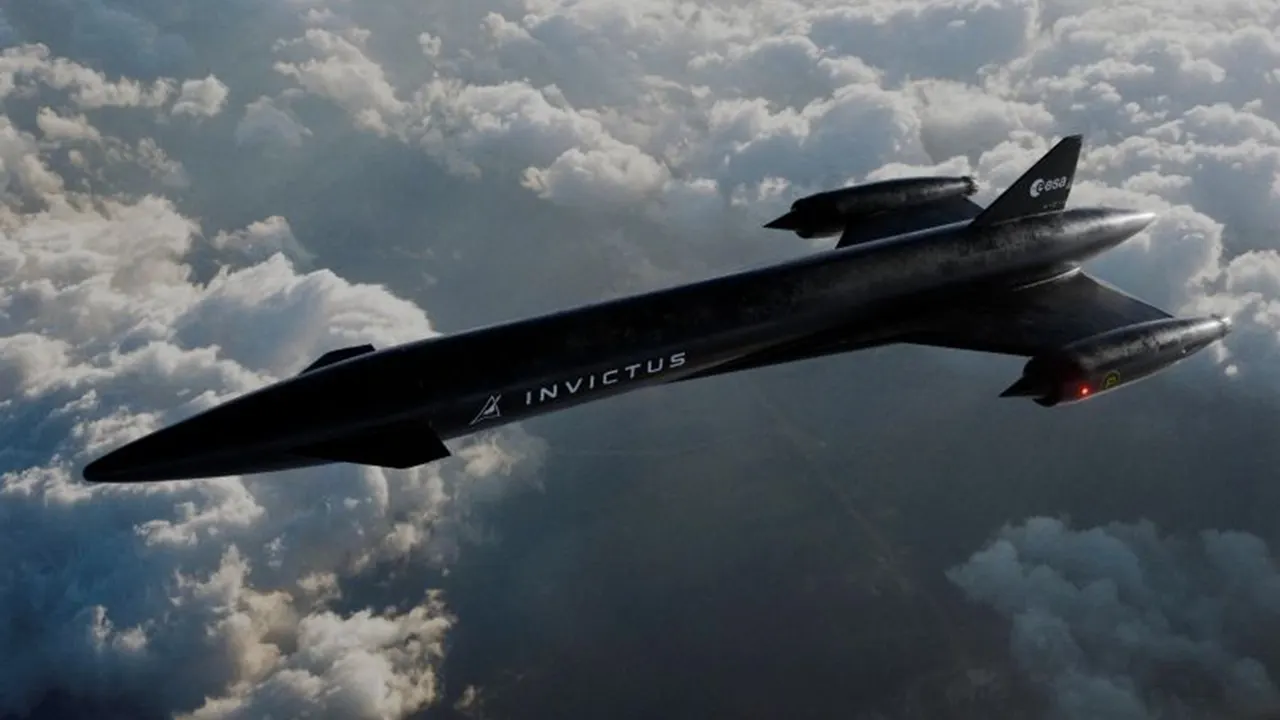
Invictus, the experimental hypersonic aircraft backed by the European Space Agency (ESA), has passed an important design milestone. Stephan Carroll, chief engineer for Invictus at British engineering firm Frazer-Nash, which leads the project, announced on 23 October that the programme cleared its first System Requirements Review (SRR-1) in March 2026.
In practical terms, the aircraft's specification has been validated once: as designed, it should be able to meet its goals for speed, aerodynamics and propulsion. Frazer-Nash waited seven months before going public, while the next steps were agreed with ESA and the UK Space Agency. The next review, SRR-2, is planned for October 2027.
Built on the ashes of Skylon
Invictus draws on work done for Skylon, the spaceplane developed by Reaction Engines. That company, a long-time partner of BAE Systems and ESA, went bankrupt at the end of October 2024 after failing to find new investors. ESA kept part of the legacy, notably the heat exchanger that cools the scorching air entering the engine in a fraction of a second.
ESA signed a €7 million contract with Frazer-Nash in July 2025 to start the design. The reusable demonstrator is meant to take off and land on a conventional runway and reach Mach 5, roughly 6,000 km/h, or two and a half times the speed of Concorde, at high altitude. The engine is to run on hydrogen, presented as less polluting than kerosene.
A later first flight
Frazer-Nash had been aiming for a first flight in early 2031. But in June 2026, ESA's Invictus technical lead David Perigo spoke of integrated propulsion tests around 2032, which suggests the schedule could slip by at least a year.
ESA sees Invictus as a testbed for future spaceplanes that take off like an aircraft and reach orbit like a rocket. Frazer-Nash chief executive Sarah Wilkes also points to military applications. Invictus will carry no passengers, and no commercial Mach 5 flights are planned.
Competition is moving too. NASA has been flight-testing its quiet supersonic X-59 since October 2025, while Dassault Aviation is working on its own spaceplane, Vortex, in Europe.
More from this day
See all →
Spain's LZB rail safety system failed 170 times in 2026, minister says
Starlink Cuts Spain Prices but Can Now Change Them Monthly

'SMS of Death': Invisible Text Crashes Android Phones

Android Studio Rabbit 2 opens up to Claude, GPT and other AIs
More in: Science
See all →
Polish Scientists Build Robot for Precise Drug Delivery to the Eye
Beta Pictoris 'Cat's Tail' Traced to Pluto-Sized Collision

Acesur builds 5,150-panel solar plant above olive grove in Jaén