Beta Pictoris 'Cat's Tail' Traced to Pluto-Sized Collision
A dark dust plume nicknamed the 'cat's tail' in the Beta Pictoris disk likely came from a crash between two Pluto-sized bodies, new Hubble and Webb data suggest.
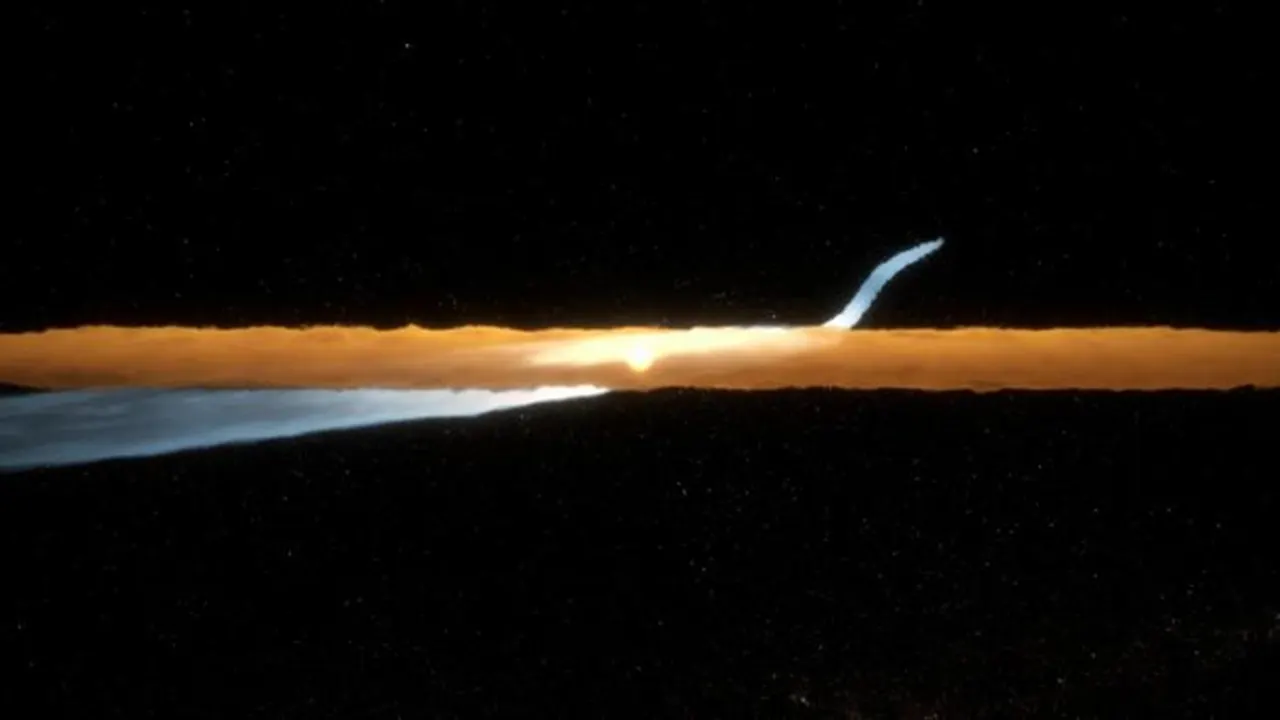
A strange dust structure nicknamed the "cat's tail" in the disk around the young star Beta Pictoris was most likely created by a collision between two bodies as large as Pluto, according to a new study in The Astrophysical Journal Letters. The plume could stretch across about 150 billion kilometers.
A tail first spotted by Webb
Beta Pictoris lies 63 light-years from Earth in the constellation Pictor, which is visible only from the southern hemisphere. The star is young, and its planetary system has existed for only a few million years. Its disk was detected by the IRAS infrared satellite in 1983 and photographed in 1984 from Las Campanas Observatory in Chile, making it the first circumstellar disk ever imaged.
In 2024, the James Webb Space Telescope revealed the tail-shaped protrusion, which appears to emerge from the disk, in unprecedented detail. A study in The Astronomical Journal already raised a collision as a possible explanation.
Hubble supports the impact scenario
The new work includes several authors of the 2024 paper, among them Isabel Rebollido of the Astrobiology Center in Madrid and Christopher Stark of NASA's Goddard Space Flight Center. They combined fresh Hubble images with observations going back 14 years to pin down the structure's position and nature.
Their results back the impact hypothesis. The dust is almost entirely carbon-rich organic material that absorbs visible light, so it is very dark. That explains why only Webb, with its infrared vision, had captured it until Hubble's new visible-light observations.
The grains are tiny, around one micron, and very porous. According to Kevin Wagner of the University of Arizona's Steward Observatory, a coauthor, the collision speeds may have been so high that carbon grains vaporized and then recondensed as they cooled, producing the porous structure.
The whole plume could span about 1,000 astronomical units, roughly 150 billion kilometers. The accompanying press release puts that at about 200,000 billion cats laid end to end.
Why it matters
Because Beta Pictoris is so young, it offers a window on the kind of collisions that may also have happened in our own Solar System before Earth and the other planets took their final form.
More from this day
See all →
Freshworks Acquires Israeli AI Startup Robusta for Freshservice

Pixxel launches Pixxel Federal to expand US government work
Navi raises Rs 940 crore from Prosus; Sachin Bansal keeps 84.34%

Apple v. OpenAI Trade Secrets Trial Set for July 19, 2027
More in: Science
See all →
Acesur builds 5,150-panel solar plant above olive grove in Jaén

Polish AI robot discovers four new chemical reactions at IChO PAN

Northwestern Physicists Trap a Single Positron for Months