How many satellites are in the night sky? About 710 over a UK town
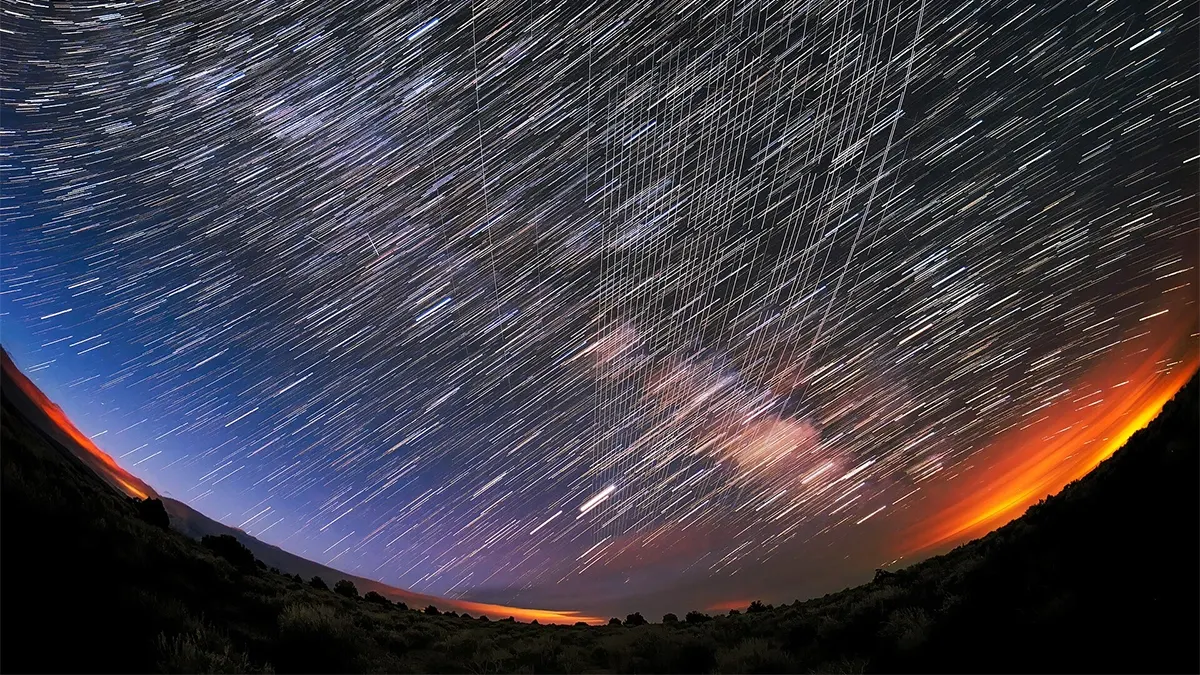
A new analysis estimates around 710 satellites sit above the horizon of a typical UK town after dark, and Starlink makes up roughly 70% of active ones in low orbit.
 SUMO· the number puzzle
 Dialo· learn languages by speaking
 ediviewer· read EDI files like documents
 giftdetect· the right gift in minutes
Remember when a neat string of Starlink satellites crossing the sky set off a small wave of "is that a UFO?" posts on local groups? That was a curiosity. It is getting harder to treat it that way.
According to a report from Accu Components, the number of satellites in orbit, dead ones included, rose from 5,415 at the end of 2019 to 20,095 in October 2026. That is almost four times as many in under seven years.
How many satellites are in the night sky?
The firm used orbital data from CelesTrak, which draws on US Space Force catalogues. It covered 15,883 active satellites in low Earth orbit (LEO, below roughly 2,000 km) and calculated their positions every two minutes between 12 and 18 October 2026 for 186 UK towns. The figures are averages over those seven nights.
The result: about 710 satellites above the horizon of a typical town at any moment after dark. Around 310 were higher than 10 degrees, so above rooftops and trees, and 79 were higher than 30 degrees. Over a single night, 12,891 different satellites passed over a typical town. One caveat: this is a company analysis, not peer-reviewed research, so read it as a picture of scale.
Why Starlink dominates
At the end of 2019 there were 120 Starlink satellites. In October there were 11,131, around 70% of all active satellites in LEO.
The data is British, but the effect is not. Many Starlink satellites fly in orbits tilted about 53 degrees to the equator, which packs them densely over mid-latitudes. Warsaw sits at roughly 52 degrees north, so Poland is well inside that zone, and the same goes for much of Europe.
Why it matters beyond pretty streaks
A bright trail is a nice sight for a person. For a telescope taking a long exposure of a faint object, it is a ruined frame. Radio astronomy has problems too. In October the European Space Agency signed an agreement with the International Astronomical Union's centre for protecting the sky from optical and radio interference.
Darker coatings and shields help, but a satellite swings between sunlight and Earth's shadow about every 90 minutes, and changing its surface also changes how it handles heat. Crowding is a physical risk as well. In 2009 the active Iridium 33 collided with the defunct Russian Kosmos 2251, producing more than 2,000 trackable fragments.
Starlink will not be alone for long. The report lists planned constellations including China's Guowang and Qianfan and Amazon Leo, each of which could add thousands more.
Apps worth a look
SUMO: the number puzzleTap the right tiles, add them up, hit the target. Easy to learn, hard to master. Free, for all ages.
Dialo: learn languages by speakingTalk to an AI conversation partner; every sentence comes back corrected and explained in your language. 9 languages, A1 to C2.
ediviewer: read EDI files like documentsOpen EDIFACT and X12 messages, see every segment explained, convert to JSON/XML, export PDF and Excel. Runs locally, no upload.
giftdetect: the right gift in minutesPick who it is for, the occasion and their personality. The search engine reads product descriptions from local shops and ranks what fits. Free, no sign-up.
More from this day
See all →
Siri AI daily limit in iOS 27.3: 20 tokens per iPhone, leak says

Poland's CBK PAN space lab: from huts to a probe bound for Jupiter

The Sun's heliotail: 14 years of NASA IBEX data show it changes