The Logos: a Finnish cathedral plays fast radio bursts every day
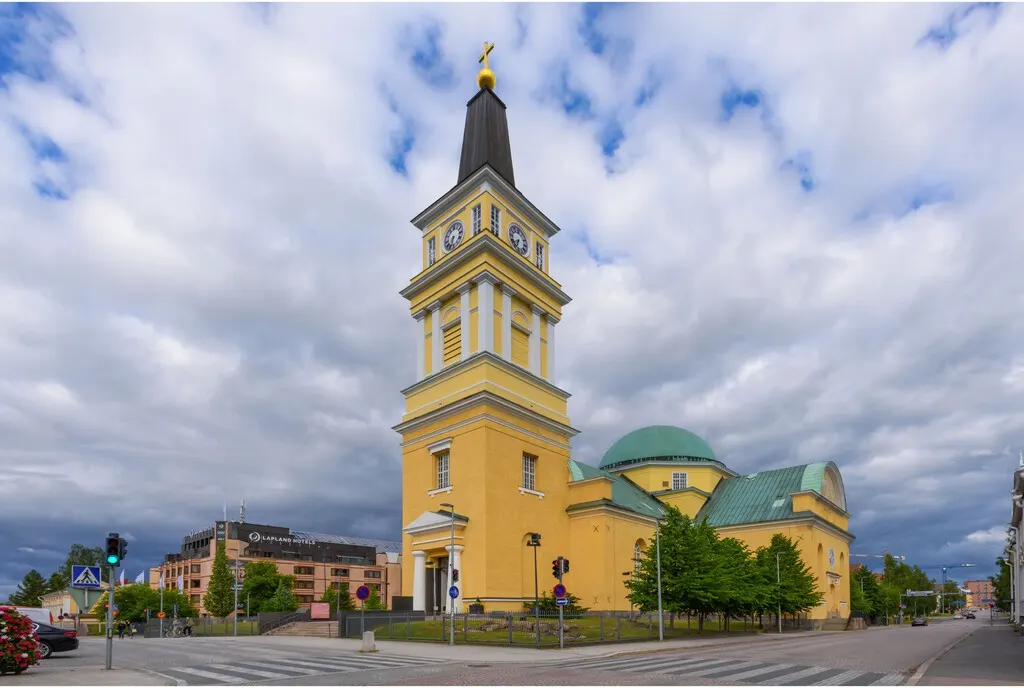
Every midday, 12 speakers in Oulu Cathedral play the sound of fast radio bursts that left their galaxies 8 to 50 billion years ago. A choir joins live on 21 November.
 SUMO· the number puzzle
 Dialo· learn languages by speaking
 ediviewer· read EDI files like documents
 giftdetect· the right gift in minutes
At noon every day, the cathedral in Oulu, Finland, fills with buzzes, rumbles, clicks and whistles. They are fast radio bursts (FRBs), signals from deep space that left their sources billions of years ago, turned into sound.
The project comes from Kiyoshi Masui, a physics professor at MIT, and Andrew Melchior, a composer and creative technologist. They used data on 4,539 bursts from 3,641 sources, picked up between 2018 and 2023 by CHIME, the Canadian Hydrogen Intensity Mapping Experiment. CHIME is a radio telescope in Canada built to map neutral hydrogen, but its huge field of view and data capacity turned out to be ideal for catching FRBs.
The result runs on a device called The Logos, installed in the cathedral in April 2026. It uses 12 speakers spread around the building. On 21 November the recording pauses for a live performance: Melchior plays the bursts on keyboard while a choir of 30 sings from among the audience.
How do fast radio bursts sound?
Each burst slides from high pitch to low. That is a real effect, caused by the signal's trip through intergaural gas. Because the radio frequencies arrive at slightly different moments, high and low tones form harmonies, and that is where the music comes from.
What are fast radio bursts?
FRBs are extremely energetic radio waves. In a single millisecond they release as much energy as the Sun gives off in three days. They were discovered in 2007 and their origin is still unclear. Ideas include the magnetospheres of neutron stars or black holes, young pulsars, and neutron star mergers. For the bursts in The Logos, researchers only know they formed between 8 and 50 billion years ago.
Will the music solve the mystery? Probably not. Sonification has helped before: in 1981 a sound pattern helped reveal a problem on Voyager 2 caused by micrometeoroid impacts. But for FRBs it does not look likely to help pin down their origin. Its value here is getting people to hear a phenomenon that can be neither seen nor heard.
Apps worth a look
SUMO: the number puzzleTap the right tiles, add them up, hit the target. Easy to learn, hard to master. Free, for all ages.
Dialo: learn languages by speakingTalk to an AI conversation partner; every sentence comes back corrected and explained in your language. 9 languages, A1 to C2.
ediviewer: read EDI files like documentsOpen EDIFACT and X12 messages, see every segment explained, convert to JSON/XML, export PDF and Excel. Runs locally, no upload.
giftdetect: the right gift in minutesPick who it is for, the occasion and their personality. The search engine reads product descriptions from local shops and ranks what fits. Free, no sign-up.
More from this day
See all →
Sam Altman wants Samsung's help building an OpenAI phone rival
Signal encryption code verified by DeepMind AI in four weeks
Calif.io Brotli exploit hits iPhone, iPad and Mac via Wi-Fi portal

Mittwald hosting attack via MCP server: site in emergency mode
More in: Science
See all →
Stingray laser robots zap parasites on Norwegian salmon
New peanut worm species found in Japan's deep sea has saw-toothed hooks
Webb spots H3+ 'forbidden' signal predicted 40 years ago