ESA's Space HPC supercomputer packs 5 petaflops for space data
Space HPC, the European Space Agency's first owned supercomputer, combines 34,000 CPU cores and 108 Nvidia H100 GPUs to process a growing flood of satellite data.
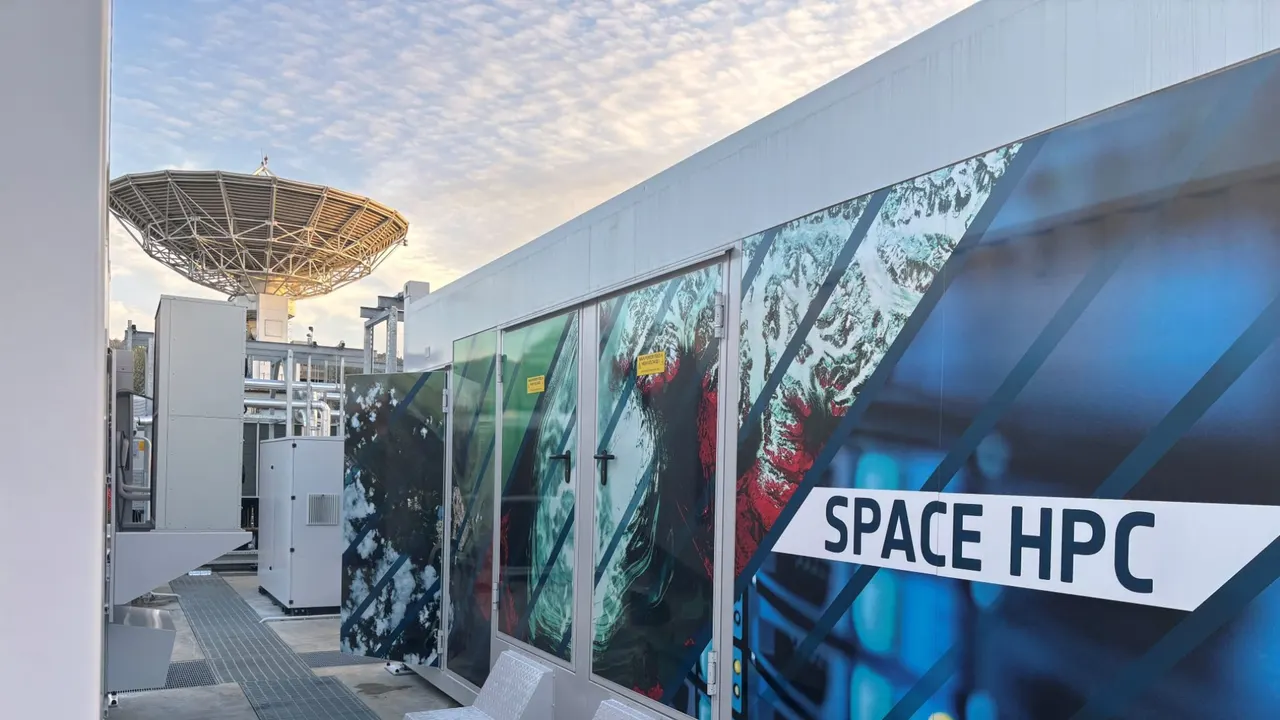
The European Space Agency now has a supercomputer of its own. Space HPC, installed at the ESRIN centre in Frascati near Rome, runs about 34,000 processor cores and 108 Nvidia H100 graphics chips, for a raw power of 5 petaflops, or 5 quadrillion operations per second.
The machine was inaugurated on 12 March 2025 in partnership with Hewlett Packard Enterprise. According to the agency's documentation, it is ESA's first high-performance computing system. Project manager Michel Leonard sums up its purpose simply: the agency has more and more data, and processing it takes computing power. Data volumes are growing exponentially, he says, and so is the computing time needed to handle them.
Three blocks, one shared resource
ESRIN is ESA's Earth observation centre, so the machine mainly serves scientists working on satellite data, with capacity shared project by project. Companies, start-ups and laboratories in ESA member states can also apply for access, and each request is reviewed.
The system is split into three parts: a massively parallel CPU section for classic physics simulations; a GPU-accelerated section for AI, fluid dynamics and large data processing; and a quantum emulation section. Using 64 GPUs, Space HPC can simulate a 39-qubit quantum computer, letting teams test algorithms written for future quantum hardware. Storage reaches 3.6 petabytes on SSD.
Direct liquid cooling gives a PUE below 1.09, meaning cooling and other equipment add less than 9% to the servers' own electricity use. Waste heat is reused to warm the ESRIN campus, according to ESA.
Not a rival to Jupiter
Space HPC is modest by European standards. Jupiter, the continent's first exascale machine, inaugurated in September 2025 in Jülich, Germany, reaches 1,000 petaflops, roughly 200 times more. ESA does not aim to compete: it presents Space HPC as a tool sized to complement the large national and European supercomputers.
One highlighted use is space weather. Solar flares send particles toward Earth, and satellites such as ESA and NASA's SOHO, positioned at the L1 Lagrange point 1.5 million kilometres away, see them leave. With the new machine, forecasts of solar storms could shrink from several hours to a few minutes.
Apps worth a look
 SUMO: the number puzzle
Tap the right tiles, add them up, hit the target. Easy to learn, hard to master. Free, for all ages.
 Dialo: learn languages by speaking
Talk to an AI conversation partner; every sentence comes back corrected and explained in your language. 9 languages, A1 to C2.
 ediviewer: read EDI files like documents
Open EDIFACT and X12 messages, see every segment explained, convert to JSON/XML, export PDF and Excel. Runs locally, no upload.
More from this day
See all →


More in: Science
See all →
European Power Grid's Mysterious 60-Second Pulse Traced to UPS Units

ESA-backed JASPER system will warn pilots of GPS spoofing

UNEP: US CO2 Emissions Rose 133 Million Tons Under Trump