Spanish Team Turns Rain Into Power With Perovskite Solar Hybrid
Researchers in Seville have paired a perovskite solar cell with a triboelectric nanogenerator so the panel generates power from raindrops as well as sunlight.
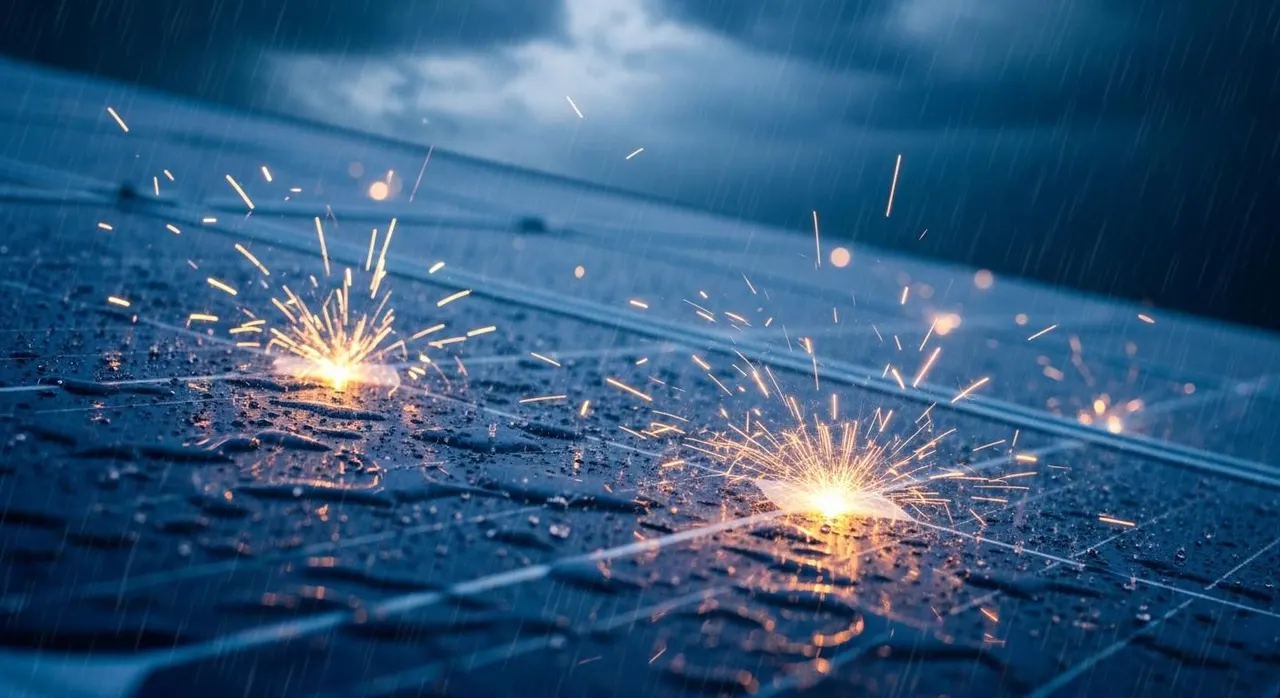
A Spanish research team has built a hybrid device that produces electricity from both sunlight and falling rain, turning the biggest weakness of perovskite solar cells into an advantage. The group combines a perovskite cell with a triboelectric nanogenerator (TENG).
The work comes from the Institute of Materials Science of Seville (ICMS), the Spanish National Research Council (CSIC) and the University of Seville.
Turning a weakness into a feature
Perovskite cells are a leading candidate for the next generation of solar power. They are cheaper to make than conventional silicon cells, offer high conversion efficiency, and are thin, light and flexible. Their fatal flaw is water: rain dissolves the material and degrades it quickly, which is a serious contradiction for a technology meant to work outdoors.
A TENG generates electricity from the friction between two different materials, the same principle as static electricity from rubbing a balloon on hair. The team used plasma technology to coat the cell's surface with a protective film about 100 nanometers thick, roughly one-thousandth the width of a human hair.
This film acts as the triboelectric surface, converting the impact of each raindrop into current. According to the researchers, a single drop can yield up to 110 volts.
The ultra-thin layer does three jobs at once. It generates power from raindrops, shields the perovskite from water damage, and works as an optical filter that improves light absorption.
Where it could be used
The most obvious applications are small devices where a dead battery is a problem: smart-home and weather-monitoring IoT sensors, structural sensors on bridges and tall buildings that detect cracks and strain, power for street lights and traffic signals, and soil sensors in fields.
Perovskite cells are also being paired with other materials elsewhere. In December 2025, Japan's Okumura Corporation and Iwate University began field tests of a disaster-prevention sheet that layers perovskite cells onto waterproofing material, aimed at slopes and rooftops where conventional panels cannot be installed.
The Spanish design shifts the thinking from rain as a loss to rain as an additional source of energy.
Apps worth a look
 SUMO: the number puzzle
Tap the right tiles, add them up, hit the target. Easy to learn, hard to master. Free, for all ages.
 Dialo: learn languages by speaking
Talk to an AI conversation partner; every sentence comes back corrected and explained in your language. 9 languages, A1 to C2.
 ediviewer: read EDI files like documents
Open EDIFACT and X12 messages, see every segment explained, convert to JSON/XML, export PDF and Excel. Runs locally, no upload.
More from this day
See all →Russia's MTS CEO to Visit South Korea After 7 Years to Seek 5G Partners

Meta Muse AI Agent Launches in Japan, Books and Reminds Itself

Android Now Hides Passwords in Chrome During Screen Sharing

Anthropic renames Claude Max 20x to Ultra, drops 5-hour limit
More in: Science
See all →
European Power Grid's Mysterious 60-Second Pulse Traced to UPS Units

ESA-backed JASPER system will warn pilots of GPS spoofing
ESA's Space HPC supercomputer packs 5 petaflops for space data