ESA-backed JASPER system will warn pilots of GPS spoofing
The European Space Agency is backing JASPER, a cockpit add-on from Germany that detects GPS jamming and spoofing and alerts flight crews on airliners.
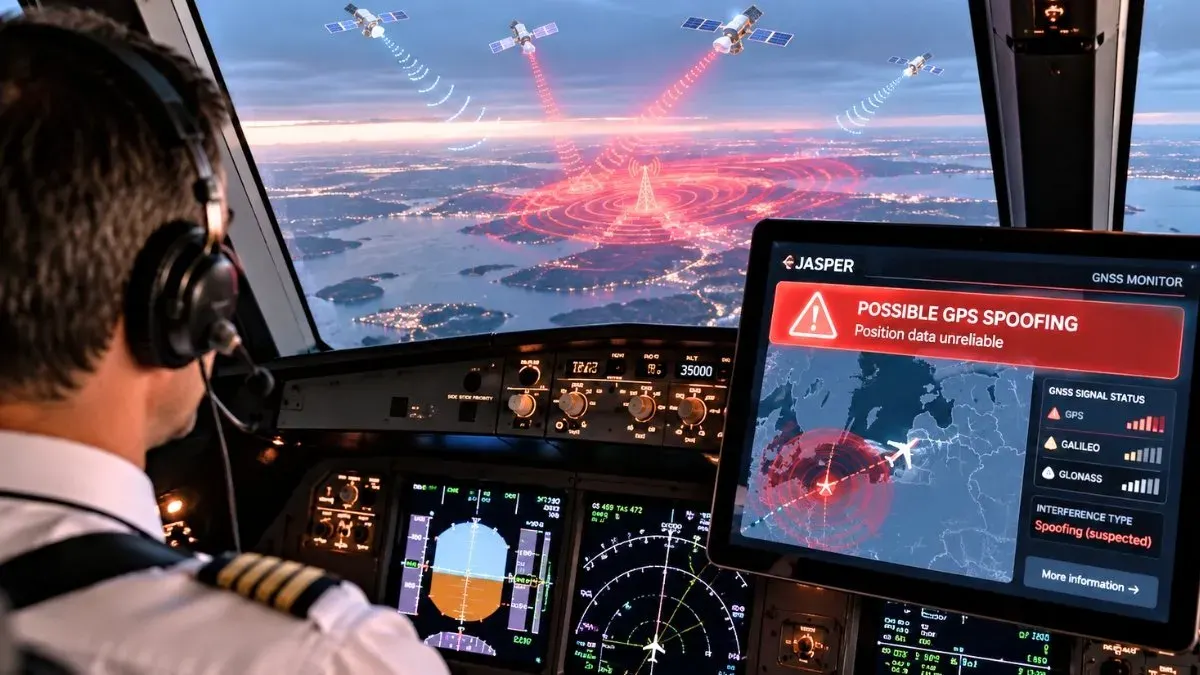
The European Space Agency is supporting the development of a device that recognizes fake GPS signals and warns pilots about them. The system, called JASPER (Jamming/Spoofing Event Recognition System), is being built in Germany, and results of its first project phase were presented on 22 October.
Behind the project are avionics maker f.u.n.k.e. AVIONICS and the German Aerospace Center DLR. It is funded through ESA's NAVISP programme, which finances navigation technologies.
Two threats, one warning
JASPER is designed to detect two kinds of interference. Jamming drowns out the weak satellite signal with stronger radio transmissions, so a receiver cannot determine its position. Spoofing is subtler: the receiver gets a signal that looks like genuine navigation data, but the position or time it carries is false, so the system may show a wrong location while appearing to work normally.
The technology is based on a satellite receiver developed by DLR and previously tested in flight trials. f.u.n.k.e. AVIONICS is turning it into a product suitable for passenger aircraft. The project initially focuses on the Airbus A320.
An add-on, not a cure
The unit is meant as additional equipment that does not replace existing navigation receivers or require deep changes to onboard avionics. Alerts are to be shown to pilots via an Electronic Flight Bag, the tablet-style tool crews use for documents, maps and flight data.
JASPER will not remove interference or make an aircraft immune to spoofing. Its job is to tell the crew how trustworthy satellite navigation is at a given moment. The developers are consulting Lufthansa, Eurowings and Condor on requirements.
The system is also planned to log detected incidents for later analysis. Aggregated data could feed maps of areas where navigation signals are especially exposed to manipulation, which matters for regions such as the Baltic, where Russian interference can make devices show positions hundreds of kilometres off. Poland's air navigation agency has already had to issue extra information to crews because of GPS problems.
The issue is also on regulators' radar: in July 2026 EASA updated its guidance on jamming and spoofing, covering electronic onboard tools, crew training and communication procedures with air traffic control. A separate project by Polish firm Creotech Instruments aims to locate sources of GNSS interference using satellites.
Apps worth a look
 SUMO: the number puzzle
Tap the right tiles, add them up, hit the target. Easy to learn, hard to master. Free, for all ages.
 Dialo: learn languages by speaking
Talk to an AI conversation partner; every sentence comes back corrected and explained in your language. 9 languages, A1 to C2.
 ediviewer: read EDI files like documents
Open EDIFACT and X12 messages, see every segment explained, convert to JSON/XML, export PDF and Excel. Runs locally, no upload.
More from this day
See all →



More in: Science
See all →
European Power Grid's Mysterious 60-Second Pulse Traced to UPS Units

ESA's Space HPC supercomputer packs 5 petaflops for space data

UNEP: US CO2 Emissions Rose 133 Million Tons Under Trump