Did comets bring life's building blocks to Earth? Probably not
A Cambridge simulation suggests comets hit Earth too fast and too steeply for complex organic molecules to survive. Asteroids look like the better suspect.
 SUMO· the number puzzle
 Dialo· learn languages by speaking
 ediviewer· read EDI files like documents
 giftdetect· the right gift in minutes
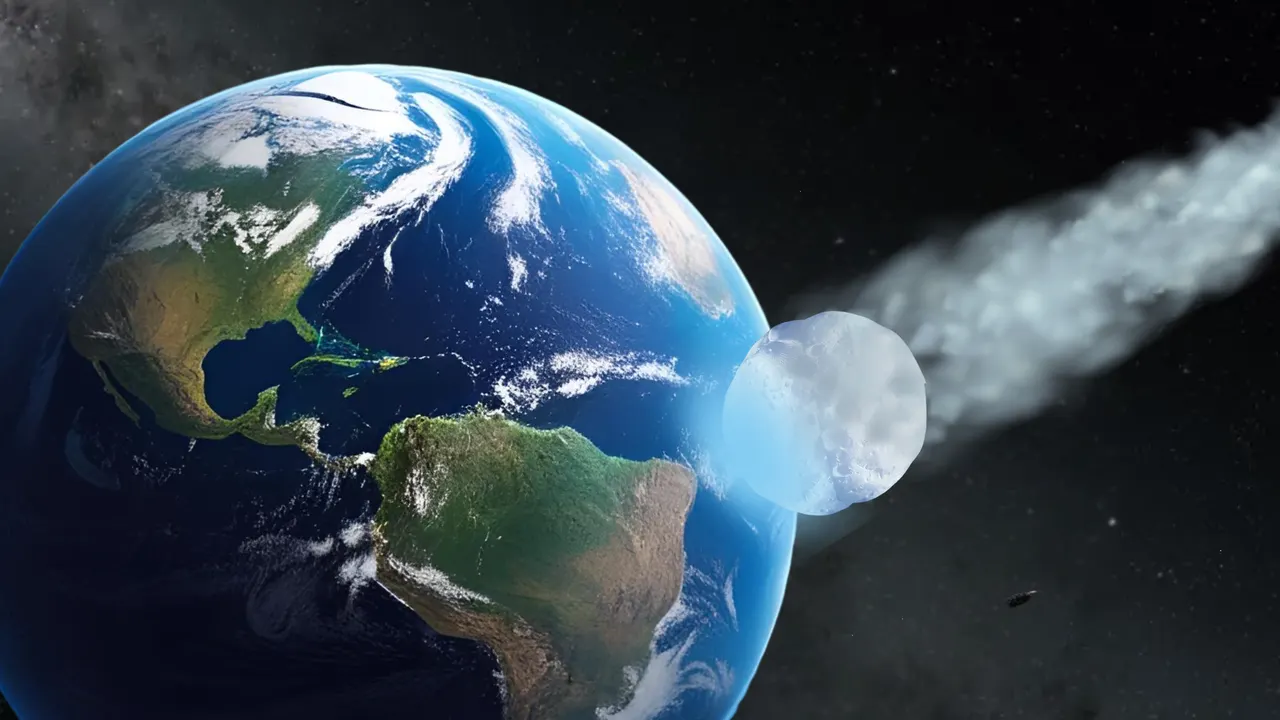
Did comets bring the building blocks of life to Earth? For over a century that was a popular guess. New computer modelling from the University of Cambridge says it almost certainly didn't happen.
Planetary scientist Richard Anslow and colleagues simulated how comets formed, how their orbits changed, how they pushed through Earth's atmosphere and what happened when they hit. They used hydrogen cyanide, a molecule common in comets (it was even spotted in the interstellar comet 3I/ATLAS), as a stand-in for complex organic molecules in general.
The problem is speed. For these molecules to survive, a comet would need to hit at below about 15 kilometres per second (33,500 mph). Most comets arrive faster than that and at too sharp an angle, so the molecules mostly vaporise. Even when some survive, there usually isn't enough of them to kick off meaningful prebiotic chemistry.
"It would really have to be a one-in-a-million occurrence," Anslow said. The team can't rule it out, but calls it at best a one-off fluke.
What else could have delivered the ingredients?
Researchers are now leaning toward two alternatives: the chemistry happened on Earth itself, or asteroids brought the molecules. Asteroids look promising. The sample returned from the near-Earth asteroid Bennu by the OSIRIS-REx mission contained all the building blocks of RNA.
What about Mars and other planets?
Mars would have been slightly kinder to incoming comets, thanks to its thinner atmosphere and lower gravity. Anslow doesn't claim it happened there. He says it would be odd if it happened on Earth but not on Mars, and that the likelier answer is that it happened on neither.
The more interesting case may be compact systems around red dwarf stars, such as TRAPPIST-1. In a 2023 paper, Anslow described how comets could bounce gravitationally from planet to planet, losing speed each time, so a final impact would be gentler and molecules might survive.
The study was published on 28 October in Scientific Reports.
Apps worth a look
SUMO: the number puzzleTap the right tiles, add them up, hit the target. Easy to learn, hard to master. Free, for all ages.
Dialo: learn languages by speakingTalk to an AI conversation partner; every sentence comes back corrected and explained in your language. 9 languages, A1 to C2.
ediviewer: read EDI files like documentsOpen EDIFACT and X12 messages, see every segment explained, convert to JSON/XML, export PDF and Excel. Runs locally, no upload.
giftdetect: the right gift in minutesPick who it is for, the occasion and their personality. The search engine reads product descriptions from local shops and ranks what fits. Free, no sign-up.
More from this day
See all →


More in: Space
See all →
TOI-2535 b: the Jupiter-sized exoplanet that vanished from TESS
Astra robot builds a structure in orbit on its own, a first

Starlink Mini 2 Adds a Removable Battery for Off-Grid Internet