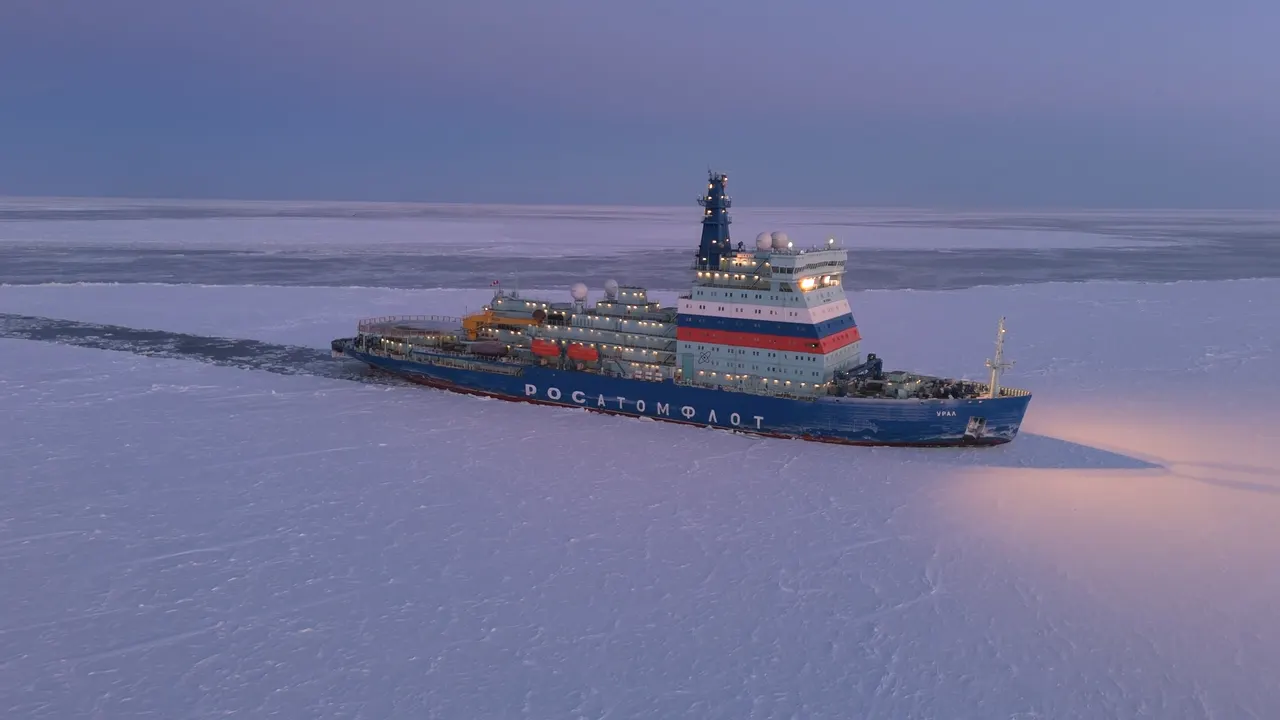
Bureau 1440 Tests Satellite Terminal on Nuclear Icebreaker Ural
Russia's Bureau 1440 has tested its 1440.ULTRA satellite terminal aboard the nuclear icebreaker Ural on the Northern Sea Route, including a telemedicine session.
 SUMO· the number puzzle
 Dialo· learn languages by speaking
 ediviewer· read EDI files like documents
 giftdetect· the right gift in minutes
Russian aerospace company Bureau 1440, part of IKS Holding, has tested next-generation satellite communications in real shipping conditions on the Northern Sea Route. The trials were run together with GlavSevmorput, Atomflot (both Rosatom enterprises) and the Federal Medical-Biological Agency (FMBA). According to the participants, it was the first time an icebreaker's communications were provided by Bureau 1440's own satellite and ground infrastructure.
What was tested
A serial 1440.ULTRA subscriber terminal was installed aboard the nuclear icebreaker Ural, a Project 22220 vessel. Captain Viktor Suryadov used the link for a video conference with Atomflot's situation center in Murmansk, reporting on the voyage task and ice conditions along the route.
In a second scenario, medical staff from the Pirogov multidisciplinary center in Murmansk contacted specialists at the Burnazyan center in Moscow for a telemedicine consultation. Radiology and other examination data for a crew member were transmitted successfully.
The companies say this is the first time in Russia that an icebreaker was connected through domestic low-Earth-orbit technology. Once the constellation reaches global coverage, Bureau 1440 expects to provide stable communications and broadband internet for vessels on the Northern Sea Route, including routes to the North Pole, where other Russian satellite solutions are unavailable or lack sufficient bandwidth.
The terminal and recent tests
The 1440.ULTRA delivers up to 700 Mbit/s, measures 600×600 mm, weighs 30% less than the pre-series unit, and carries an IP67 rating. It can be used in a fixed position or on the move. Bureau 1440 is also developing a portable 1440.MINI (300×300 mm, about 100 Mbit/s) and the 1440.ZEMLYA terminal for railways, already being tested on Russian Railways trains.
In October 2026, Bureau 1440, YADRO and MegaFon demonstrated a hybrid link between Moscow and the Siberian taiga in Krasnoyarsk Krai via satellites of the Rassvet constellation, without a terrestrial transport line.
GlavSevmorput said the results will help define how the system is used on the route, including for navigation safety and icebreaker escort. Atomflot expects the technology to become the basis of a unified digital fleet-management loop.
Apps worth a look
SUMO: the number puzzleTap the right tiles, add them up, hit the target. Easy to learn, hard to master. Free, for all ages.
Dialo: learn languages by speakingTalk to an AI conversation partner; every sentence comes back corrected and explained in your language. 9 languages, A1 to C2.
ediviewer: read EDI files like documentsOpen EDIFACT and X12 messages, see every segment explained, convert to JSON/XML, export PDF and Excel. Runs locally, no upload.
giftdetect: the right gift in minutesPick who it is for, the occasion and their personality. The search engine reads product descriptions from local shops and ranks what fits. Free, no sign-up.
More from this day
See all →
QuantumDiamonds: Munich Start-up Uses Diamond Sensors to Find Chip Defects

Parloa Deepens OpenAI Partnership With Early Model Access

Paribu Unveils Intelligence AI and Free Terminal at 10-Year Event

Meta Launches Muse Ember, Its Smallest AI Model, for Agents
More in: Space
See all →
Starlink Mini 2 Adds Swappable Battery for 4.5 Hours Off-Grid

NASA Opens $10 Billion Moon Base Contracts to SpaceX, Blue Origin

NASA CHAPEA 2 Crew Exits 3D-Printed Mars Habitat After 378 Days
