Viking 2 Data May Hold the Oldest Marsquake Ever Recorded
Fifty years after NASA's Viking 2 landed, Chinese researchers say a long-dismissed signal from Sol 80 could be the earliest recording of a marsquake.
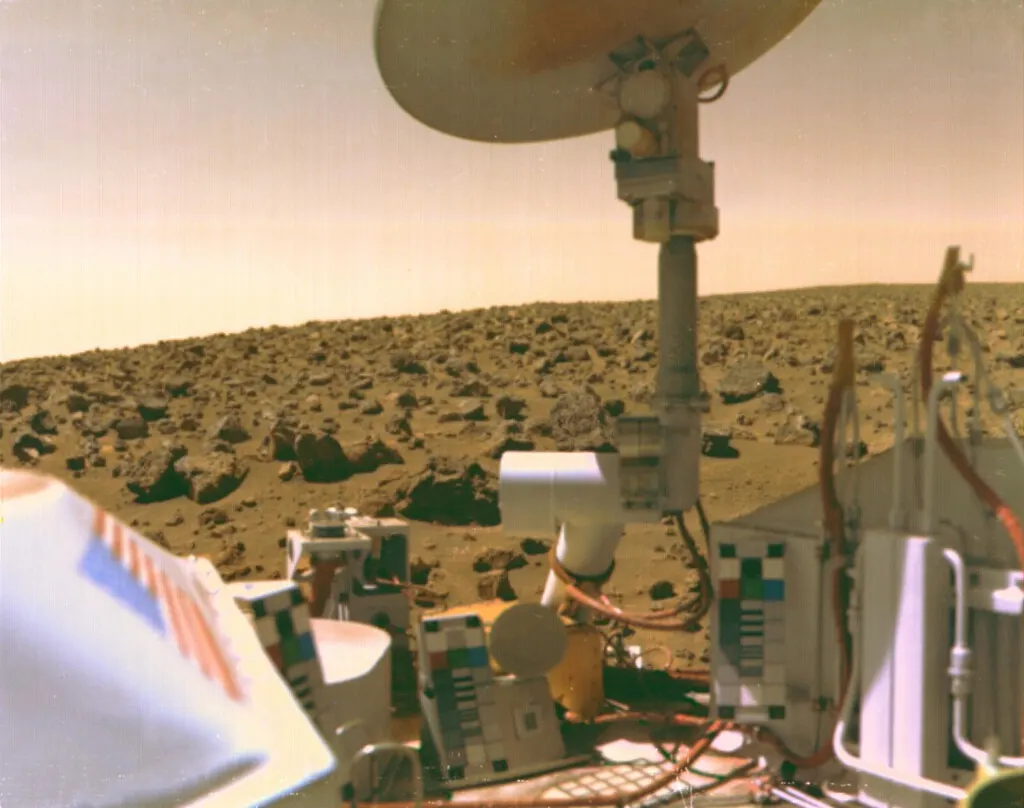
A team of Chinese scientists says a signal recorded by NASA's Viking 2 lander half a century ago may be the oldest known recording of a marsquake. The data had been set aside for decades because it was too noisy to trust.
NASA sent Viking 1 and Viking 2 to Mars in 1975 to look for signs of life. Both carried a seismometer to help judge whether the planet is or once was habitable. Viking 1 deployed its instrument badly, and Viking 2's picked up too much interference to confirm any quakes, so the records were largely forgotten.
Why Viking 2 was so noisy
Viking 2's seismometer was mounted directly on the lander. The wind moved the craft, much like a sail, and passed those vibrations to the instrument. It was impossible to tell whether a signal came from the ground or from the air. The lander's legs were its only contact with the surface, adding more room for distortion along the way.
NASA fixed this with InSight, launched in 2018. A robotic arm placed its seismometer directly on the ground, cutting wind interference. Between 2018 and 2022, InSight detected 1,319 marsquakes, showing Mars is more seismically active than expected.
The Sol 80 signal
Viking 2 made two suspicious recordings, on Sol 53 and Sol 80 (Martian days are called sols). The first was classified as a gust of wind. The second had long been seen as a quake candidate, but doubts over interference kept it unresolved.
Applying what InSight taught them, the authors of the new study re-examined it. They found the Sol 80 signal closely resembles both California earthquakes and InSight's marsquakes. It was also recorded in the early hours, when winds tend to be weaker, and about 20 minutes after a period of light wind, which makes wind interference unlikely.
Certainty is out of reach. The recording could still come from another event, such as a meteorite impact. Even so, the work shows that old planetary data can yield new results when read with modern knowledge.
Apps worth a look
 SUMO: the number puzzle
Tap the right tiles, add them up, hit the target. Easy to learn, hard to master. Free, for all ages.
 Dialo: learn languages by speaking
Talk to an AI conversation partner; every sentence comes back corrected and explained in your language. 9 languages, A1 to C2.
 ediviewer: read EDI files like documents
Open EDIFACT and X12 messages, see every segment explained, convert to JSON/XML, export PDF and Excel. Runs locally, no upload.
More from this day
See all →
Hacked Alert Apps in Russia and Ukraine Send Fake Nuclear Warnings
LLMjacking: Hackers Run Up $100,000-a-Day AI Bills for Firms

PostgreSQL 19 delayed to November 19 as AI finds more bugs
Anthropic Shows Unreleased AI Model Exploiting Linux and Chrome Flaws
More in: Space
See all →
Google Runs Gemma 4 on a TPU in Orbit in Suncatcher Test
Google: Orbital AI Data Centers Cost 100 Times More Than Earth
EIB and Deutsche Bank Aim to Mobilise €560M for European Space