TOI-2535 b: the planet that vanished while astronomers watched
A hot Jupiter 1,000 light-years away stopped crossing its star in 2026. Astronomers say an unseen neighbour is tilting its orbit out of our line of sight.
 SUMO· the number puzzle
 Dialo· learn languages by speaking
 ediviewer· read EDI files like documents
 giftdetect· the right gift in minutes
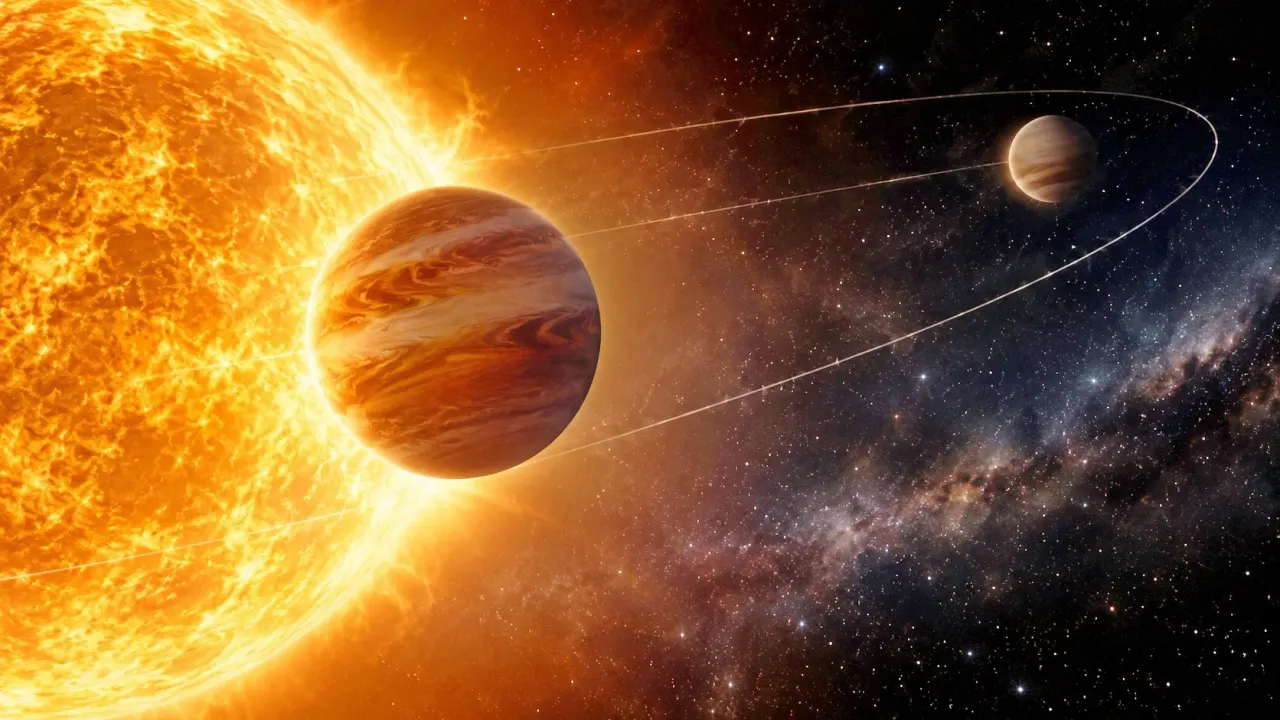
For seven years, NASA's TESS space telescope watched a planet dim its star on schedule. Then, in 2026, the dimming stopped. TOI-2535 b, a gas giant about 1,000 light-years from Earth, had dropped out of view while astronomers were looking.
The team at the University of California, Los Angeles (UCLA) says it is the first known vanishing planet. Their paper appears in Astrophysical Journal Letters.
Why did TOI-2535 b disappear?
TOI-2535 b is a hot Jupiter: a Jupiter-sized planet hugging its star. It circles it in just 8.25 days. Mercury needs 88 to orbit our Sun.
TESS finds planets by spotting tiny drops in a star's brightness when a planet passes in front of it. That is called a transit, and it only works if the orbit lines up with our view. From April 2019 to March 2026, the transits of TOI-2535 b ran late by up to six hours. They also got shorter and shallower, and by 2026 they were gone.
The explanation is a second, unseen planet whose orbit is tilted relative to the first. According to the astronomers' calculations, the two tug on each other so strongly that their orbits wobble, and TOI-2535 b now crosses its star at an angle that misses our line of sight.
"We imagine the universe as clockwork, where everything is regular, but that isn't true," said Samuel Yee of UCLA, the paper's corresponding author. He called it the most extreme example of this kind they have seen.
Will the planet come back?
Yes, in 30 to 50 years, according to the team. Its hidden neighbour could show up sooner. UCLA's Erik Petigura compared it to eclipses: if the Moon's orbit were perfectly aligned with Earth's, we would get one every month. Its tilt is why they are rare.
What it says about hot Jupiters
Hundreds of hot Jupiters are known, but they rarely have neighbours massive enough to disturb them. Yee and Petigura are studying how these planets ended up so close to their stars. One idea is a violent path, such as a close encounter. The other is a calm migration through the disc of gas and dust around a young star, which should leave a flat system with no tilts.
The wobble of TOI-2535 b suggests the system's parts interacted in a way that tilted the orbits over time, much like the Moon's orbit was probably tilted by a violent event. The team used TESS data and observations from the 3.5-metre WIYN telescope at Kitt Peak in Arizona.
Apps worth a look
SUMO: the number puzzleTap the right tiles, add them up, hit the target. Easy to learn, hard to master. Free, for all ages.
Dialo: learn languages by speakingTalk to an AI conversation partner; every sentence comes back corrected and explained in your language. 9 languages, A1 to C2.
ediviewer: read EDI files like documentsOpen EDIFACT and X12 messages, see every segment explained, convert to JSON/XML, export PDF and Excel. Runs locally, no upload.
giftdetect: the right gift in minutesPick who it is for, the occasion and their personality. The search engine reads product descriptions from local shops and ranks what fits. Free, no sign-up.