GPM J071507-114153: a white dwarf pulses every 7.9 minutes
A radio signal from 5,000 light-years away ticks every 7.9 minutes. Astronomers traced it to a white dwarf orbiting a Sun-like star, a first.
 SUMO· the number puzzle
 Dialo· learn languages by speaking
 ediviewer· read EDI files like documents
 giftdetect· the right gift in minutes
A radio signal from more than 5,000 light-years away arrives almost like clockwork: one pulse every 7.9 minutes. Astronomers now know what sends it, and it is a pairing nobody had seen producing signals like this before.
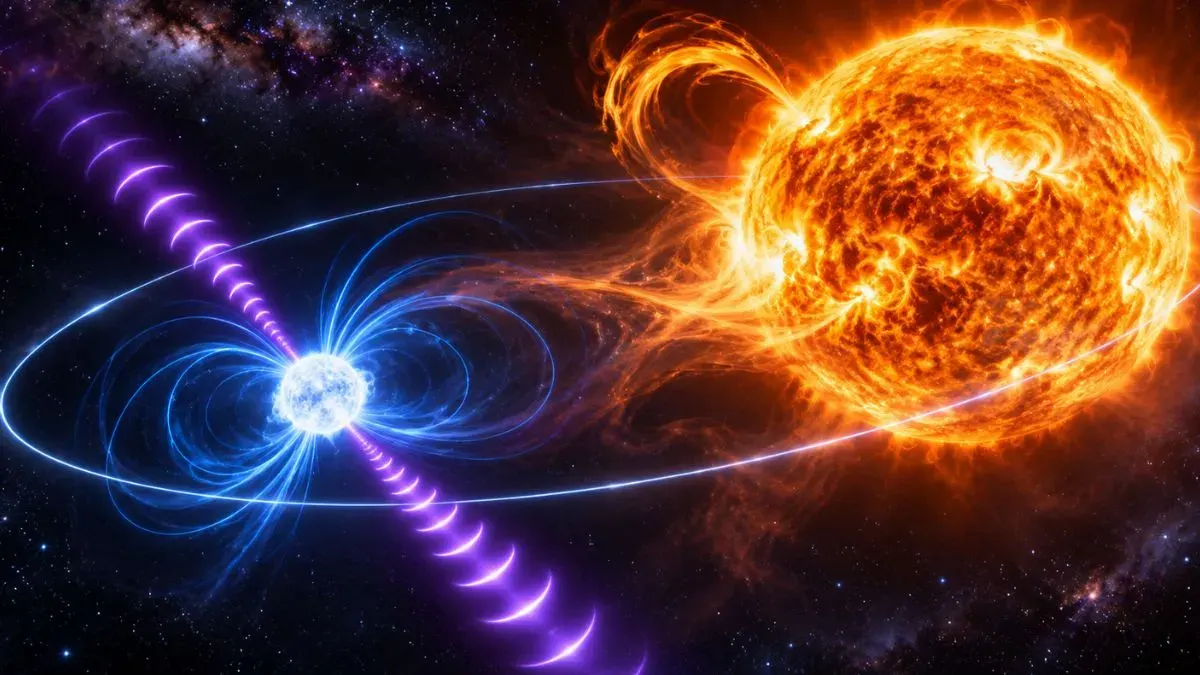
The source is called GPM J071507-114153 and sits in the Milky Way. It is a binary system made of a white dwarf, the dense leftover core of a star that has burned through its fuel, and a much larger G-type star, the same spectral class as our Sun. Researchers link the 7.9-minute rhythm (about 7 minutes 54 seconds) to the white dwarf's rotation, a bit like a lighthouse beam sweeping past Earth. A second, slower cycle of about 1.3 days appears to be the time the two stars take to orbit each other.
What is a long-period transient?
GPM J071507-114153 belongs to a group called long-period transients, or LPTs: sources that send repeating radio pulses minutes or even hours apart. Ordinary pulsars, spinning neutron stars, usually flash much faster, so LPTs are hard to explain with the usual pulsar model. Other examples include an object pulsing every 22 minutes, described in 2023, and ASKAP J1832-0911, which emits radio and X-ray signals every 44 minutes.
Some similar systems already turned out to be white dwarfs paired with small red dwarfs. This is the first where the pulses come from a white dwarf orbiting a Sun-like star. The authors, publishing in Nature Astronomy, note the larger star probably does not fill its Roche lobe, the zone beyond which matter could flow freely to its partner. So heavy matter transfer is not an obvious explanation.
How did astronomers find it?
The team used the Murchison Widefield Array in Australia to survey the southern Milky Way, then South Africa's MeerKAT to pin down the position. Optical spectra from the Keck Observatory in Hawaii revealed the G-type star. More than 100 hours of radio data, crunched at the Pawsey Supercomputing Research Centre, showed tiny shifts in pulse arrival times that follow the white dwarf's orbit.
The polarisation of the waves held a surprise. Passing through magnetised plasma twists it, an effect called Faraday rotation, and the team saw sharp changes at certain orbital phases. One likely explanation is a prominence, a huge plasma structure held up by magnetic fields, like those on our Sun. In effect, the white dwarf works as a natural probe of its companion's magnetic surroundings, which no telescope could resolve directly at that distance. Exactly where the emission arises, on the surface or just around the white dwarf, is still unknown.
Apps worth a look
SUMO: the number puzzleTap the right tiles, add them up, hit the target. Easy to learn, hard to master. Free, for all ages.
Dialo: learn languages by speakingTalk to an AI conversation partner; every sentence comes back corrected and explained in your language. 9 languages, A1 to C2.
ediviewer: read EDI files like documentsOpen EDIFACT and X12 messages, see every segment explained, convert to JSON/XML, export PDF and Excel. Runs locally, no upload.
giftdetect: the right gift in minutesPick who it is for, the occasion and their personality. The search engine reads product descriptions from local shops and ranks what fits. Free, no sign-up.
More from this day
See all →
Optimizely script attack put malware on 178 major websites

Google Maps ranking: 4.9 stars and a copy shop still at its mercy

Android Auto update: new features limited to just 8 phones

Why is GTA called Grand Theft Auto? It started as a cop game
More in: Science
See all →
US hyperscale data centers use more power than 148 countries

Curiosity rover finds hints of liquid water films on Mars

Vitamin B12 battery: Spanish team builds a rechargeable zinc-air cell