Stack Overflow Says Reports of Its Death Are Exaggerated
Stack Overflow's Philippe Beaudette says the platform is shifting from a Q&A site to knowledge infrastructure for developers, companies and AI agents, even as new questions fall.
Stack Overflow's senior vice president of community, Philippe Beaudette, has pushed back on predictions that the platform is dead. He called them catchy headlines that confuse a change in how people reach knowledge with the disappearance of that knowledge, and of the company behind it.
Beaudette acknowledged that AI has changed developer habits. In the Developer Survey 2026, 64% of respondents said they visit Stack Overflow less often for simple questions. At the same time, developers say they now ask harder questions and use the site to check answers generated by AI.
From a Q&A site to knowledge infrastructure
According to Beaudette, the public Q&A site is only one part of the company. Human-verified content is used to train and improve models, tune retrieval systems and make AI assistants more reliable. Developers may get answers inside their IDE, he argued, but the knowledge often originates from someone sharing experience on Stack Overflow.
The company has recently launched a beta of Stack Overflow for Agents, an API-oriented knowledge exchange where AI agents can share information and verify solutions. It has also brought back Developer Story, which lets professionals demonstrate experience and contributions in a verified way. In September it introduced a new generation of Stack Internal, a managed context layer for companies using AI. It organizes corporate knowledge, tracks its provenance, checks its accuracy and brings in subject experts when verification is needed.
The numbers behind the debate
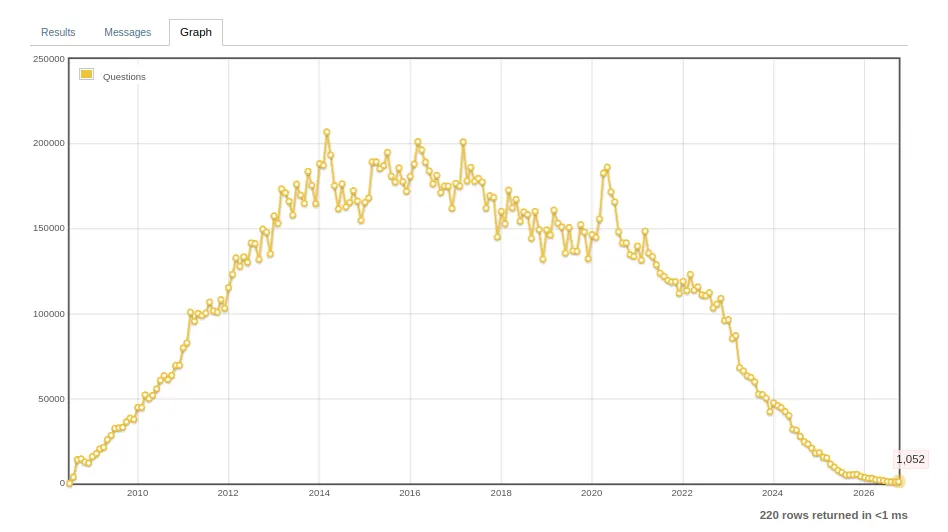
The traffic data tells a harsher story. The platform recorded 1,019 new questions in August, 969 in September and 1,052 in October. At the 2014 peak, users asked about 200,000 questions a month; by the end of 2025 that had fallen to 3,000–4,000, and it is now around 1,000. Most of the decline came in the past couple of years, after ChatGPT, Claude and GitHub Copilot became everyday tools.
Beaudette's summary: Stack Overflow is not standing still and is not going away, but turning from a site people visit for answers into infrastructure that supports developers, companies and AI systems wherever they work.
Apps worth a look
 SUMO: the number puzzle
Tap the right tiles, add them up, hit the target. Easy to learn, hard to master. Free, for all ages.
 Dialo: learn languages by speaking
Talk to an AI conversation partner; every sentence comes back corrected and explained in your language. 9 languages, A1 to C2.
 ediviewer: read EDI files like documents
Open EDIFACT and X12 messages, see every segment explained, convert to JSON/XML, export PDF and Excel. Runs locally, no upload.
More from this day
See all →
OpenAI Cuts Funding Round Target to $20 Billion From $30 Billion
MobiKwik Posts Record Quarterly Profit of Rs 11.8 Crore in Q2 FY27

Provision Labs Acquires Hardware Startup Basilisk Industries
Dispatch Network raises Rs 5 crore pre-seed led by Antler India
More in: AI
See all →
Microsoft AI chief Mustafa Suleyman: AI has no rights or feelings

Anthropic Eyes Up to 3.5 Billion From Japanese Investors in IPO

Vibecoding lets users build the apps developers never made