Polish Crystals Flown Around the Moon on Orion Detect Faint Radiation
Lithium fluoride crystals grown in Kraków flew around the Moon on Artemis I and recorded cosmic radiation traces that standard plastic detectors miss.
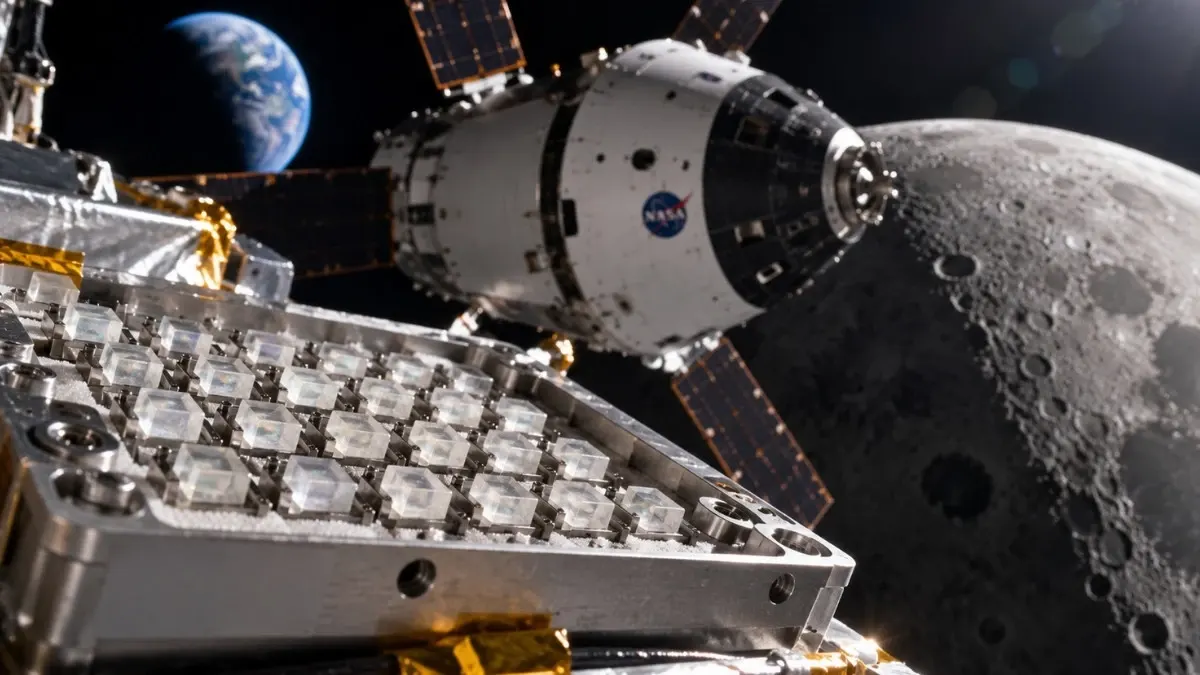
Tiny crystals developed in Kraków have flown around the Moon aboard NASA's Orion spacecraft and returned to Earth carrying records of cosmic radiation. Polish researchers have now published their analysis, showing the devices can register signals that traditional detectors do not.
From Artemis I to the lab
The uncrewed Artemis I mission launched in November 2022, and Orion returned after more than 25 days. One goal was to measure the radiation future astronauts would face. Two phantoms, models of the human body named Helga and Zohar, carried more than 10,000 detectors for the MARE experiment.
The Institute of Nuclear Physics of the Polish Academy of Sciences in Kraków supplied about 600 thermoluminescent detectors and several dozen experimental fluorescent sensors made of lithium fluoride crystals. A team led by Prof. Paweł Bilski, working with Germany's DLR, developed a method to read radiation of varying energies from them. The results appeared in Radiation Measurements.
The crystals are passive and need no power. A charged particle passing through creates colour centres, defects that emit red light when illuminated with blue light in the lab. Under a specialised microscope, individual particle tracks become visible. The crystals, roughly 3 mm by 3 mm and 1 mm thick, were grown using the Czochralski method, and unlike plastic detectors they need no chemical etching.
Greater sensitivity
Compared with plastic detectors placed in the same spots, the crystals gave a similar picture across a wide energy range. But they also captured weaker tracks: plastic detectors typically register particles above about 10 keV per micrometre (linear energy transfer, in water), while the crystals can show tracks at about 4.5 keV per micrometre.
The researchers stress that these faintest signals cannot yet be reliably converted into dose, and calibration methods are still being developed. In some ranges, especially for particles depositing very large amounts of energy, the crystals overestimated results compared with conventional sensors. Particle direction is another challenge, since in space particles arrive from all sides.
What it means for astronauts
MARE measurements show total doses near the Moon are higher than in low Earth orbit, but not as much as might be expected. Dose inside the phantoms was fairly uniform because high-energy galactic radiation passes through the whole body. Long exposure remains a major planning problem for crewed missions, particularly when solar events are added.
More from this day
See all →
Nagoya University Cracks Century-Old Mystery of Mosquito Mating

Google's Orbital TPUs Run Gemma 4 and Write a Space Haiku

Heroes of Might & Magic: Olden Era Gets Its Biggest Balance Patch