GIST Develops Grid Safety Tool for Solar and ESS Output Limits
Researchers at GIST built a framework that calculates how much distributed energy resources can safely adjust, cutting grid limit violations from 6.7% to 0% in tests.
A research team at the Gwangju Institute of Science and Technology (GIST) has developed a technology that guarantees power grid safety when distributed energy resources (DER) such as solar plants and energy storage systems (ESS) change their output. It also calculates, in real time, how much more each device can adjust. The team, led by Professor Kim Yoon-soo of the School of Electrical Engineering and Computer Science, announced the result on the 31st.
The tool acts as a "safety guardrail" for virtual power plants (VPP), which bundle many generators and storage units to run like a single plant, and for power trading. The problem it addresses is that devices can each respect their own capacity limits, yet simultaneous output changes may push grid voltage too high or too low, or overload particular lines. The same amount of power affects the grid differently depending on where a device is connected and the surrounding power flows, so checking per-device capacity alone is not enough.
How the framework works
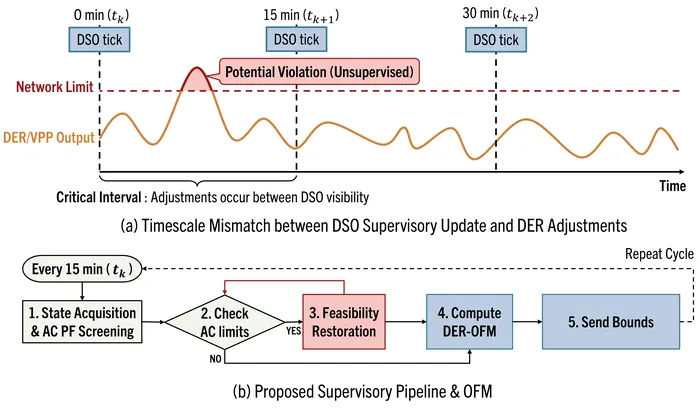
The framework first checks the grid's voltage and power flow. If operating limits are breached, it adjusts some DER output to restore a safe state. It then calculates an "operational flexibility margin" (OFM), computes adjustment amounts for several devices together, and repeatedly verifies that changing them at the same time still respects voltage and line limits. The verified results are passed on to support each device's operating decisions. The grid state is monitored in 15-minute intervals.
In tests, the rate of grid operating-limit violations fell from 6.7% when only individual ESS conditions were considered to 0% with the new technology. Total ESS charge and discharge throughput stayed almost unchanged, because adjustments were allocated to devices in locations with more headroom rather than those straining the grid.
The team also ran additional simulations with distribution line data from Jeju Island and confirmed that the calculation can estimate operating margins for multiple distribution lines within the 15-minute control cycle.
Already in use
According to Kim, the technology is already applied in Korea Electric Power Corporation's distribution system (DSO-MD). He said it should help raise renewable energy acceptance and establish Korea's distribution grid operating framework and regional power markets.
More from this day
See all →
Fallout: New York, an AI-built fan game, pulled after Bethesda request

Reddit CEO Says Google AI Mode Sends No Traffic, Plans Login Wall
Spain's Data Center Rules Could Require 50 GW of Renewables

Google raises TV Streamer 4K price by more than 40 percent
More in: Science
See all →
Polish Researchers Turn Potato Peels Into Solar Cell Material
Invictus: Europe's Mach 5 Hypersonic Aircraft Clears Key Review

Polish Scientists Build Robot for Precise Drug Delivery to the Eye