PhoneBot: UCLA Turns an Old Smartphone Into a Walking Robot
UCLA's RoMeLa lab built PhoneBot, a 48.3 cm biped that uses a smartphone as its brain. The body costs about $400 without the phone.
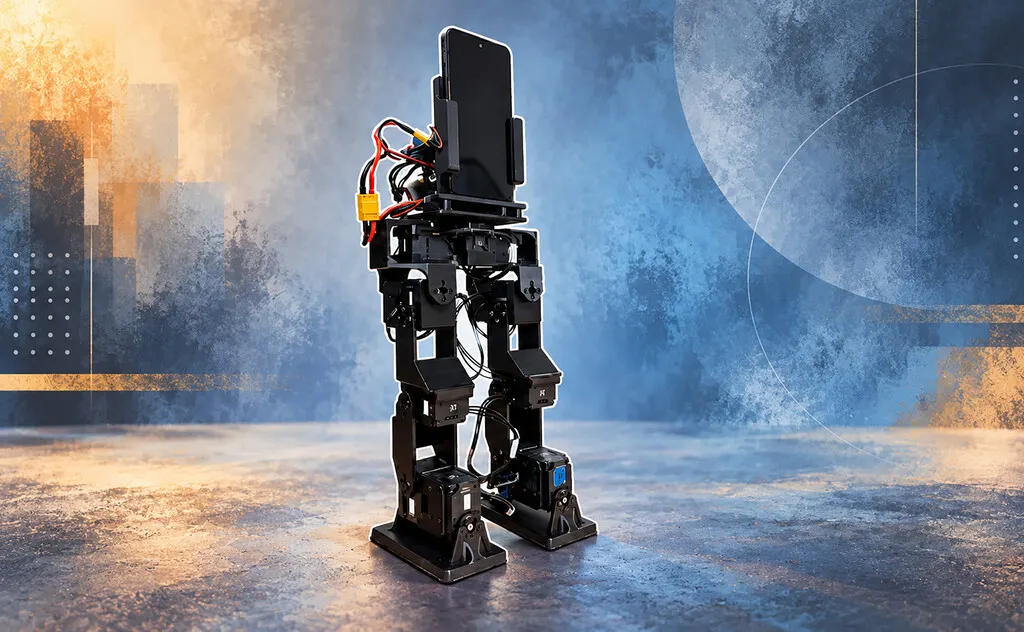
Researchers at the University of California, Los Angeles (UCLA) have built a small walking robot that uses a smartphone as its brain. The machine, called PhoneBot, stands 48.3 centimeters tall and weighs 1.8 kilograms, phone included. The RoMeLa robotics lab described it in a study posted on arXiv on October 6, 2026.
The phone does real work
The smartphone sits in the robot's torso and takes part directly in running its 13 motorized joints. Its sensors track the robot's tilt, its processor computes movement commands, and its camera lets the robot interpret what is in front of it. Commands travel over Wi-Fi to a small electronics board that talks to the motors. A user can also send movement instructions, so balancing and choosing a direction are separate functions.
The team trained the walking controller in simulation using reinforcement learning, which improves behavior through rewards and penalties. They noticed the robot favored one leg, so they added a mechanism that encourages symmetric movement. The controller was then moved to the physical prototype.
According to the researchers' own tests, PhoneBot can walk and get back up after ending up face down. It can also use the phone's camera to detect a person and turn its torso toward them, though that does not show it can follow someone autonomously in any environment. Conversation features exist, but speech recognition and the language model run on an external computer.
Old phones are enough
Among the devices tested was a Honor 9, released in 2017, alongside three newer budget Android phones. The study says the Honor 9 handled the main functions evaluated, except ARCore environment mapping, which was unavailable because the required Google services were missing on that device in the US. The authors do not attribute every physical demonstration to that phone.
The researchers estimate the parts for the body cost about $400, excluding the phone, with much of that going to the 13 motors. They have shared documentation and design files, but under a license that restricts commercial use, so the materials do not meet the usual criteria for open-source hardware.
The idea has precedent: in 2021, Intel Labs presented OpenBot at ICRA, turning a phone into the controller of a wheeled vehicle with a body costing around $50. PhoneBot applies the approach to a two-legged machine, where balance is harder.
For now its abilities are limited. It has no arms, and its gait was trained for flat floors. The team plans to add lightweight arms and test more difficult terrain.
Apps worth a look
 SUMO: the number puzzle
Tap the right tiles, add them up, hit the target. Easy to learn, hard to master. Free, for all ages.
 Dialo: learn languages by speaking
Talk to an AI conversation partner; every sentence comes back corrected and explained in your language. 9 languages, A1 to C2.
 ediviewer: read EDI files like documents
Open EDIFACT and X12 messages, see every segment explained, convert to JSON/XML, export PDF and Excel. Runs locally, no upload.
More from this day
See all →
Google's AI satellite sends first data back from orbit
San Francisco's AI Boom Turns First Dates Into Job Interviews

Meta, TikTok and X Lose High Court Challenge Against Ofcom

Two Point O raises $10 million led by Transition Venture Capital
More in: Hardware
See all →
MacBook Pro Gets a Touchscreen and Dynamic Island for the First Time
The G-Lab Keyz Elite 300 GRW Review: Compact Wireless Keyboard

Yomy Smart Feeder Serves Wet and Dry Food to Cats on Demand