NGC 1850 BH1 is not a black hole, new telescope data shows
For years NGC 1850 BH1 looked like a dormant black hole in a neighbouring galaxy. Sharper spectra from the VLT now show two ordinary stars instead.
 SUMO· the number puzzle
 Dialo· learn languages by speaking
 ediviewer· read EDI files like documents
 giftdetect· the right gift in minutes
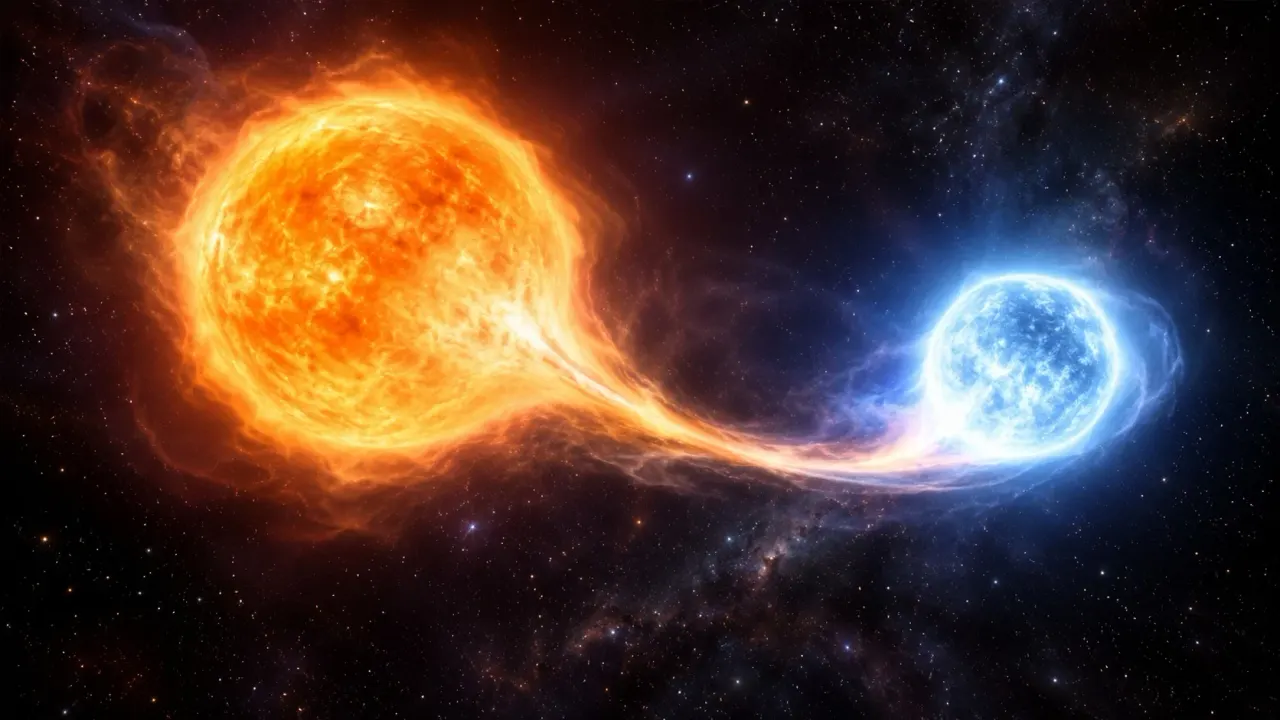
NGC 1850 BH1 was supposed to be a black hole hiding in plain sight. It turns out to be two stars, one of them spinning at a frantic pace after feeding on the other.
The system sits in the star cluster NGC 1850 in the Large Magellanic Cloud, a satellite galaxy of the Milky Way about 160,000 light years away. The cluster is young, around 100 million years old. Astronomers noticed the object in 2021. One visible star seemed to orbit something unseen with a mass of about 11 Suns, while the visible star weighed roughly 5 Suns. The orbit takes about 5 days, and the star's radial velocity, its motion towards or away from us, swung by hundreds of kilometres per second. A quiet black hole fit the picture well.
Not everyone bought it. Later analyses suggested the visible star could be the leftover of a heavier star that had handed much of its material to a companion. In that case the invisible partner might simply be an ordinary star that is hard to see.
How was NGC 1850 BH1 unmasked?
A team led by Rhys Seeburger of Liverpool John Moores University used the FLAMES instrument on the European Southern Observatory's Very Large Telescope. They gathered more precise spectra, including shorter wavelengths, and applied spectral disentangling. When two stars are too close to separate, their light arrives as one blend. Each star leaves its own set of spectral lines, a kind of fingerprint, so many observations across the orbit let researchers pull the two signals apart.
The result: two bright components. One is cooler, puffed up and stripped of much of its envelope. The other is hotter, more massive and spins fast, with a rotation component of about 275 km/s. That fits a star that has gained material and angular momentum from its partner.
The revised masses are about 1.7 Suns for the star losing material and about 5.2 Suns for its companion, though the latter carries an uncertainty of 2.6 Suns. The results were posted on arXiv, where papers appear before formal journal publication.
Why it matters for black hole counts
Models suggest the Milky Way could host around 100,000 dormant black holes in binary systems, yet only a handful are confirmed. According to the authors, BH1 is another binary that can convincingly pass as one, so each misclassified system skews the count of black holes out there.
Apps worth a look
SUMO: the number puzzleTap the right tiles, add them up, hit the target. Easy to learn, hard to master. Free, for all ages.
Dialo: learn languages by speakingTalk to an AI conversation partner; every sentence comes back corrected and explained in your language. 9 languages, A1 to C2.
ediviewer: read EDI files like documentsOpen EDIFACT and X12 messages, see every segment explained, convert to JSON/XML, export PDF and Excel. Runs locally, no upload.
giftdetect: the right gift in minutesPick who it is for, the occasion and their personality. The search engine reads product descriptions from local shops and ranks what fits. Free, no sign-up.
More from this day
See all →



More in: Science
See all →
SS United States sunk off Florida to become a giant reef

Teen's DIY ferrofluid water filter removes 95% of microplastics

Chinese medical drone fires emergency drugs into wounded soldiers