Teen's DIY ferrofluid water filter removes 95% of microplastics
Virginia teenager Mia Heller built a magnetic water filter in her garage. It removed 95.52% of microplastics in her tests, with no replaceable membranes.
 SUMO· the number puzzle
 Dialo· learn languages by speaking
 ediviewer· read EDI files like documents
 giftdetect· the right gift in minutes
Mia Heller, an 18-year-old from Warrenton, Virginia, built a DIY water filter in her family's garage and kitchen. In her tests it pulled 95.52% of microplastics out of water, and it needs no replacement membranes.
The trigger was a local newspaper story. Water tests in Warrenton had shown high levels of PFAS (long-lived industrial chemicals) and microplastics, and the local authorities reportedly would not pay for filtration. Her family bought a high-end purification system instead, but it needed constant upkeep. Heller watched her mother swap filter membranes again and again and figured there had to be a better way.
How does the ferrofluid microplastic filter work?
Heller turned to ferrofluid, a liquid that contains nano-sized magnetic particles such as iron oxide, so it is pulled toward magnets. It is already used in hard drive seals, vibration dampers and speaker cooling. Her idea: let the oil bind to microplastics floating in water, then use a magnetic field to lift them out.
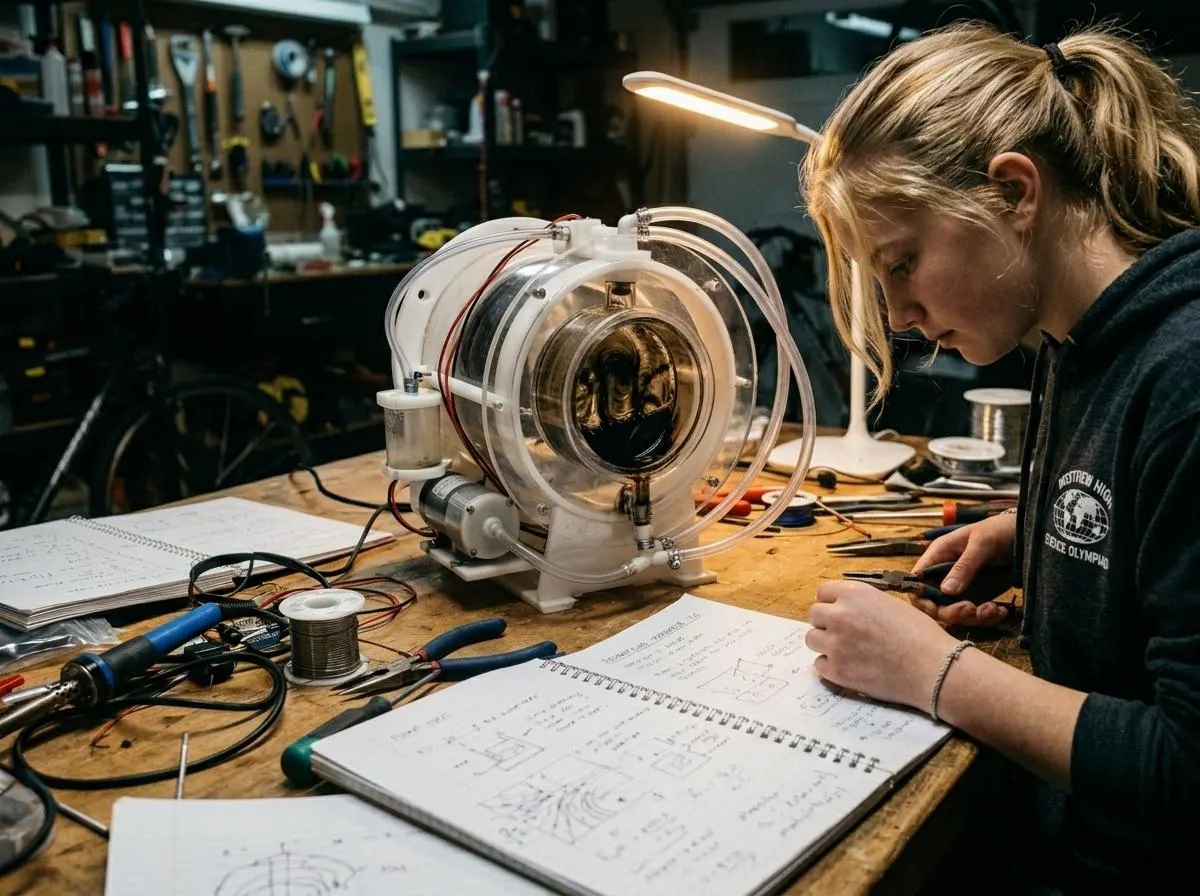
The prototype is about the size of a bag of flour and has three modules: a roughly 1-litre tank for dirty water, a tank for the ferrofluid, and a smaller unit where the separation happens. The ferrofluid is recovered and reused in a closed loop. Think of a Brita jug, filtering about one litre at a time.
To measure results, Heller even built her own turbidity sensor, which gauges how many solids are suspended in a liquid. She calculated removal by weight: 95.52% of microplastics removed, and 87.15% of the ferrofluid reused. Water treatment plants typically remove roughly 70% to a little over 90%, though a plant and a one-litre prototype are very different things.
The project made her a 2025 finalist at the Regeneron International Science and Engineering Fair (ISEF) and won a $500 special award from the Patent and Trademark Office Society.
Is it ready for homes?
Not yet. University of New Mexico toxicologist Matthew J. Campen called it a "really great idea", but wants to know whether the captured microplastics can be disposed of or broken down without leaving other pollution behind. Scaling up is the next question, since ferrofluid is costly to make in bulk. Heller sees it as a home system for now, an under-sink filter, and wants outside experts to verify her results before aiming for the market.
Apps worth a look
SUMO: the number puzzleTap the right tiles, add them up, hit the target. Easy to learn, hard to master. Free, for all ages.
Dialo: learn languages by speakingTalk to an AI conversation partner; every sentence comes back corrected and explained in your language. 9 languages, A1 to C2.
ediviewer: read EDI files like documentsOpen EDIFACT and X12 messages, see every segment explained, convert to JSON/XML, export PDF and Excel. Runs locally, no upload.
giftdetect: the right gift in minutesPick who it is for, the occasion and their personality. The search engine reads product descriptions from local shops and ranks what fits. Free, no sign-up.
More from this day
See all →
SS United States sunk off Florida to become a giant reef

GTA VI Macca & Friends: the in-game cartoon gets a trailer

Half-Life 2: Episode Three weapons run again thanks to a modder