LG Chem Starts Developing MR-MUF Material for HBM Chips
LG Chem has begun developing a bonding material for the MR-MUF process used in HBM production, adding to its NCF work and loosening reliance on Japanese suppliers.
 SUMO· the number puzzle
 Dialo· learn languages by speaking
 ediviewer· read EDI files like documents
 giftdetect· the right gift in minutes
LG Chem has started developing a material for the mass reflow-molded underfill (MR-MUF) process, a key step in making high-bandwidth memory (HBM), according to industry sources on Wednesday. The move comes on top of the company's existing work on non-conductive film (NCF), the material used to bond DRAM dies into HBM stacks.
HBM stacks DRAM vertically to maximize data-processing performance and is regarded as a flagship AI memory. The bonding material fills the tiny gaps between chips and protects the joints, which determines the stability and heat dissipation of the stack. As layer counts rise, gaps between chips narrow and the material becomes much harder to develop.
Two processes, two customer groups
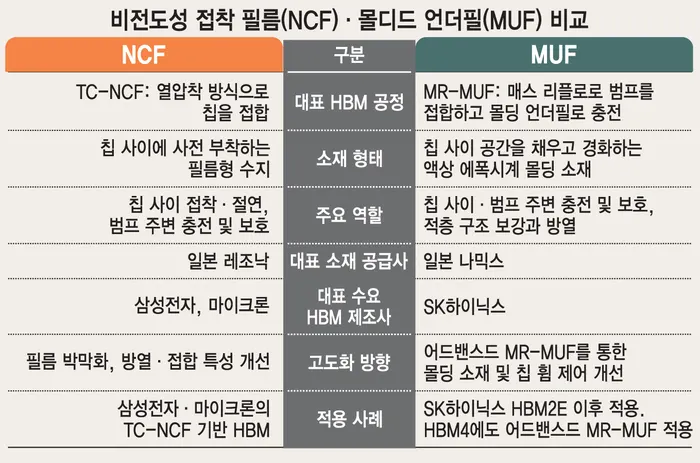
Samsung Electronics and Micron place NCF in film form and bond the chips with heat and pressure. LG Chem has developed its NCF with its own technology and is running evaluations with major customers. It is reportedly making notable technical progress and has received good assessment results.
SK hynix takes a different route. It stacks the chips first, bonds the electrodes in one step, then injects a liquid protective material and cures it. That is the MR-MUF process, and the liquid MUF LG Chem is developing is tailored to it. With NCF aimed at Samsung and Micron and MUF at SK hynix and other potential customers, LG Chem could serve both process types.
Supply chain implications
The NCF Samsung uses comes mainly from Japan's Resonac, while SK hynix's MR-MUF material is supplied by Japan's Namics. If LG Chem succeeds, HBM makers could lower their dependence on Japanese products and diversify supply. LG Chem is expected to go through performance evaluation and reliability verification matched to each customer's process.
"Korean chipmakers lead HBM manufacturing, but most of the key materials supply chain depends on overseas suppliers," an industry official said. Successful mass production of both NCF and MR-MUF materials, the official added, would be a chance to strengthen the domestic supply chain.
Apps worth a look
SUMO: the number puzzleTap the right tiles, add them up, hit the target. Easy to learn, hard to master. Free, for all ages.
Dialo: learn languages by speakingTalk to an AI conversation partner; every sentence comes back corrected and explained in your language. 9 languages, A1 to C2.
ediviewer: read EDI files like documentsOpen EDIFACT and X12 messages, see every segment explained, convert to JSON/XML, export PDF and Excel. Runs locally, no upload.
giftdetect: the right gift in minutesPick who it is for, the occasion and their personality. The search engine reads product descriptions from local shops and ranks what fits. Free, no sign-up.
More from this day
See all →
Paribu Unveils Intelligence AI and Free Terminal at 10-Year Event
Meta Launches Muse Ember, Its Smallest AI Model, for Agents

Oura to Acquire AI Health Startup Counsel Health for $625M

OpenAI launches Businesses beta to let firms claim ChatGPT profiles
More in: Hardware
See all →
AMD Epyc Venice-X Brings Back 3D V-Cache With 5.3 GHz Clocks
Seagate FireCuda Forge Brings Smart Caching, Up to 20TB
Boston Dynamics Swaps Atlas Feet for Wheels, Lands Full-Spin Jump
