Heavy fermions seen at a one-atom-thick layer's edge for the first time
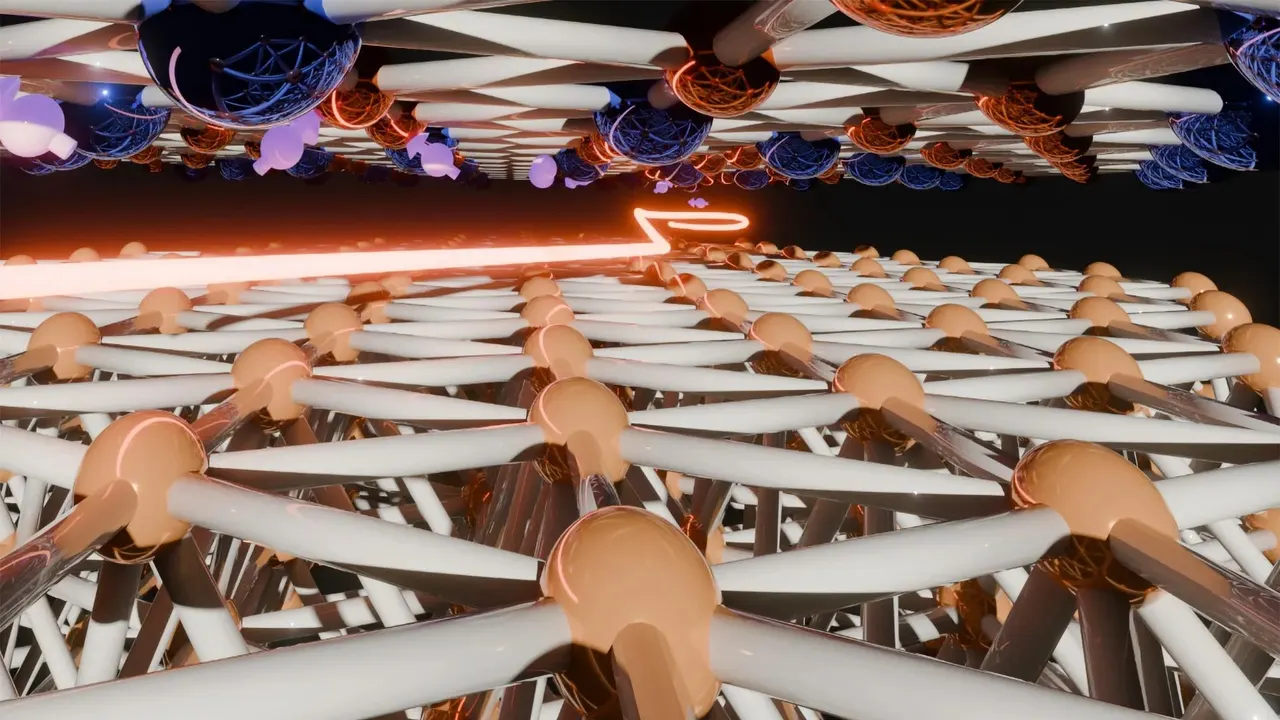
Osaka physicists have directly observed heavy fermions, electrons acting far heavier than they are, where a one-atom layer meets a copper surface.
 SUMO· the number puzzle
 Dialo· learn languages by speaking
 ediviewer· read EDI files like documents
 giftdetect· the right gift in minutes
Electrons that behave as if they were much heavier than they really are: researchers at Osaka University have now caught this happening at the boundary between a material one atom thick and a block of metal. It is the first direct observation of heavy fermions forming at such an interface.
The team built a single atomic layer of a compound of ytterbium and copper and placed it on a single-crystal copper base. They then used intense synchrotron radiation (a very bright X-ray-type light from a particle accelerator) together with angle-resolved photoemission spectroscopy. That technique shows the electronic structure of a material and how its particles interact at the boundary.
The results revealed two separate heavy-fermion states. One was tied mainly to the two-dimensional layer. The second was the surprise, because it reached down into the three-dimensional copper underneath. That is the direct evidence that heavy fermions can form at the border between two materials, something that was hard to confirm experimentally before.
What are heavy fermions?
Heavy fermions are a state of matter in which electrons act as though their effective mass is many times that of ordinary electrons. Their real mass does not change. The effect comes from strong quantum interactions between electrons. Here, electrons in ytterbium orbitals, confined to the thin layer, interacted with freer conduction electrons in the copper. This process is called hybridization: electronic states influence each other and give the whole system new properties.
Why does it matter?
The main hope is research into unconventional superconductivity, where a material carries current with no electrical resistance by a mechanism that differs from the classical one. Until now, heavy-fermion studies focused mostly on bulk materials. The new results suggest similar states can be created and controlled by combining ultrathin atomic layers with other substances.
The next goal is to learn how to control and engineer such electronic states. The team wants to test how changes to the interface structure, the properties of electron orbitals and moiré patterns (interference patterns between stacked atomic layers) affect the appearance of quantum phenomena.
Apps worth a look
SUMO: the number puzzleTap the right tiles, add them up, hit the target. Easy to learn, hard to master. Free, for all ages.
Dialo: learn languages by speakingTalk to an AI conversation partner; every sentence comes back corrected and explained in your language. 9 languages, A1 to C2.
ediviewer: read EDI files like documentsOpen EDIFACT and X12 messages, see every segment explained, convert to JSON/XML, export PDF and Excel. Runs locally, no upload.
giftdetect: the right gift in minutesPick who it is for, the occasion and their personality. The search engine reads product descriptions from local shops and ranks what fits. Free, no sign-up.
More from this day
See all →



More in: Science
See all →
Vitamin C after ham or sausage: what a new model suggests

Endurance Energy tests seafloor geothermal power at a volcano

Neanderthal DNA variant shrinks part of the brain and lowers schizophrenia risk