Fake Samsung Browser Update on Hacked Sites Spreads Android Malware
Security firm Everspin found legitimate company websites injected with scripts that push a fake Samsung browser plugin and trick Android users into installing malware.
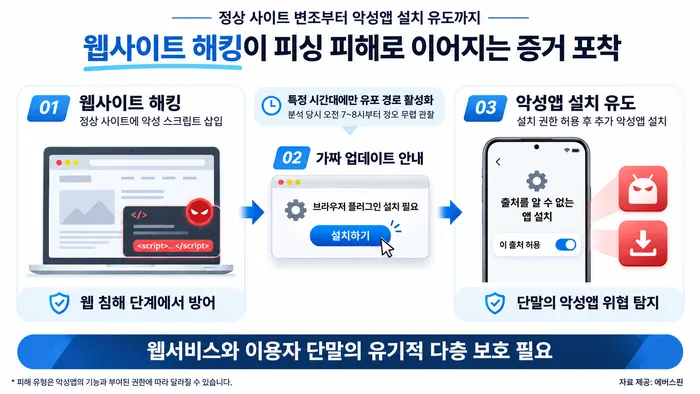
Security firm Everspin said on Wednesday it has identified attacks in which legitimate websites display a fake browser update notice to push visitors into installing a malicious Android app. The company found externally hosted scripts injected into sites across several sectors, including fishing, audio equipment and hospitals.
How the attack works
Visitors to a compromised site see a pop-up claiming a Samsung browser plugin must be installed. Tapping the install button downloads an app file. Running it triggers a second prompt saying a further update is needed, which leads to a second app installation.
Android requires explicit user consent to install apps from outside the official app store. According to Everspin, the attack steers users into granting the "install unknown apps" permission. The final malicious app does not appear in the normal app list. It shows up in device settings under the name "Samsung".
Active only at certain hours
Everspin also saw signs that the attackers switched the distribution path on only at certain times. The install prompt and download function worked from roughly 7 to 8 a.m. until around noon, while other hours produced errors. Because the behavior changes with the time of day, a security check may miss the malicious activity depending on when it runs.
Why it matters
Everspin argues the case exposes the limits of handling web hacking and mobile phishing as separate problems. When a company's website becomes a delivery channel for malicious apps, its visitors become targets as well. The firm pointed to its web security product Eversafe Web and its malicious app detection tool FakeFinder as part of an integrated approach covering both web services and mobile devices.
Everspin CEO Ha Young-bin said hacking and phishing are linked in this chain: a site is breached to create a distribution channel, then users are deceived into installing the app. He added that in an environment where AI helps attackers analyze, build and modify attacks, securing only the web or only mobile cannot cover the whole attack path.
Apps worth a look
 SUMO: the number puzzle
Tap the right tiles, add them up, hit the target. Easy to learn, hard to master. Free, for all ages.
 Dialo: learn languages by speaking
Talk to an AI conversation partner; every sentence comes back corrected and explained in your language. 9 languages, A1 to C2.
 ediviewer: read EDI files like documents
Open EDIFACT and X12 messages, see every segment explained, convert to JSON/XML, export PDF and Excel. Runs locally, no upload.
More from this day
See all →
VOLTA malware steals passwords and asks AI what victims are worth

Samsung One UI 9 Update Breaks Android Auto for Galaxy Users

Free Starlink for Polish villagers as developer wins local goodwill