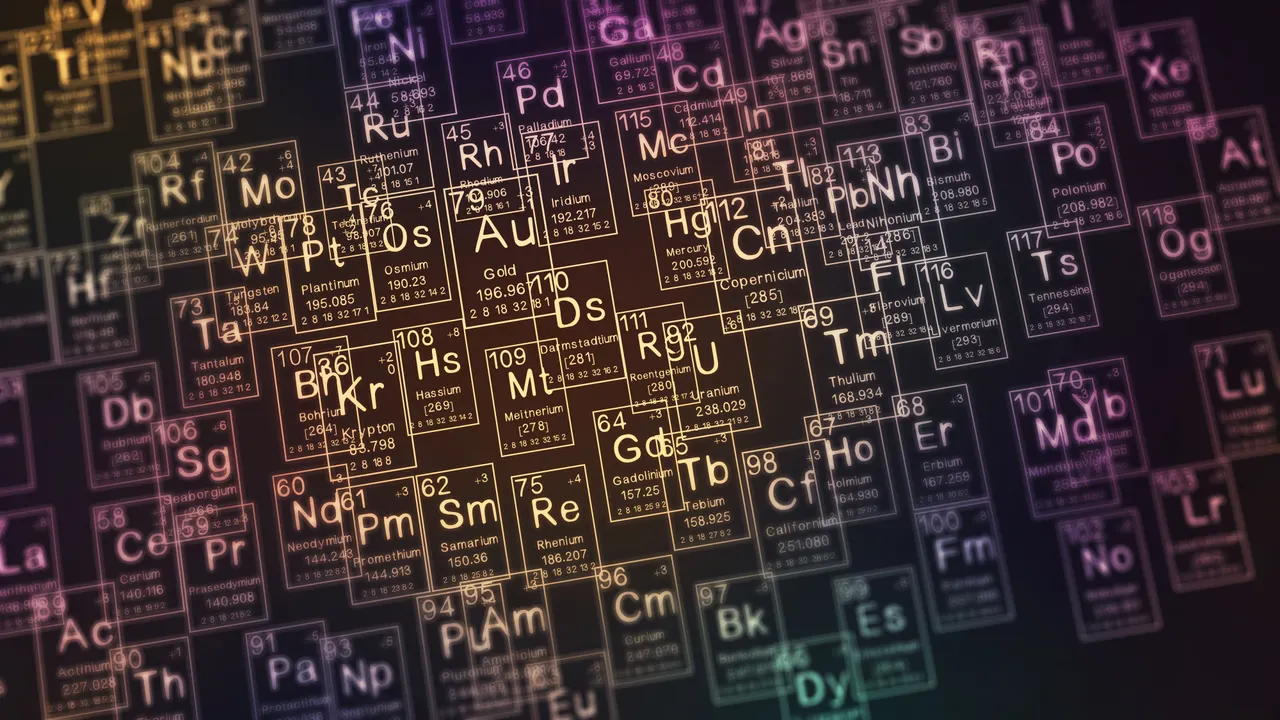
Dark matter periodic table: physicists imagine dark atoms
Five physicists ask whether dark matter could build its own atoms. In their model, dark hydrogen would not survive, but heavier dark elements up to carbon could.
 SUMO· the number puzzle
 Dialo· learn languages by speaking
 ediviewer· read EDI files like documents
 giftdetect· the right gift in minutes
Dark matter makes up about 85 percent of all matter in the universe, and we still don't know what it is. Now a team of physicists is asking a stranger question: could it have its own periodic table?
That is the idea in a new preprint from five researchers. They explore a scenario in which dark matter particles combine into dark nuclei and atoms, following rules of their own.
What is a dark matter periodic table?
Scientists infer dark matter from its gravitational pull on galaxies and other cosmic structures. It does not otherwise interact with ordinary matter, which makes it very hard to study. For decades the open question has been whether it is one type of particle or several, each with different properties.
If there are several, they might also bind together, the way the particles we know form atoms and molecules. The dark universe would then be far more complex than assumed. And if that complexity exists, you would need a way to organize it. The periodic table did exactly that for ordinary elements, and it even helped predict elements nobody had found yet.
The mirror sector behind it
The work rests on the "Mirror Twin Higgs", proposed two decades ago to explain why the Higgs boson's mass is not far larger than observed. In that theory, a hypothetical "mirror sector" of particles would offset certain quantum effects. Those particles would barely interact with visible matter, but they would have their own forces and could interact with each other.
Zackaria Chacko, one of the theory's creators, is part of the new study. The team's calculations suggest that, under certain conditions, these particles could form dark versions of some known elements, from the simplest up to something as complex as carbon.
But it would not be a copy of our chemistry. The dark particles would have different masses and properties, which changes how they bond, what structures they form and which ones are stable. In the model, dark hydrogen atoms would be unstable and could not survive as they do in our universe. That is a striking result, since hydrogen is the simplest and most abundant element we know.
Is any of this real?
Not yet. It all remains theoretical physics. Nobody has observed these atoms, and some researchers doubt such structures could form at all. If dark elements were ever found, though, knowing the rules behind them would be the key to sorting them.
Apps worth a look
SUMO: the number puzzleTap the right tiles, add them up, hit the target. Easy to learn, hard to master. Free, for all ages.
Dialo: learn languages by speakingTalk to an AI conversation partner; every sentence comes back corrected and explained in your language. 9 languages, A1 to C2.
ediviewer: read EDI files like documentsOpen EDIFACT and X12 messages, see every segment explained, convert to JSON/XML, export PDF and Excel. Runs locally, no upload.
giftdetect: the right gift in minutesPick who it is for, the occasion and their personality. The search engine reads product descriptions from local shops and ranks what fits. Free, no sign-up.
More from this day
See all →
NVIDIA GB300 rack found at Chinese data center tied to Alice Huang

Flipkart CEO Exit: Walmart's Chris Nicholas to Meet Staff Monday

Apple Intelligence: South Korea targets Apple over iPhone 16 ads

Anthropic denies training Claude to sabotage user work
More in: Science
See all →
Baltic Sea cyanobacteria blooms may affect cloud formation

Fiber optic cable earthquake sensor maps New Zealand's Alpine Fault

Wind turbine blade recycling: flash heating turns waste into graphene