Curiosity rover finds hints of liquid water films on Mars
Thirteen years of carbon dioxide readings from NASA's Curiosity rover point to microscopically thin films of liquid water in Gale Crater during Mars's warm seasons.
 SUMO· the number puzzle
 Dialo· learn languages by speaking
 ediviewer· read EDI files like documents
 giftdetect· the right gift in minutes
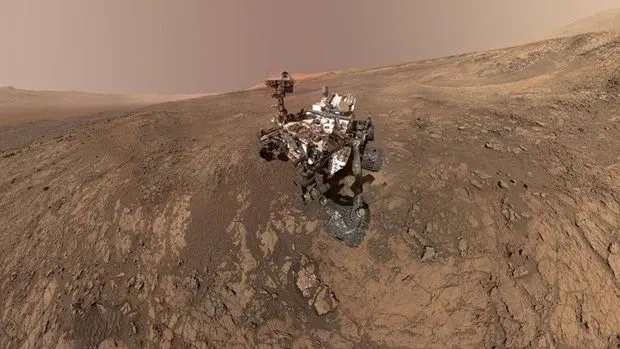
NASA's Curiosity rover may have found signs of liquid water on Mars, though not puddles or streams. The evidence points to films so thin they could be just a few water molecules thick, clinging to the surface or to soil grains in Gale Crater.
The finding comes from a study published in PNAS. Researchers went through carbon dioxide data that Curiosity gathered from the Martian atmosphere between 2012 and 2025. According to the team, it is the first long-term record of the isotopic makeup of carbon dioxide in that atmosphere. (Isotopes are versions of an element with slightly different weights, and their ratios can act as a fingerprint.)
What did Curiosity actually measure?
Using its onboard SAM instrument, which analyses the chemistry of the atmosphere, Curiosity has tracked carbon and oxygen isotope ratios for more than a decade. The team looked at how those ratios shift with the seasons and between day and night.
Day and night showed no meaningful difference. Spring and summer did: the share of oxygen-18 went up.
The researchers tested several computer models to explain that rise. Only one reproduced what Curiosity saw. In it, carbon dioxide in the air swaps oxygen isotopes with an extremely thin layer of liquid water. Lead author Heather Franz, an isotope geochemist at NASA's Goddard Space Flight Center, said oxygen exchange between carbon dioxide and water was the only factor in the models that could explain the oxygen-18 enrichment seen in Gale Crater's atmosphere.
Is there liquid water on Mars?
This is indirect evidence, not a direct sighting. Water on Mars is mostly known as ice. The new work suggests that in the warmest seasons, some of it may exist as liquid films rather than ice crystals. Such a film might be only a few molecules thick, but the team says isotope exchange can happen even between individual water molecules.
Franz said nobody expected this result when the measurements began early in the mission. "We're following the water again," she said.
The team hopes future Mars missions can collect similar data at other sites, to see how widespread the exchange is across the planet. Franz added that this could also help reveal what is in groundwater elsewhere on Mars.
Apps worth a look
SUMO: the number puzzleTap the right tiles, add them up, hit the target. Easy to learn, hard to master. Free, for all ages.
Dialo: learn languages by speakingTalk to an AI conversation partner; every sentence comes back corrected and explained in your language. 9 languages, A1 to C2.
ediviewer: read EDI files like documentsOpen EDIFACT and X12 messages, see every segment explained, convert to JSON/XML, export PDF and Excel. Runs locally, no upload.
giftdetect: the right gift in minutesPick who it is for, the occasion and their personality. The search engine reads product descriptions from local shops and ranks what fits. Free, no sign-up.
More from this day
See all →
South Korea's CSAT cheating crackdown: phone logs and AI records

Smart glasses privacy: Korea warns on hidden cameras in changing rooms

NUREMBERG AI trailer hits 130,000 likes on X: what is it?

Rakuten Securities breach: up to 11.25 million accounts' IDs exposed
More in: Space
See all →
2026 QQ8: Earth has a temporary mini-moon until January 2027
Polish Bursztyn 2K rocket hits Mach 2 to test comms gear
Voyager 1 reaches one light-day from Earth on 18 November