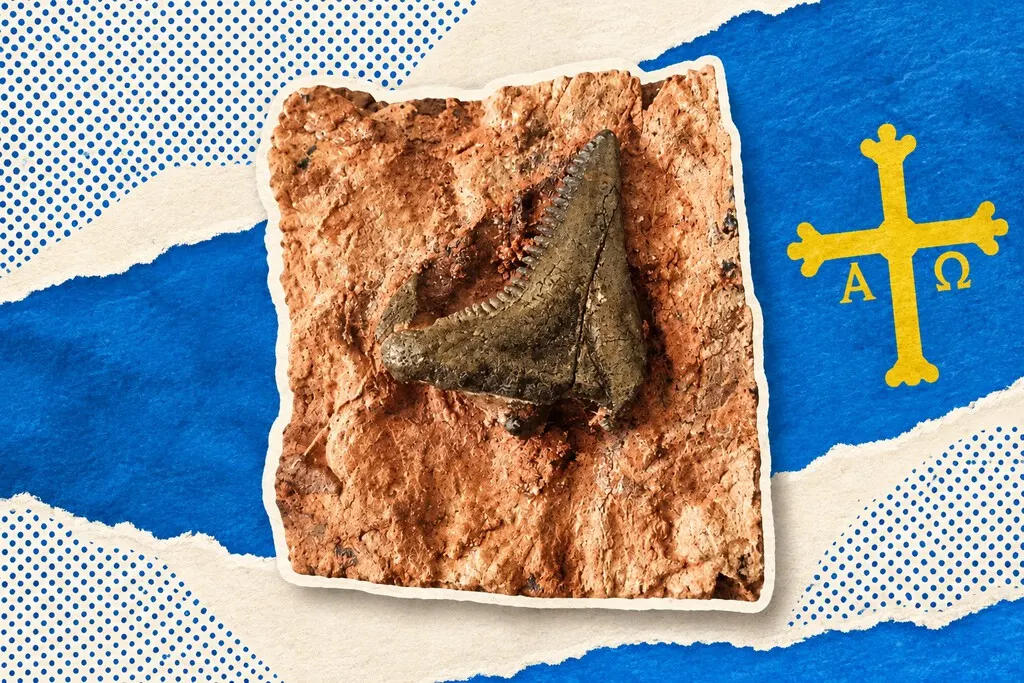
Covadonga shark tooth: a 331-million-year-old giant found in Asturias
Geologists looked down instead of up at Covadonga and spotted a 43 mm fossil tooth in red limestone, from a shark that may have reached 5 to 6 metres.
 SUMO· the number puzzle
 Dialo· learn languages by speaking
 ediviewer· read EDI files like documents
 giftdetect· the right gift in minutes
Visitors to Covadonga are told to look up, at the neo-Gothic basilica and the ceiling of the Holy Cave. This time the discovery came from looking down: geologists found a fossil shark tooth set in a slab of red limestone next to the Sanctuary. The animal swam here 331 million years ago, long before dinosaurs existed, and may have been 5 to 6 metres long.
What was found in Covadonga
Researchers from the University of Oviedo, the University of Valencia and UNED described the tooth in the Journal of Palaeogeography. It arrived broken, so they reassembled it with computed microtomography, basically a laboratory CT scan that does not damage the fossil. That let them see the network of vascular canals in the dentine and the shape of the crown in 3D.
The tooth is 43 millimetres tall, the greatest height recorded for its genus, Carcharopsis (the exact species is still undecided). The cusp is wide and curved, with doubly serrated edges. The tiny enamel serrations match those of today's tiger shark, built to cut through flesh and even shells. The authors describe a hypercarnivorous diet.
How big was the shark?
Using proportion models based on the great white and the tiger shark, the team estimates 5 to 6 metres. A large tiger shark measures 3.8 to 4.5 metres, and almost none exceed 5. There is a catch: the figure comes from analogy with living sharks, not from a skeleton. Cartilage rarely fossilises, which is why most shark fossils are teeth.
Why it matters
Most Carcharopsis fossils come from southern Laurussia, now North America and part of Europe. This is the first from northern Gondwana, which the team takes as evidence that the shark moved between coastal waters and open sea. The area was then the shore of a warm tropical sea. The tooth sat at the base of a carbonate pile, in reddish nodular griotte limestone. A 2003 study argues the same stone was used to build the basilica, and quarries in Amieva and Llanes sold it as “Rojo Covadonga” in 2000.
The date falls in the Mississippian, after the Hangenberg event ended the Devonian. Jawed vertebrates lost 32% of their genera, according to a 2010 study, and armoured placoderms such as Dunkleosteus vanished. Sharks, ray-finned fishes and tetrapods then diversified. A 5 to 6 metre predator at the top suggests, per the authors, that the food chain had already been rebuilt.
Carcharopsis reigned for millions of years. Its decline coincided with the mid-Carboniferous crisis, which brought new shark lineages with scissor-shaped teeth. That crisis came with ice, and the Covadonga tooth predates it.
Apps worth a look
SUMO: the number puzzleTap the right tiles, add them up, hit the target. Easy to learn, hard to master. Free, for all ages.
Dialo: learn languages by speakingTalk to an AI conversation partner; every sentence comes back corrected and explained in your language. 9 languages, A1 to C2.
ediviewer: read EDI files like documentsOpen EDIFACT and X12 messages, see every segment explained, convert to JSON/XML, export PDF and Excel. Runs locally, no upload.
giftdetect: the right gift in minutesPick who it is for, the occasion and their personality. The search engine reads product descriptions from local shops and ranks what fits. Free, no sign-up.
More from this day
See all →
Uber data breach: drivers' license data stolen via Fireworks AI

FAA ground stop: all US flights halted after equipment outage

Pedro Sánchez on his hacked iPhone: "It's a UFO" on Jordi Wild's podcast

Space USB: Europe's universal connector to repair satellites
More in: Science
See all →
Nāpōwawāʻenakaulua: two giant quasars that formed too early
Linky smart meter ruling and Starship flight 15 explained

1960 doomsday study set the end of the world for 13 November 2026