Kuiper Belt water: 12 dust grains point to a hidden ice reservoir
NASA scientists studied 12 specks of dust caught in Earth's stratosphere and found signs of a distinct kind of water that may come from the Kuiper Belt.
 SUMO· the number puzzle
 Dialo· learn languages by speaking
 ediviewer· read EDI files like documents
 giftdetect· the right gift in minutes
Nobody has flown a probe to the Kuiper Belt to scoop up a sample. So a team led by NASA scientist Lindsay P. Keller did something simpler: they studied 12 tiny grains of space dust that had already come to us.
The grains were collected in Earth's stratosphere by NASA aircraft. According to the study in Science Advances, they point to a separate reservoir of water in the outer Solar System, with an oxygen makeup unlike the water found closer to the Sun.
What is the Kuiper Belt?
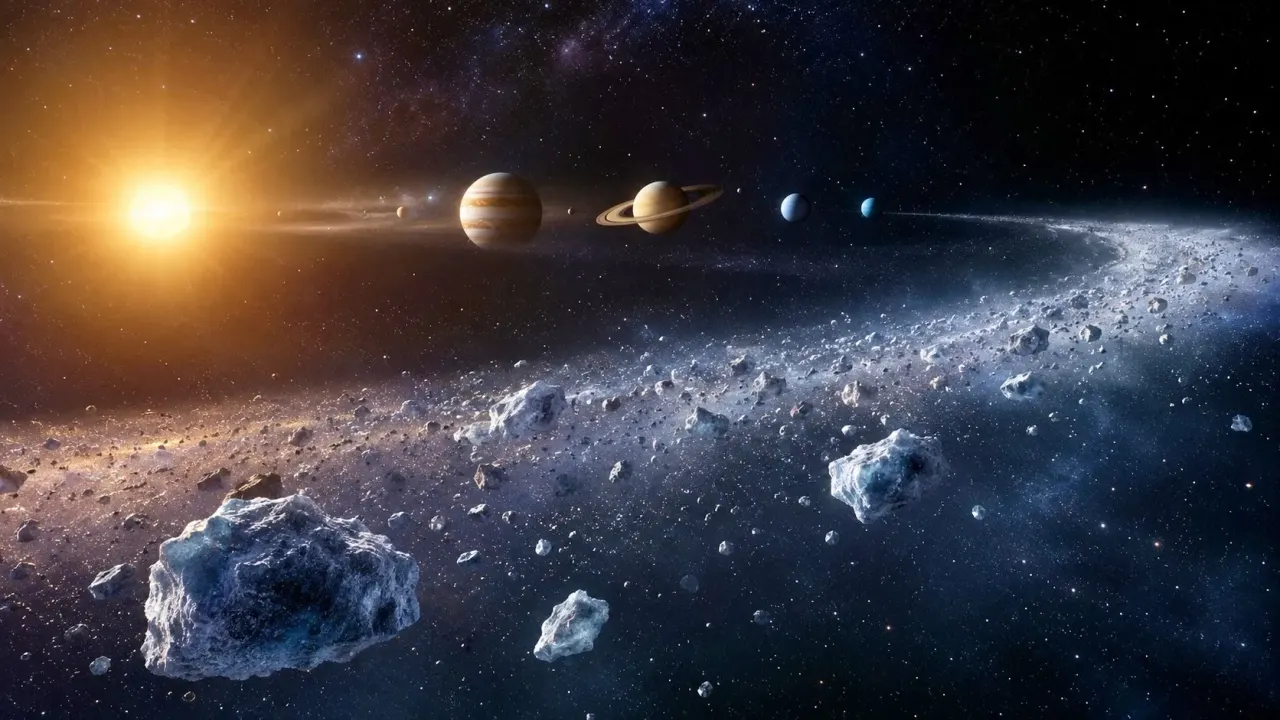
The Kuiper Belt lies beyond Neptune, more than 30 astronomical units from the Sun. One astronomical unit is the Earth-Sun distance, about 150 million km. Unlike the asteroid belt between Mars and Jupiter, it is mostly water ice, frozen methane and ammonia mixed with rock and dust. Pluto lives there too. Because the material has stayed so far from the Sun, it was never heated and reworked as much as material nearby, so astronomers treat it as a deep freezer from more than 4.5 billion years ago.
How the dust gave away its origin
The team used electron microscopy, chemical analysis and precise measurements of oxygen isotopes. Isotopes are versions of an element with the same number of protons but different numbers of neutrons. Oxygen-16 is the common one, while oxygen-17 and oxygen-18 are heavier.
To guess where the grains came from, the researchers looked at tracks left by high-energy particles from the Sun. Earlier work suggested that a dense scattering of these marks hints at an origin in the Kuiper Belt, since material out there is exposed for a very long time. The 12 grains showed many such marks.
Their oxygen was also clearly different from known meteorites. The original water no longer exists in the grains, so the researchers worked backwards from the minerals to reconstruct the liquid that formed them. Their results suggest that water had an oxygen-18 to oxygen-16 ratio up to about 15 percent higher than Earth's ocean water.
Similar traces had turned up before in one primitive meteorite and in material linked to comet 67P/Churyumov-Gerasimenko, but it was unclear whether they were typical of the outer Solar System. These 12 grains make that case more convincing.
Apps worth a look
SUMO: the number puzzleTap the right tiles, add them up, hit the target. Easy to learn, hard to master. Free, for all ages.
Dialo: learn languages by speakingTalk to an AI conversation partner; every sentence comes back corrected and explained in your language. 9 languages, A1 to C2.
ediviewer: read EDI files like documentsOpen EDIFACT and X12 messages, see every segment explained, convert to JSON/XML, export PDF and Excel. Runs locally, no upload.
giftdetect: the right gift in minutesPick who it is for, the occasion and their personality. The search engine reads product descriptions from local shops and ranks what fits. Free, no sign-up.
More from this day
See all →
Qalu, an AI app that reads Arabic dialects and spots PR crises

60 driverless electric trucks now run a Tibet copper mine at 5,400 m
Xbox's new boss signals AI will change how games are made

Apple's new smart home hub can show household members' messages
More in: Science
See all →
NTT data center heat will raise shrimp, and maybe dinner

Data center waste heat will warm a shrimp farm in Tokyo project

Quantum memory made of vibrations: ETH Zurich's tiny resonators