Invisible object in the mass gap: neither neutron star nor black hole
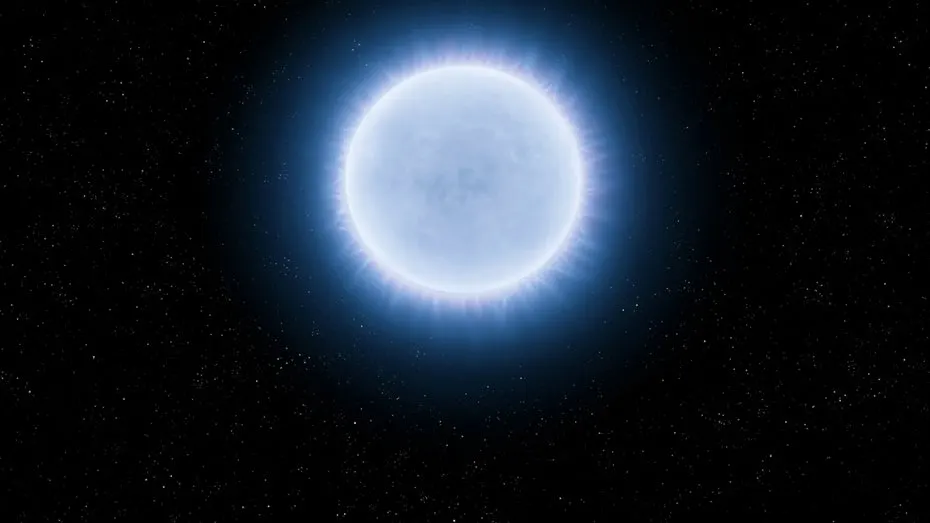
Astronomers found a red giant orbiting something they can't see. It weighs about 2.2 Suns, too heavy for a neutron star and too light for a black hole.
 SUMO· the number puzzle
 Dialo· learn languages by speaking
 ediviewer· read EDI files like documents
 giftdetect· the right gift in minutes
A red giant in the constellation Pisces is circling something nobody can see, and that something shouldn't really exist. Researchers report an invisible object that is too heavy to be an ordinary neutron star and too light to be a typical black hole.
Binary systems are nothing unusual. Roughly 50 to 70 percent of the stars in the Milky Way belong to a double or multiple system. What makes this one odd is the companion. It is small, unusually massive, and invisible. The team only knows it is there because its gravity tugs on the red giant's orbit.
What is the invisible object?
The authors, writing in the journal Science Advances, first suspected a neutron star. These are extremely dense remnants left when a massive star explodes as a supernova. Their light is usually too faint for standard instruments, and they typically weigh about 1.4 Suns.
This one doesn't fit. The researchers estimate its mass at between 1.8 and 2.8 solar masses, with 2.2 as the most likely value. Light black holes start at around three solar masses. So the object lands in what the study calls the mass gap between neutron stars and black holes.
That leaves two options: an exceptionally heavy neutron star or an extremely light black hole. According to the study, a very massive neutron star is the more likely answer. Such objects are rare, because they sit right at the limit where a star would normally collapse into a black hole.
How did it form?
The team doesn't know yet. Heavy neutron stars can grow in binaries by pulling matter off a partner star. Here, though, the red giant and its companion are too far apart for matter to pass between them.
One idea is that the system began with three stars. Two neutron stars, or a neutron star and an ordinary star, could have merged into a single heavy object. The researchers also don't rule out that supermassive neutron stars can come from perfectly normal supernovae. Either way, our knowledge of extremely massive objects clearly has gaps.
Apps worth a look
SUMO: the number puzzleTap the right tiles, add them up, hit the target. Easy to learn, hard to master. Free, for all ages.
Dialo: learn languages by speakingTalk to an AI conversation partner; every sentence comes back corrected and explained in your language. 9 languages, A1 to C2.
ediviewer: read EDI files like documentsOpen EDIFACT and X12 messages, see every segment explained, convert to JSON/XML, export PDF and Excel. Runs locally, no upload.
giftdetect: the right gift in minutesPick who it is for, the occasion and their personality. The search engine reads product descriptions from local shops and ranks what fits. Free, no sign-up.
More from this day
See all →
Microsoft 365 outage hits Teams, Exchange Online and Copilot

Trump suggests Tim Cook should run Nvidia after Jensen Huang quits

GTA 6 PC version: Take-Two CEO warns about AI-made unofficial ports

WhatsApp view once text messages: they vanish after reading
More in: Science
See all →
TOI-2535 b: the exoplanet that vanished from TESS, and why
Supersolid at room temperature: Polish team sees new quantum phase

Doomsday 2026: the 1960 Science paper that predicted today