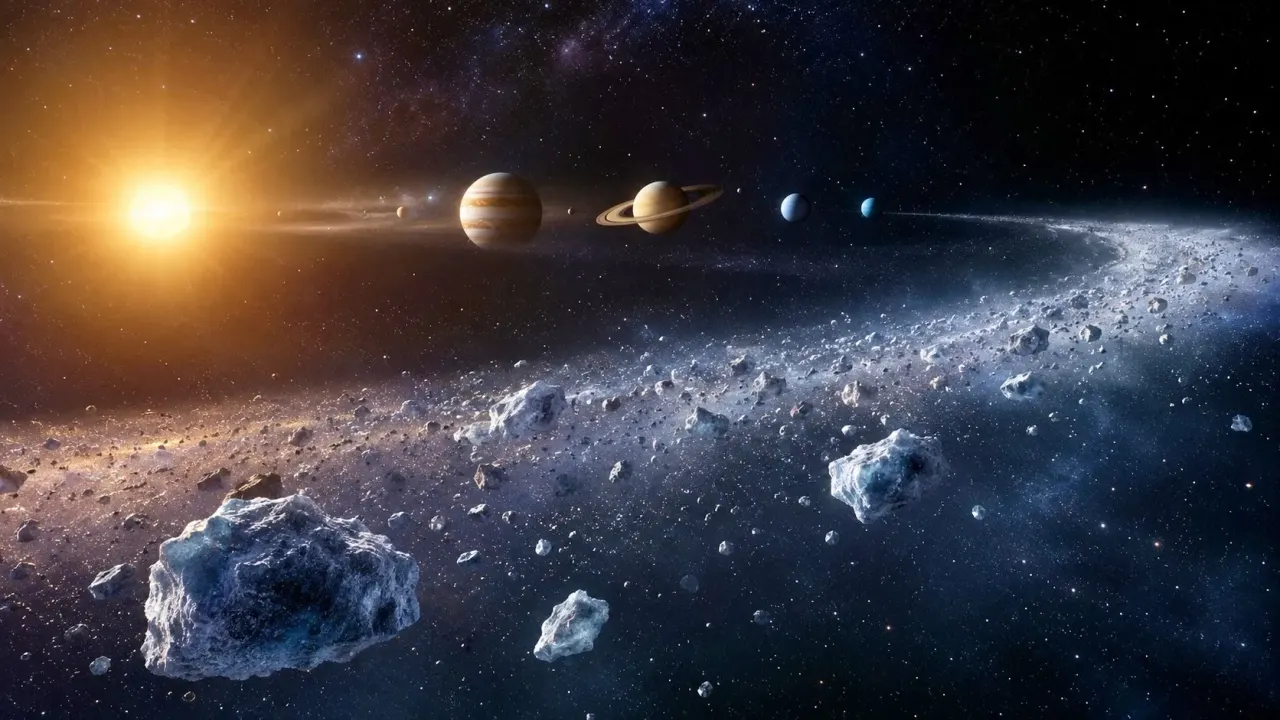
Nāpōwawāʻenakaulua: two giant quasars that formed too early
Two supermassive black holes, only 18,100 light-years apart, were already huge 900 million years after the Big Bang. Astronomers can't yet explain how.
 SUMO· the number puzzle
 Dialo· learn languages by speaking
 ediviewer· read EDI files like documents
 giftdetect· the right gift in minutes
Nāpōwawāʻenakaulua is a mouthful, but the object behind the name is worth the effort: a pair of quasars so far away that we see them as they were just 900 million years after the Big Bang. It is the most compact quasar pair ever found this far back in time, and nobody is sure how it got there.
Quasars are supermassive black holes that are feeding on matter so fast that they shine brighter than anything else in the cosmos. The pair, also called J1602+4228AB, is described in a study published on 10 November 2026 in The Astrophysical Journal Letters. The two black holes sit 18,100 light-years apart, about a fifth of the width of the Milky Way. One weighs 1.5 billion times the mass of the Sun, the other 400 million.
How was Nāpōwawāʻenakaulua found?
The pair first showed up in data from Aether, a James Webb Space Telescope programme led by Emanuele Paolo Farina of NOIRLab. Aether looked at 200 quasars, 43% of those known from that era. The team spotted a companion next to the quasar J1602+4228A. Then the infrared spectrograph on the Gemini North telescope in Hawaii separated the two objects cleanly. The companion, J1602+4228B, is faint, and from the ground this should have been close to impossible. Unusually clear skies above Maunakea let the team collect the data in just two nights.
The name comes from the A Hua He Inoa programme of the ʻImiloa Astronomy Center and the University of Hawaiʻi's Hawaiian language college. It translates roughly as two celestial bodies of powerful, unfathomable darkness, in the glow of heat, reincarnating energy in the universe.
Why are astronomers puzzled?
For comparison, Sagittarius A*, the black hole at the centre of our galaxy, weighs about 4 million solar masses. The bigger of the two is over 300 times heavier. Black holes of this size today have had billions of years to swallow matter and merge. These had under a billion.
Silvia Onorato, the NOIRLab postdoctoral researcher who led the study, said there is no definitive theoretical explanation for even one such giant quasar this early, let alone two. The team suspects a region where matter was unusually concentrated, with galaxy interactions feeding star formation and black hole growth at once. Data from that era is still thin, so solid models are hard to build.
Apps worth a look
SUMO: the number puzzleTap the right tiles, add them up, hit the target. Easy to learn, hard to master. Free, for all ages.
Dialo: learn languages by speakingTalk to an AI conversation partner; every sentence comes back corrected and explained in your language. 9 languages, A1 to C2.
ediviewer: read EDI files like documentsOpen EDIFACT and X12 messages, see every segment explained, convert to JSON/XML, export PDF and Excel. Runs locally, no upload.
giftdetect: the right gift in minutesPick who it is for, the occasion and their personality. The search engine reads product descriptions from local shops and ranks what fits. Free, no sign-up.