CHIME Measures Cosmic Hydrogen Without Galaxy Maps, Aiding Dark Energy Study
Scientists improved CHIME's software to detect neutral hydrogen directly, with no galaxy catalogues. The method could help reveal how dark energy evolves over time.
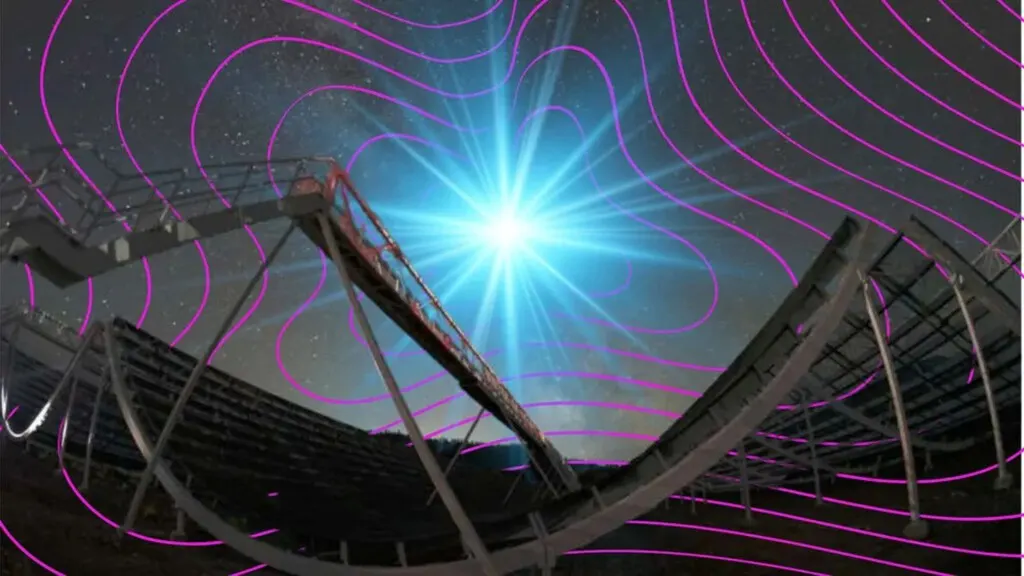
An international team of scientists has shown that the Canadian Hydrogen Intensity Mapping Experiment (CHIME) can measure neutral hydrogen emission from the universe directly, without comparing its data against galaxy maps. The result, described in two recently published studies, is a key step toward understanding dark energy, the mysterious force believed to be accelerating cosmic expansion.
Why the old approach was costly
CHIME records the combined hydrogen signal from different directions and distances. A strong signal suggests many galaxies, a weak one suggests few. But the instrument also picks up interference from Earth and background noise from the Milky Way. To confirm it was really tracing galaxies, researchers had to cross-check against maps made by other telescopes, which was expensive. The authors changed the software so hydrogen can be measured without that step.
Why hydrogen matters
About 380,000 years after the Big Bang, pressure waves travelling through the hot, dense early gas became "frozen" in place as matter cooled. They left an imprint roughly 500 million light-years across, where matter is more likely to be clustered. Tracking how the apparent size of that imprint changes with distance shows how the universe has expanded and what energy drives it. Because clustered matter contains a lot of hydrogen, measuring that element is the ideal way to follow it.
What comes next
The team analysed 94 nights of CHIME observations from 2019 and found results consistent with the standard cosmological model, which suggests the method works. That is not enough to study how dark energy changes over time. The researchers now plan to apply the technique to the seven years of data available from CHIME.
The goal is to discriminate between three scenarios: eternal expansion, a big rip, in which ever-stronger dark energy would tear apart clusters, galaxies, stars, planets and finally atoms, or a big crunch, in which dark energy weakens and the universe collapses. For now it is impossible to say which is correct, but the new method gives astronomers a cheaper way to find out.
More from this day
See all →
Pilot-wave theory survives a new test on quantum tunneling
France's Gigabyte Tax Passes Assembly by One Vote, Targets Streaming

French Armed Forces' AI Agency Amiad Details Mistral Deal and Plans