Webb Telescope Detects Unexplained Emission Line in Empty Sky
Astronomers using the James Webb Space Telescope found a bright emission line in an apparently empty patch of sky. Its source matches nothing in earlier images.
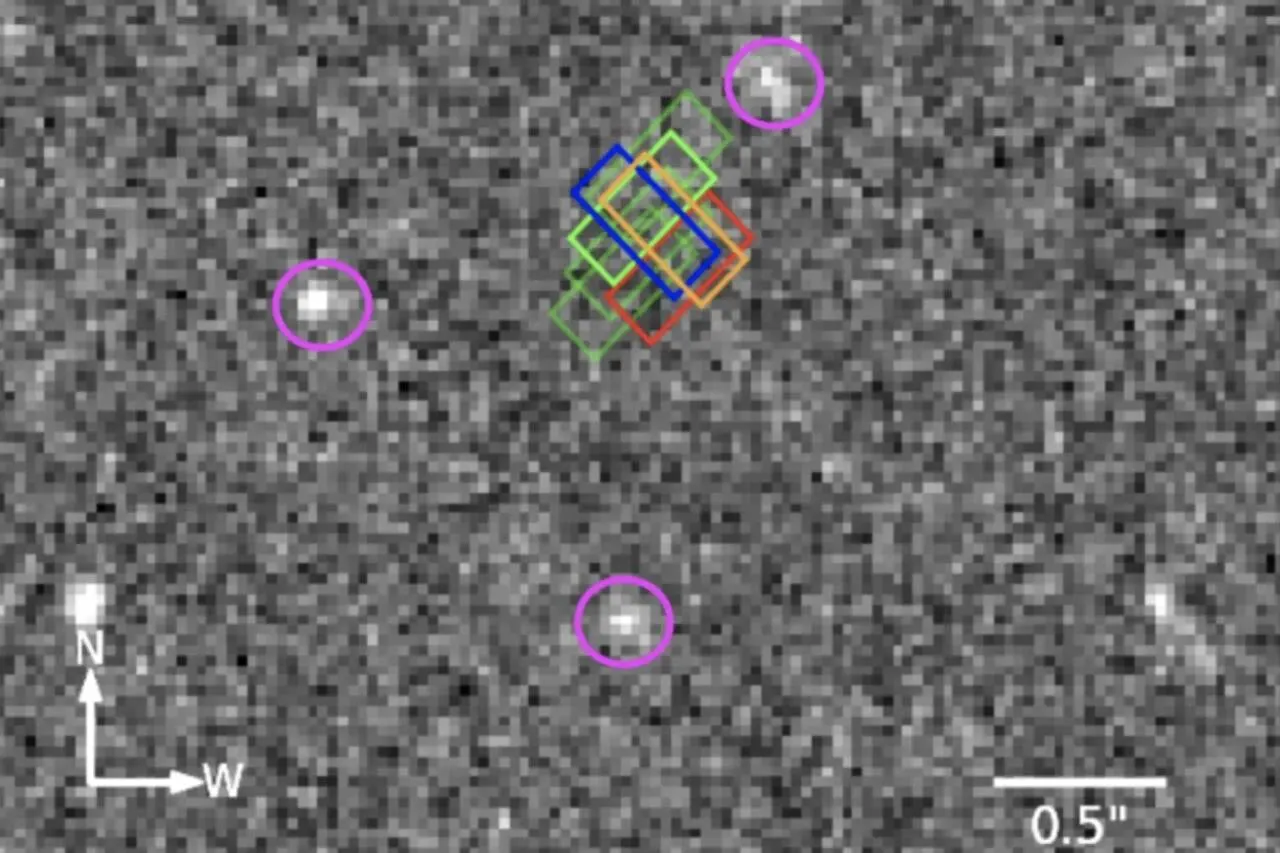
Astronomers searching for ancient objects born shortly after the Big Bang have picked up an unexplained signal with the James Webb Space Telescope (JWST). A single bright emission line appeared in what looks like empty space in the southern constellation Fornax, and its source remains unidentified.
The finding is described in a new paper in The Astrophysical Journal, led by University of Minnesota astrophysicist Mason Huberty. The team used Webb's Near-Infrared Spectrograph (NIRSpec) to block light from known objects and scan the data for emission lines. They found seven signals. Six were linked to distant galaxies.
A signal that appeared twice
The seventh showed up as a single bright line in two observations taken 88 days apart, in August and November 2023. Earlier observations of the region with both Hubble and Webb had shown no object at that position. No other emission lines turned up in the observed range, and the team says this line alone was bright enough that earlier observations should have caught it.
Emission lines are bright features in a spectrum produced by atoms and molecules at specific wavelengths. Astronomers use them to work out an object's composition, distance and motion. Here, wavelength alone is not enough. Cosmic expansion stretches light toward redder wavelengths, so the photon could come from a very distant source or from a nearer object that emitted at lower energy.
Possible explanations, none a clean fit
The researchers note the line could come from a primitive galaxy formed only a few hundred million years after the Big Bang, but such an object should already have appeared in earlier images. A black-hole-powered active galactic nucleus in a quiet phase is another option, yet that would normally produce additional emission lines.
A short-lived event, such as a star torn apart by a black hole, could explain why nothing appeared in images taken about a year earlier. Whatever it is, the object is highly unusual and could offer a window onto extreme physical conditions. Pinning it down starts with measuring how far away it is.
More from this day
See all →
Vishay Gets Funding for 300mm Wafer Production in Itzehoe

PB Fintech Q2 Profit Jumps 42% to ₹192 Crore as Revenue Rises 35%

CapGrid Raises ₹50 Cr to Move Into Precision Parts and Drones

Atomberg Gets SEBI Nod for IPO; Delhivery Posts Rs 41 Cr Profit
More in: Science
See all →
RheEnergise High-Density Fluid Brings Pumped Hydro to Low Hills

Scentronic: Ohio State's Electronic Nose Shares Smells Remotely

Scentronic Sends Smells Over the Internet With an E-Nose and AI