RheEnergise High-Density Fluid Brings Pumped Hydro to Low Hills
UK startup RheEnergise uses a fluid 2.5 times denser than water to run pumped hydro storage on modest hills instead of steep mountains, with a 500 kW pilot already running.
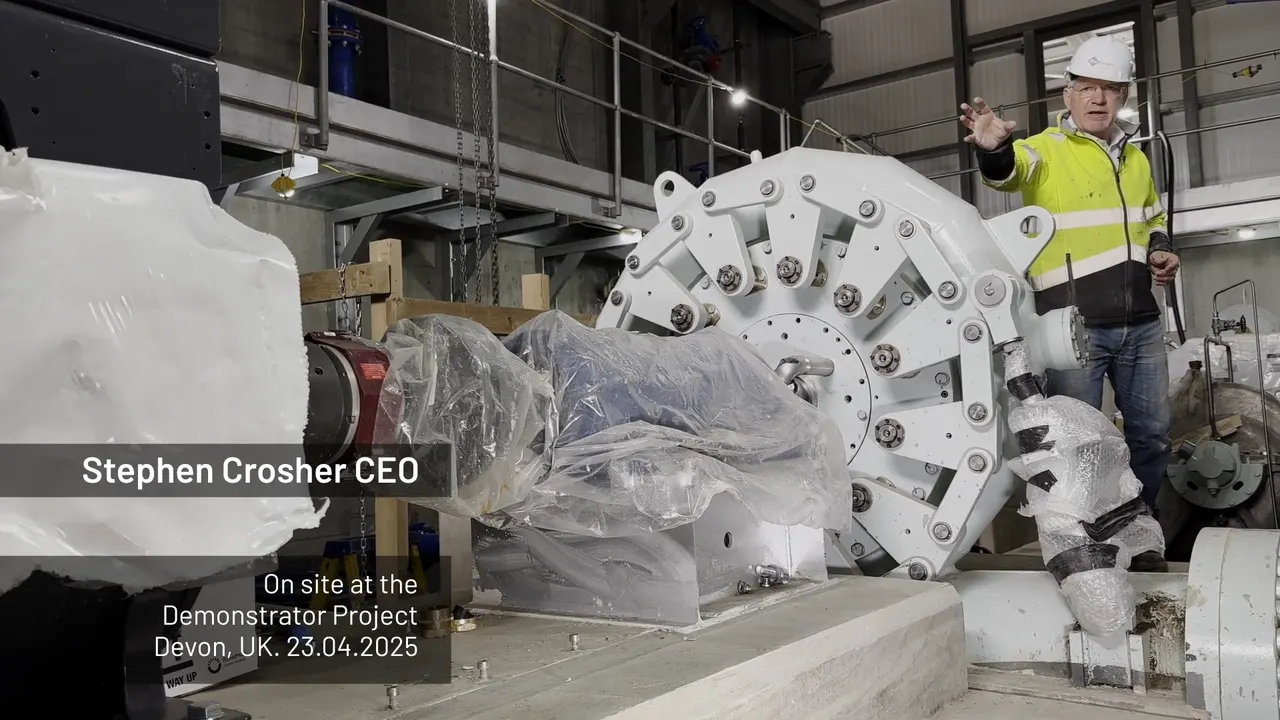
British startup RheEnergise says it has found a way to build pumped hydro storage without mountains. Its approach replaces water with a proprietary "High-Density Fluid" that is 2.5 times denser than water.
In January 2026 the company announced that a pilot project had reached a peak output of 500 kilowatts.
Why density changes the equation
Pumped hydro is the world's largest energy storage system. Worldwide capacity is about 200 gigawatts, more than 90% of all long-duration storage. The principle dates back to Switzerland in 1907: surplus power pumps water to an upper reservoir, and when electricity is short, the water is released through a turbine.
The weakness is geography. Plants need a large height difference, a water supply and a valley suitable for a dam. In Japan, for example, suitable sites are said to be almost exhausted.
A denser fluid releases more energy from the same volume and drop, so the required height difference shrinks. Gentle hills could be enough where steep mountains were once needed.
Dense but still flowing
Dense fluids tend to be viscous, like honey, which makes them hard to pump. According to the company, it solved this together with the University of Exeter by making a liquid whose mass is mostly solid particles. It behaves somewhat like ketchup: it stays put until pushed, then flows. The design is also meant to keep any spill from seeping into soil or groundwater.
The pilot's upper reservoir sits 80 metres up and connects to the lower tank through a 2.5-metre fibreglass pipe. Both tanks are buried, leaving only a powerhouse with the generator, pumps and fluid management system above ground.
What comes next
Commercial projects are planned at 10 to 20 MW, using two to four 5 MW turbines, with a first commercial system targeted for the end of 2028.
Challenges remain. Upfront investment is large, civil engineering is still required, and rivals such as sodium-ion batteries, flow batteries and compressed air storage are advancing quickly. RheEnergise estimates that for eight hours of storage its system would cost half as much as lithium-ion, but that claim has yet to be demonstrated at commercial scale.
More from this day
See all →
Vishay Gets Funding for 300mm Wafer Production in Itzehoe

PB Fintech Q2 Profit Jumps 42% to ₹192 Crore as Revenue Rises 35%

CapGrid Raises ₹50 Cr to Move Into Precision Parts and Drones

Atomberg Gets SEBI Nod for IPO; Delhivery Posts Rs 41 Cr Profit
More in: Science
See all →
Webb Telescope Detects Unexplained Emission Line in Empty Sky

Scentronic: Ohio State's Electronic Nose Shares Smells Remotely
Scentronic Sends Smells Over the Internet With an E-Nose and AI