Callisto Replica Rises at Kourou's Historic Diamant Launch Pad
A full-scale replica of Callisto, the reusable rocket demonstrator, now stands on the old Diamant pad in French Guiana, the first rocket upright there since 1975.
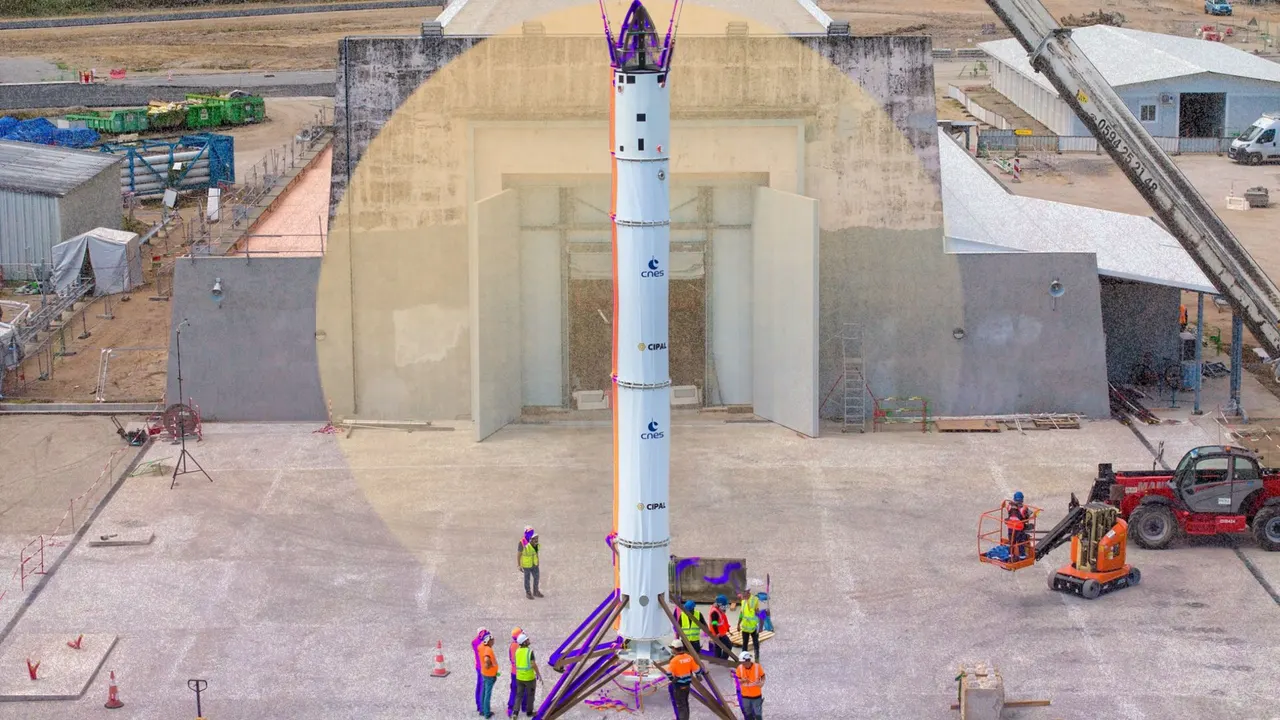
A full-scale replica of Callisto, the reusable rocket demonstrator developed by France's CNES with Germany's DLR and Japan's JAXA, has been standing since Thursday, 29 October 2026, on the former Diamant launch complex at the Guiana Space Centre near Kourou. No rocket had stood upright on the site since 1975, according to the CNES, which published photos on X and LinkedIn.
The replica will never fly. It measures 13 metres high and one metre in diameter, like the real demonstrator, and serves as a ground test bench. Over about a week, it is meant to check communications with the base's radar and other facilities. It was built by the French company CIPAL and carries six antennas placed exactly where they will be on the flight vehicle, notably to test the new controlled descent phase.
A site steeped in history
The choice of location is symbolic. Diamant, France's first satellite launcher, lifted off eight times from this pad between March 1970 and September 1975. Earlier Diamant A launches took place from Hammaguir in Algeria, and one of them put Astérix, France's first satellite, into orbit on 26 November 1965. Over its career, Diamant recorded nine successes, two critical failures and one partial failure before France ended the programme in 1975 to join the European Ariane adventure.
Reusability, with delays
Callisto aims to prove that a first stage can return and land vertically and gently, as SpaceX already does with the Falcon 9. Its engine, supplied by JAXA, burns liquid hydrogen and liquid oxygen, whereas the Falcon 9 uses liquid oxygen and RP-1 kerosene.
The ground tests open a qualification campaign that runs until 2027. The schedule has slipped considerably: Callisto was originally due to fly in 2020, and its first flight is now planned for 2027 at the earliest. Ten test flights are planned, up to roughly 20 kilometres in altitude. The real Callisto is to arrive in French Guiana shortly after the ground tests, the CNES says, but no date has been given.
More from this day
See all →
Meta quietly launches Style Sketch, an AI outfit app

Google Gemini Now Lets You View and Edit PDFs and Docs in Chat

DoorDash to Acquire Instacart in a Deal Worth About $17 Billion
Atomberg Gets SEBI Approval for Its Proposed IPO in India
More in: Space
See all →
Seraphim Academy to Invest $150,000 in Early-Stage SpaceTech
Multimillion Loans for Space Firms in Germany and the EU

Pixxel Launches US Subsidiary Pixxel Federal to Win Government Deals