Apollon Wins Both Tracks of DTM 2026 Glucose Prediction Challenge
Korean startup Apollon topped both the analytical and clinical tracks among 31 teams, and will take its needle-free Moglu CGM prototype into a Joslin clinical study.
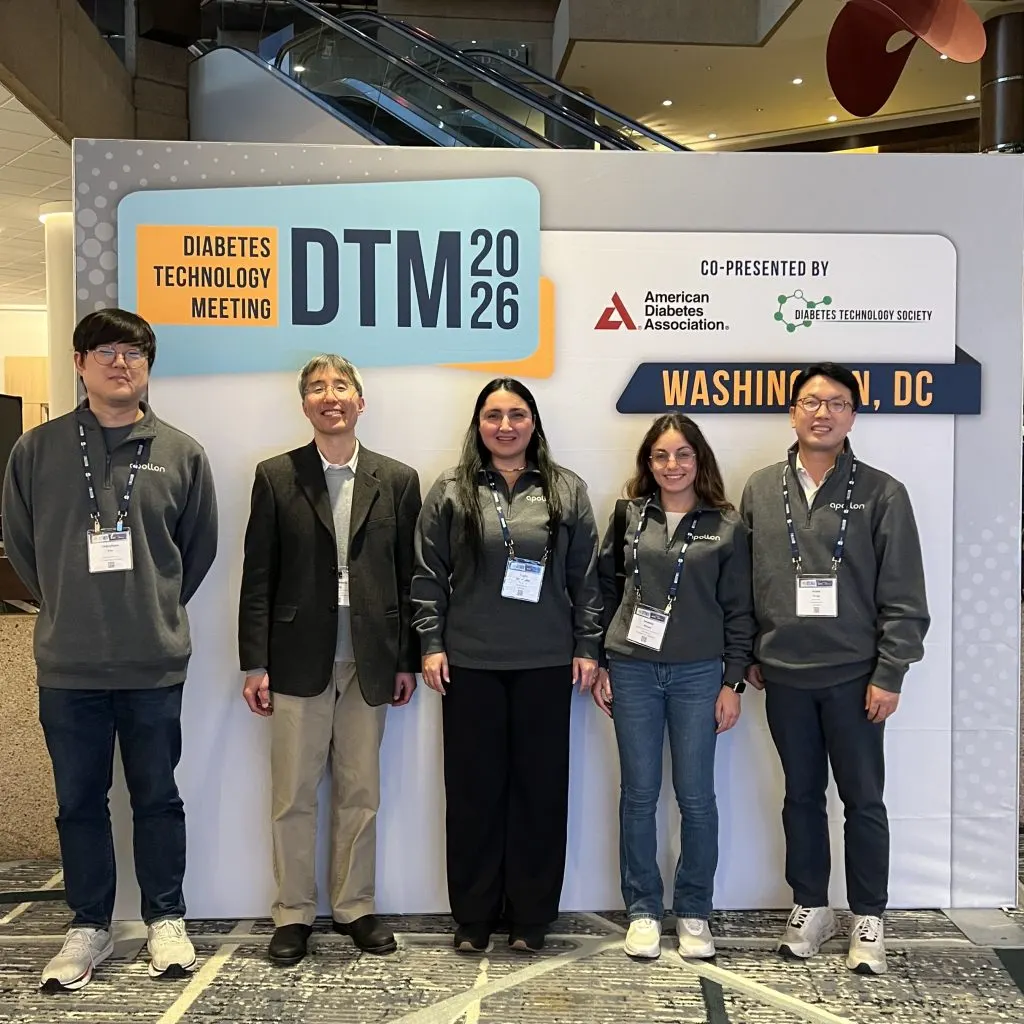
Apollon, a Korean developer of needle-free continuous glucose monitors (CGM), took first place in both tracks of the Glucose Prediction Challenge 2026, held at the Diabetes Technology Meeting (DTM 2026) in Washington, DC, from October 27 to 29 local time.
The contest was backed by the Helmsley Charitable Trust, a global funder of type 1 diabetes research. Apollon's team, led by Dr. Changhyun Yu, ranked first among 31 participating teams in the Analytical Track and the Clinical Track. It recorded a mean absolute relative difference (MARD) of 4.65% and 97.0% of readings in zone A of the DTS error grid, the highest figures in the field on both measures.
An attention-based forecasting model
The algorithm is an attention-based AI model. It combines a patient's past glucose readings with insulin dosing data and projects glucose trends for the next two hours at five-minute intervals. According to the company, it weights the long-range part of the forecast more heavily and was trained extensively on data from the same type of insulin pump to improve accuracy on swings in glucose levels.
Apollon plans to use the validated model in its non-invasive CGM, Moglu, which is still in development, to power early warnings for low and high blood sugar.
Research and hardware on show
A joint paper by Apollon and MIT was published in the Journal of Diabetes Science and Technology, the official journal run by the American Diabetes Association and the Diabetes Technology Society. MIT collaborator Dr. Jeonwoong Kang chaired a workshop on non-invasive glucose and ketone measurement and presented work on non-invasive glucose sensing with bandpass Raman spectroscopy.
At the startup showcase, the company also unveiled a prototype measuring 80×90×30 mm. The device reads glucose through spectroscopy without drawing blood. It is slated for a clinical feasibility evaluation in people with diabetes at the Joslin Diabetes Center, affiliated with Harvard Medical School.
CEO Aram Hong said hardware that minimizes measurement error and software that anticipates future trends are the two pillars of digital healthcare, and that the company intends to build a next-generation non-invasive diabetes management solution combining the two.
Apps worth a look
 SUMO: the number puzzle
Tap the right tiles, add them up, hit the target. Easy to learn, hard to master. Free, for all ages.
 Dialo: learn languages by speaking
Talk to an AI conversation partner; every sentence comes back corrected and explained in your language. 9 languages, A1 to C2.
 ediviewer: read EDI files like documents
Open EDIFACT and X12 messages, see every segment explained, convert to JSON/XML, export PDF and Excel. Runs locally, no upload.
More from this day
See all →Two Point O Capital raises $10 million led by Transition VC
Clinics On Cloud Raises $12.5 Million Series A From Dubai Investors

Google: Orbital AI Data Centers Cost 100 Times More Than Earth