WLTR bricklaying robot completes first French trials in Essonne
The 2.5-tonne WLTR robot built its first walls in France at Bouygues Construction's Scale One platform. Field data suggests it matches one mason, not five.
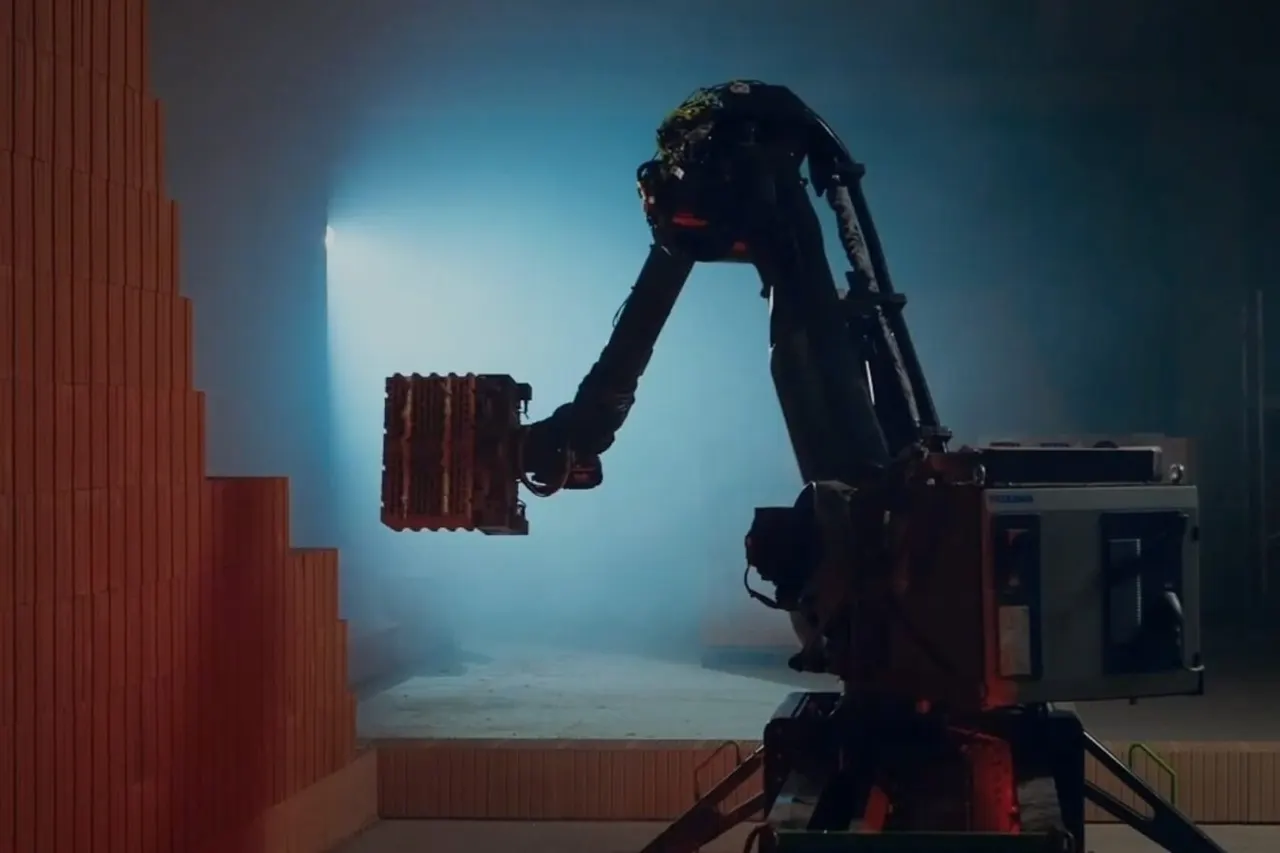
The WLTR bricklaying robot has built its first walls in France. At the end of October, the machine ran a week of full-scale trials on Scale One, the platform Bouygues Construction has just opened in Chilly-Mazarin, in the Essonne department. A first real construction site could follow in early 2027.
WLTR was developed by Czech group GreenBuild with building-materials maker Wienerberger and KM Robotics. The 2.5-tonne machine uses an articulated arm to pick up two bricks at a time from the pallet, apply two beads of foam in place of mortar and position each brick according to the building's digital plan. An operator supervises from a tablet while an assistant handles supply and finishing.
Speed, loads and requirements
On paper, the robot reaches up to 10 m² of wall per hour, 7.5 m² on average, for walls up to 3.50 m high. It lifts blocks weighing 52 kg, the heaviest part of the trade for a mason's back, while drawing just 1.5 kW. It needs three-phase power, a water supply, clear space along the wall and bricks designed for its gripper, from the Porotherm range.
The first trial outside the Czech Republic took place in late 2024, with about 300 m² of walls built in six days on an Austrian warehouse. About a dozen units now operate in Central Europe, from Czechia to Poland, with more than 40,000 m² built. In Budapest, one machine completed the structural work on a 100 m² house in under three days.
One mason, not five
The manufacturer pitches WLTR as the equivalent of a five-person crew. Field results are more modest. At Kladno, near Prague, construction group PORR has used one since 2025 on a 371-home development. Its interim assessment, published this summer, found productivity comparable to a single experienced mason, with two people working continuously around the machine. Quality stays constant from the first course to the last, but cutting, openings and anchoring remain manual. PORR chief Karl-Heinz Strauss says construction "is and will remain a human affair".
The timing suits France's labor shortage. The construction sector had 143,000 hiring plans this year, 65% of them considered hard to fill, a record. A machine that takes over the heaviest lifting could ease the strain even at one mason's pace. Bouygues Construction is already testing drilling robots to reduce physical strain on its sites.
Apps worth a look
 SUMO: the number puzzle
Tap the right tiles, add them up, hit the target. Easy to learn, hard to master. Free, for all ages.
 Dialo: learn languages by speaking
Talk to an AI conversation partner; every sentence comes back corrected and explained in your language. 9 languages, A1 to C2.
 ediviewer: read EDI files like documents
Open EDIFACT and X12 messages, see every segment explained, convert to JSON/XML, export PDF and Excel. Runs locally, no upload.
More from this day
See all →
Plug-In Solar: Western Australia Follows Germany's Balcony Rules

Merz Says Google Cloud Is Sovereign Enough for Intelligence
Amutable opens preview of Linux that proves its own state

Kalder Founder Gökçe Güven Gets 25 Months in Prison for Fraud
More in: Hardware
See all →
Apple Loses Its Grip on Memory Suppliers as AI Demand Surges

Polaris AI and UBTech Bring Humanoid Robots to RoboWorld 2026

XREAL AURA Android XR Glasses Open for Preorder in Japan