Vampire camel: 13-million-year-old fossil has 5 cm fangs
A fanged camel from North America's Great Plains finally has a name. Vampyrocamelus welshi had 5 cm blade-like canines, yet it most likely ate plants.
 SUMO· the number puzzle
 Dialo· learn languages by speaking
 ediviewer· read EDI files like documents
 giftdetect· the right gift in minutes
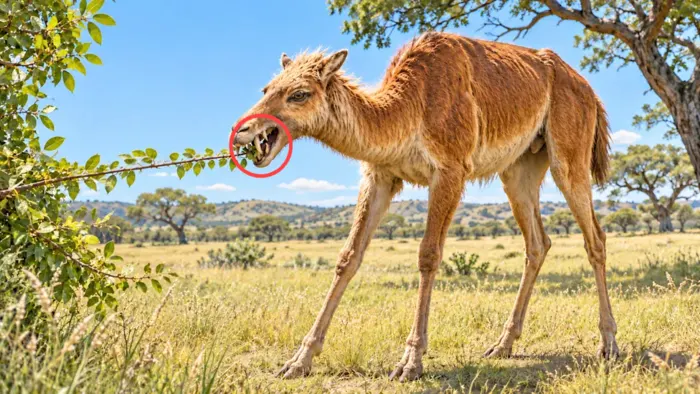
The so-called vampire camel looked terrifying, but it probably only ate leaves. Researchers have now formally named it Vampyrocamelus welshi, which literally means vampire camel, after fossils that sat in a museum for around a century.
The animal lived roughly 13 million years ago on the Great Plains of North America. It had a longer neck and legs than today's camels and a slimmer body, so it looked a bit like a giraffe. The odd part was in its mouth. Fossils found mostly in Texas and Oklahoma show curved canines about 5 cm long, thought to belong to males. They were flat and sharp like blades, and the small molars behind them were blade-shaped too.
"Male camels normally have well-developed canines, but this animal is very different," said paleontologist Donald Prothero of Cal Poly Pomona. "The tooth is less a point than a blade." The findings were posted on ResearchGate earlier this month and are due to appear in a publication of the New Mexico Museum of Natural History and Science.
What were the vampire camel's fangs for?
Nobody knows yet. One idea is defence: big cats roamed the savannas of North America between about 15 and 7 million years ago. Another is competition between males. Co-author Catherine Marriott of the American Museum of Natural History leans toward that one, since today's male camels bite each other when fighting over mates. Females had no such fangs, so the males may also have used them to get noticed. The team thinks tiny wear marks on the teeth could show how they were actually used.
Where did the fossils come from?
Not from a new dig. Collector Childs Frick gathered more than 200,000 mammal fossils, moved to the museum in New York in the 1970s, and about 20,000 of them are camels. Prothero has studied them since 1982. The fanged specimens carried an informal label, Machaerocamelus, meaning dagger camel, but never got an official classification. After comparing skulls and limb bones with other extinct camels, the team named a new genus and species.
Camels first evolved in North America around 46 million years ago. Some stood under a metre at the shoulder, others reached 4 metres. In parts of Nebraska, seven or eight species turn up in the same rock layer. As Prothero put it, North America was camel country long before deer and bison took over.
Apps worth a look
SUMO: the number puzzleTap the right tiles, add them up, hit the target. Easy to learn, hard to master. Free, for all ages.
Dialo: learn languages by speakingTalk to an AI conversation partner; every sentence comes back corrected and explained in your language. 9 languages, A1 to C2.
ediviewer: read EDI files like documentsOpen EDIFACT and X12 messages, see every segment explained, convert to JSON/XML, export PDF and Excel. Runs locally, no upload.
giftdetect: the right gift in minutesPick who it is for, the occasion and their personality. The search engine reads product descriptions from local shops and ranks what fits. Free, no sign-up.
More from this day
See all →
GPT-6.2 complaints: users call OpenAI's model lazy and forgetful

Google AI Mode temporary threads: incognito-style search

Arcom rules YouTubers must give all 2027 candidates equal time

Kerch Bridge strike: Ukraine steered missiles without Starlink
More in: Science
See all →
Poland's 2.5 m Cerro Murphy telescope sees first light in Chile

Grand Canyon's missing billion years: Great Unconformity explained

US data center electricity use: 403 sites, 28 million tonnes of CO2