Poland's 2.5 m Cerro Murphy telescope sees first light in Chile
Polish astronomers pointed their new 2.5-metre telescope at the Atacama sky for the first time. It took roughly 70 years of trying to get a big telescope like this.
 SUMO· the number puzzle
 Dialo· learn languages by speaking
 ediviewer· read EDI files like documents
 giftdetect· the right gift in minutes
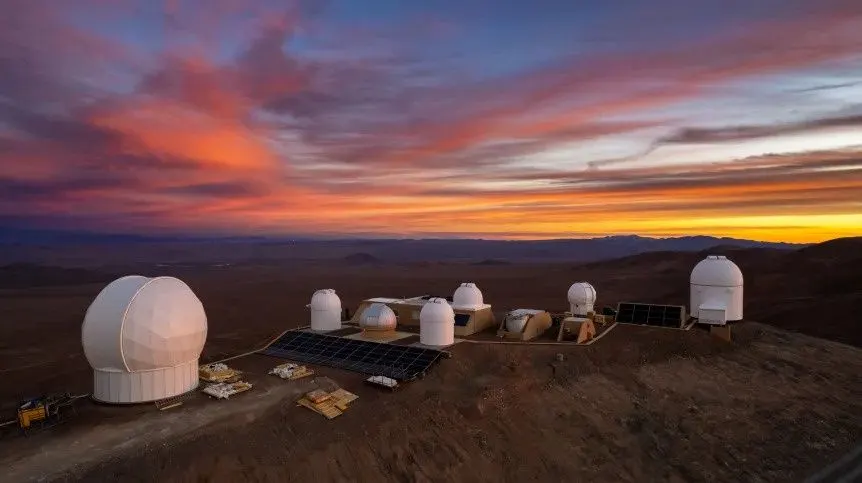
Polish astronomers have finally got their own large optical telescope working. In early November the 2.5-metre instrument at the Cerro Murphy Observatory in Chile's Atacama Desert captured its first images of the sky, an event astronomers call "first light".
It is the largest optical telescope Poland has. The observatory is run by the Nicolaus Copernicus Astronomical Center of the Polish Academy of Sciences (CAMK PAN), and the team is led by Prof. Grzegorz Pietrzyński. Among the first objects it photographed was the galaxy NGC 300 in the constellation Sculptor, about 6.5 million light years away. Astronomers are now running intensive tests, and the official launch is planned for April 2027.
Why did Poland wait so long for a big telescope?
The effort goes back to the 1950s. In 1968 Poland ordered a 2-metre instrument in Germany for the Central Astronomical Observatory near Bełsk, but the contract was cancelled in 1970 and the grant never arrived. This time the money came from an ERC Synergy grant, and the telescope cost about 15 million euros.
The Austrian company ASA Astrosysteme GmbH built it and called it the biggest order in its history. Pietrzyński said the result is a modern instrument and a large dome that meets high technical standards. CAMK director Prof. Rafał Moderski said the first light fulfils the dream of several generations of Polish astronomers.
What will the telescope be used for?
It builds on the long-running Araucaria project, which has already measured distances to nearby galaxies very precisely. Poland's Ministry of Science and Higher Education supports the observatory's construction and upkeep, and is also paying for an optical camera and a high-resolution spectrograph, a device that splits light to reveal what an object is made of and how it moves. Both should widen what the telescope can do.
Apps worth a look
SUMO: the number puzzleTap the right tiles, add them up, hit the target. Easy to learn, hard to master. Free, for all ages.
Dialo: learn languages by speakingTalk to an AI conversation partner; every sentence comes back corrected and explained in your language. 9 languages, A1 to C2.
ediviewer: read EDI files like documentsOpen EDIFACT and X12 messages, see every segment explained, convert to JSON/XML, export PDF and Excel. Runs locally, no upload.
giftdetect: the right gift in minutesPick who it is for, the occasion and their personality. The search engine reads product descriptions from local shops and ranks what fits. Free, no sign-up.
More from this day
See all →
Google AI Mode temporary threads: incognito-style search
Arcom rules YouTubers must give all 2027 candidates equal time

Kerch Bridge strike: Ukraine steered missiles without Starlink

OVHcloud Olala mini: a free AI model that runs in 8 GB of RAM
More in: Science
See all →
Grand Canyon's missing billion years: Great Unconformity explained
US data center electricity use: 403 sites, 28 million tonnes of CO2
MarinaTex: the plastic bag made from fish waste and algae