Grand Canyon's missing billion years: Great Unconformity explained
At the Grand Canyon, rock layers 540 million years old sit straight on granite over a billion years old. Two geologists now say the Earth's mantle did it.
 SUMO· the number puzzle
 Dialo· learn languages by speaking
 ediviewer· read EDI files like documents
 giftdetect· the right gift in minutes
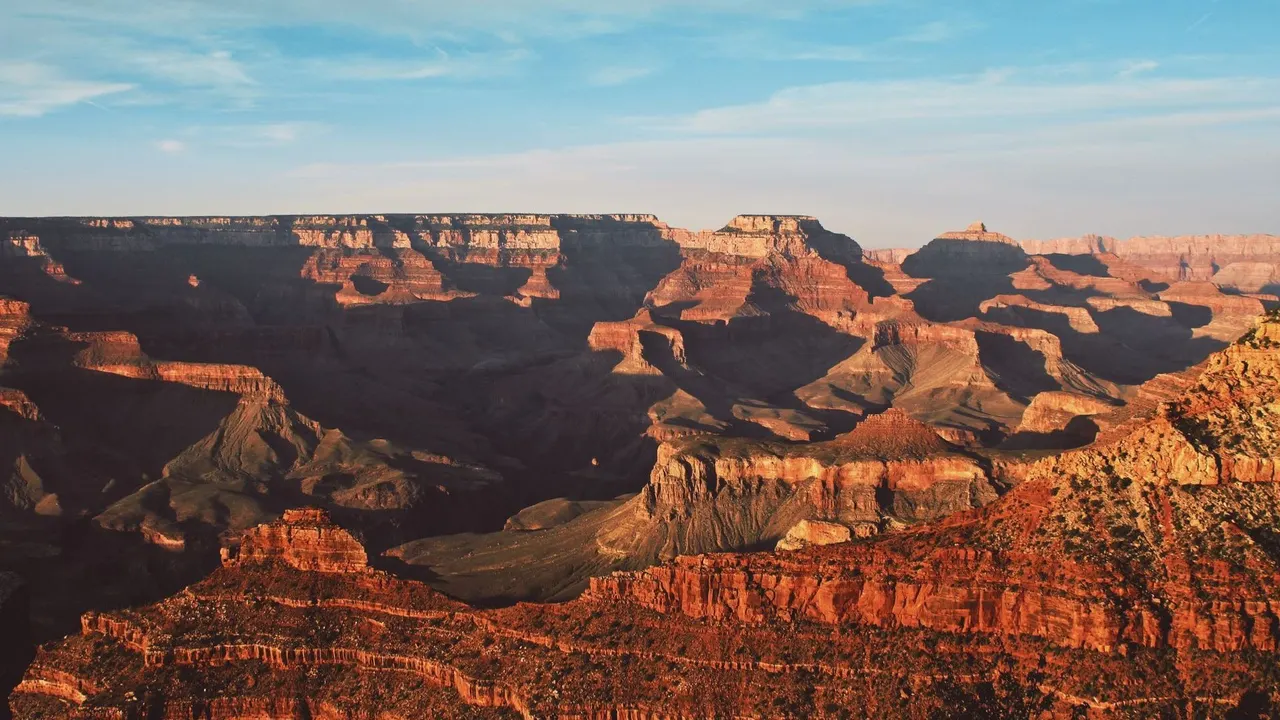
Read the Grand Canyon's walls from bottom to top and you expect the story to run in order. It doesn't. In places, up to a billion years of Earth's history is simply absent, and geologists have been puzzling over the gap for roughly 150 years. Two researchers now think they know where those rocks went.
The gap is called the Great Unconformity. At the Grand Canyon, in Northern Europe and in North China, sediments about 540 million years old rest directly on granite that can be more than a billion years old. Depending on the site, between 200 million and over a billion years of record are missing.
In a study published in Nature on 4 November 2026, Santosh Dhungana and his supervisor Nicolas Flament, from the University of Wollongong in Australia, blame slow currents deep inside the planet. They ran a billion years of mantle convection on a supercomputer. The mantle is the hot but solid rock layer between the crust and the core. Warm material rises, cold material sinks, and the surface above is pushed up or pulled down across thousands of kilometres.
How did the rocks disappear?
In most of the models, Laurentia (the ancestor of North America) rose for hundreds of millions of years until about 540 million years ago, then slowly sank. Baltica, ancestor of part of Northern Europe, and North China mostly follow the same pattern.
The ice still plays a part. The long uplift overlaps with Snowball Earth, the period from 720 to 635 million years ago when the planet may have frozen almost entirely. Glaciers wear down rock far better than rivers, so the researchers say ice sheets mostly planed off land the mantle had already lifted. When those continents sank again, the sea covered them and buried the scraped surface under new sediment, which kept it intact.
How sure are the researchers?
Not very, and they say so. Their models overstate the vertical movements, so they rely on the general trend rather than exact values. The results also depend heavily on ancient tectonic reconstructions, which grow more uncertain the further back you go.
The erosion came shortly before the Cambrian explosion, about 530 million years ago, when many animal groups appeared in a short time. The authors suggest the changed landscape may have altered seawater chemistry and helped that burst of life, an idea they want to explore next.
Apps worth a look
SUMO: the number puzzleTap the right tiles, add them up, hit the target. Easy to learn, hard to master. Free, for all ages.
Dialo: learn languages by speakingTalk to an AI conversation partner; every sentence comes back corrected and explained in your language. 9 languages, A1 to C2.
ediviewer: read EDI files like documentsOpen EDIFACT and X12 messages, see every segment explained, convert to JSON/XML, export PDF and Excel. Runs locally, no upload.
giftdetect: the right gift in minutesPick who it is for, the occasion and their personality. The search engine reads product descriptions from local shops and ranks what fits. Free, no sign-up.
More from this day
See all →
Google AI Mode temporary threads: incognito-style search

Arcom rules YouTubers must give all 2027 candidates equal time

Kerch Bridge strike: Ukraine steered missiles without Starlink

OVHcloud Olala mini: a free AI model that runs in 8 GB of RAM
More in: Science
See all →
Poland's 2.5 m Cerro Murphy telescope sees first light in Chile

US data center electricity use: 403 sites, 28 million tonnes of CO2

MarinaTex: the plastic bag made from fish waste and algae